How to Choose a Luxury Tour Operator in Nepal: 9 Questions to Ask Before You Book (2026)
Table of Contents
+
Two quotes for the same ten-day Nepal trip land in your inbox. The first names every hotel, every vehicle, the helicopter company, the guide’s licence status, and the exact cancellation deadline. The second says “luxury 5-star hotels,” “private transport,” and “experienced guides,” then asks for a deposit before it will tell you anything else.
Both quotes might describe the same trip. One of them is a professional operation. The other is a sales page with a bank account. Nothing in the price tells you which is which — and that is the problem this guide fixes.
Choosing a luxury tour operator in Nepal matters more than choosing the itinerary. Itineraries are interchangeable; operators are not. The same Kathmandu–Pokhara–Chitwan route can be delivered as a seamless private journey or as a series of surprises: a “5-star” hotel that is a standard twin room in a three-star building, a shared helicopter sold as a private charter, a guide who meets you at the airport having read your itinerary that morning.
This guide gives you the nine questions that separate the two, the red flags that follow from them, and a pre-payment checklist you can run against any operator — including us.
Why the Operator Matters More Than the Itinerary
What “luxury” actually means in Nepal
In Nepal’s tourism trade, “luxury” is an unregulated word. Any company can put it in a package name. What it should mean, when you are paying premium rates, is specific and checkable:
- Named properties, not categories. A real luxury itinerary names the hotels and lodges and the room category inside them. Nepal’s best-known properties — Dwarika’s Hotel in Kathmandu, Meghauli Serai on the edge of Chitwan, the lodge networks of the Everest and Annapurna regions — are public knowledge. An operator with genuine relationships names them. An operator reselling someone else’s package says “5-star” and reveals the property after you pay.
- Private by default. Private vehicle, private guide, private departures for small groups — not a seat on a minibus with strangers and a fixed group schedule.
- Access, not just admission. A dawn visit before the crowds, a naturalist who debriefs after the safari rather than drops you at the gate, a guide who can get you into the courtyard most visitors walk past.
- Time built in. Buffer for weather, acclimatisation days where altitude requires them, and a pace that leaves room for long breakfasts. Rushed itineraries are a cost-saving device wearing a premium price tag.
"If a quote does not yet show these things in writing, you have a price — not enough information to judge whether the trip is genuinely luxury."
Price layers — One company's margin / Reseller margin + ground operator cost
Most Nepal trips are sold twice. An agency in London, New York or Sydney sells you the tour; a Kathmandu trekking company actually runs it. That arrangement is normal and often works well — but you should know which layer you are buying from, because it changes four things: what you pay for, who answers when something goes wrong, how fast changes get made, and who holds your money.
Ask directly: “Who operates this trip on the ground, and can I contact them?” If the answer is “we do, we are based in Kathmandu,” you are talking to the operator. If the answer is “our trusted local partner,” you are talking to a reseller, and the price you are quoted carries both companies’ margins.
Direct Kathmandu operator | International agency/reseller | |
|---|---|---|
| Trip operator | Usually the company you contact | May be a separate local partner |
| Communication | Direct with local team | May pass through the selling agency |
| Changes | Usually handled locally | May require coordination between companies |
| Local accountability | Direct | Depends on contract |
| Price | Direct operator pricing | May include additional agency pricing |
None of this makes an international agency wrong. It makes the question worth asking before, not after, you pay.
The 9 Questions to Ask Before Booking a Luxury Tour in Nepal
Question 1: Is this company registered — and can you verify it?
Nepal’s trekking and tour industry is regulated, and legitimate operators should be able to provide their company registration details and any relevant tourism or trekking licences. You can also check memberships with industry bodies such as the Trekking Agencies’ Association of Nepal (TAAN) as an additional credibility check.
Do not take a logo for proof. Take a number. Ask for the registration number and check that the company name on the paperwork matches the name on the website, the name on the bank account, and the name that will appear on your contract. Our own registration is Reg. No. 184920/074/075 — published, not withheld — and any operator at your price point should be equally willing to give you theirs.
Then check the second source: reviews on platforms you control, not only testimonials the operator pastes onto its own site. Testimonials on a company’s website are selected by the company. Independent reviews are not.
What a good answer looks like: a registration number within one reply, memberships you can verify, and reviews scattered across independent platforms rather than curated on a single page.
Question 2: Which hotels and lodges, by name and by room category?
“Accommodation: luxury 5-star hotels” is not an inclusion. It is a placeholder.
Ask for three things: the property name, the room category (deluxe, suite, lake view), and the number of nights at each. A standard room and a suite in the same hotel are different products at different prices, and both can legally be described as “5-star accommodation.”
Nepal’s luxury inventory is concentrated and well documented — heritage hotels in the Kathmandu Valley, lakeside and hilltop properties around Pokhara, jungle lodges inside Chitwan’s buffer zone, mountain lodges on the Everest and Annapurna trails. An operator who works with them can list them. An operator who cannot name the property is either reselling a generic package or planning to substitute at check-in.
Two follow-ups that expose the rest:
- “Is this property confirmed for my dates, or ‘or similar’?” “Or similar” is where a premium booking quietly downgrades.
- “Which side of the park is the lodge in?” In Chitwan, lodges inside the national park boundary and lodges in the buffer zone are different experiences with different access. The buffer zone is legally separate from the park — ask which one you are paying for. Our Chitwan Jungle Safari outline shows how we describe lodge location and game-drive access in writing.
What a good answer looks like: named hotels in every city, a room category for each, and an honest note on anything still provisional — “we will confirm availability for your dates before you pay” beats a false certainty.
Question 3: Who is responsible for the trip from arrival to departure?
Covered above in the reseller section — but ask it as a contract question, not a conversation one: Who holds the contract with me? Who employs the guides? Who pays the hotels? If the answer to all three is one company, accountability is clean. If the trip is subcontracted, ask for the ground operator’s name and registration number too. You are entitled to know who is responsible for your safety in the Khumbu, not just who answered your email.
Question 4: Which helicopter operator — shared or private — and what happens in bad weather?
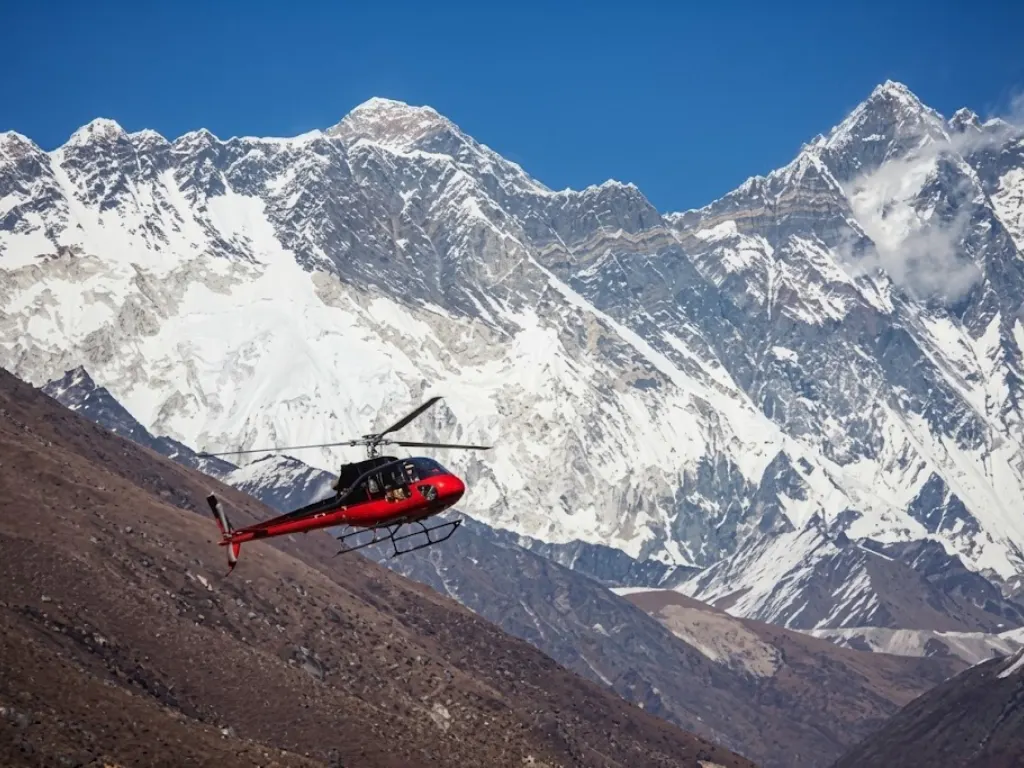
Helicopter travel is a genuine luxury in Nepal: it compresses long drives, lands you at Everest’s doorstep, and makes remote lodges reachable in an afternoon. It is also the single most misunderstood line item in a luxury quote.
Shared and private helicopter flights can differ dramatically in price because they are different products. A quote should state clearly whether the flight is shared or private, how many passengers are included, which operator is flying it, and what happens if weather prevents the flight.
Ask four things:
- Shared or private? If sharing, how many other passengers, and what are the weight limits?
- Which company flies it? Nepal’s helicopter sector has established operators with decades of rescue and VIP transport records. The operator should name theirs and confirm it is licensed — and remember, your tour company arranges the flight through a licensed charter operator; it rarely owns the aircraft itself. Anyone claiming “our helicopter” warrants a second question.
- Where does it land, and for how long? A Kala Patthar photo stop of a few minutes and a landing at an Everest-view hotel for breakfast are different itineraries.
- What is the weather policy? Mountain flying is weather-dependent. Ask: if the flight is grounded, do I get a refund, a rescheduled flight, or an alternative day — in writing?
For high-altitude itineraries, check that your travel insurance covers trekking at the maximum altitude of your trip, medical treatment and helicopter evacuation, and ask the operator what documentation or insurance confirmation is required before departure.
Question 5: Who is the guide, and what training do they hold?
At premium prices, the guide is the product. Ask:
- Are the guides appropriately licensed or certified for the type of trip they are leading?
Nepal licenses trekking and tour guides; a licensed guide is a checkable credential, not a self-description.
- What wilderness first-aid training does the team hold?
In a country where the nearest hospital can be a day’s travel from the trail, wilderness first-aid training for guides and group leaders is a meaningful standard — ask it directly and listen for specifics.
- Is the guide assigned to my trip now, or “on the day”?
Named guides with an introduction before arrival signal a real operation.
- What languages are spoken?
Ask which language your guide will speak and whether the guide has been confirmed for your dates. Additional languages can often be arranged on request. Ask which language your guide will speak and whether the guide has been confirmed for your dates. Additional languages can often be arranged on request. If an agency implies a fluent French guide is waiting in the wings, ask when he was assigned. Honest operators say: available on request, confirmed for your dates.
Question 6: What exactly is included — and what is not?
The gap between a luxury quote and a luxury experience lives in the exclusions. Request the inclusion list in writing and check it against this:
| Should be itemised in a premium quote | Commonly excluded — confirm before paying |
|---|---|
| Accommodation by name, room category, nights | International flights to/from Kathmandu |
| Private vehicle and driver, all transfers | Nepal visa fees |
| Licensed guide, days of guiding included | Travel insurance (should be mandatory, not optional) |
| Meals stated per day — which meals, exactly | Drinks, bar bills, personal expenses |
| Park entrance fees, permits, monument tickets | Tips for guide and driver |
| Domestic flights or helicopter terms (shared/private) | Hot showers, charging, laundry on the trail |
| 24-hour in-country contact number | Anything “not mentioned in the inclusions” |
“Meals included” should say which meals. “All permits” should list them. “Private transport” should name the vehicle class. Vagueness in the inclusion list is where surprise charges hide — and surprise charges are the opposite of luxury.
Question 7: What are the payment, cancellation and refund terms?
Before any money moves, get these four answers in writing:
- How much is the deposit, and when is the balance due? Reasonable operators publish this. Resistance to answering it is itself an answer.
- Is the deposit refundable, and under what conditions? Free cancellation up to a stated deadline — our own terms allow cancellation free of charge up to 14 days before departure, subject to booking terms — should be written into the contract, not promised in a chat window.
- How do I pay, and to whose account? The account name must match the company name you verified in Question 1. Paying an individual’s personal account for a corporate booking is a warning sign.
- What happens if the trip is cancelled by the operator — illness, weather, political disruption? Refund, credit, or rearranged dates: get the clause, not the reassurance.
Ask for the terms as a document. If the only terms are “please confirm to proceed,” you are booking on trust alone.
Question 8: What happens when something goes wrong?
Luxury means problems are handled before they reach you — not that problems never happen. Ask:
- What is the 24-hour contact number, and who answers it — Kathmandu or abroad? A local number answered by your own team is worth more than a toll-free line in another timezone.
- What is the evacuation plan at altitude? For itineraries above roughly 3,000 metres: which helicopter company is on call, what is the protocol, and what does insurance need to cover? Your travel insurance must be valid for trekking in Nepal, medical treatment, and evacuation at the itinerary’s altitude — check both the coverage and the exclusions.
- What happens if a domestic flight or jeep transfer is cancelled? The answer reveals whether the operator has contingency built in or improvises on the day.
- Are guides trained in wilderness first aid? If yes, ask when and by whom. Specifics separate trained operators from brochure claims.
Question 9: What is your wildlife and ethics standard?
Nepal’s luxury sector is increasingly judged on this, and most competitors’ guides never mention it. Three questions that separate responsible premium operators:
- Do your Chitwan and Bardia itineraries include elephant riding?
If responsible wildlife tourism is important to you, ask whether the operator offers alternatives to elephant riding, such as jeep safaris, canoe trips, walking experiences and naturalist-led wildlife viewing.
- Are the safari lodges inside the park or in the buffer zone, and who runs them?
Ask for the lodge name, then look at its conservation record: local staff ratios, single-use plastic policies, community programmes.
How are guides and porters treated?
Fair wages, insured staff, regulated weight limits for porters, and wilderness training are all visible if you ask. An operator proud of its standards answers in minutes; an operator hiding its subcontract answers vaguely.
These are not soft questions. They determine who you are funding and what you will see on your own trip. We went through the same test ourselves in Luxury Wildlife Lodges in Nepal: Chitwan vs Bardia, where lodge standards and ethics decide more of the experience than the safari itinerary does.
Red Flags: 7 Warning Signs When Booking a Luxury Tour in Nepal
| What you see | What it usually means | What to ask instead |
|---|---|---|
| “Luxury 5-star hotels” with no names | Property revealed after payment, or substitution at check-in | “Name the hotel and room category for each city” |
| “Private helicopter to Everest” with no operator or terms | Possibly a shared flight, unclear weather policy | “Shared or private? Which operator? Refund if grounded?” |
| Price far below comparable quotes | Group departures, omitted fees, or a thinner itinerary | “Show the inclusion list line by line” |
| Deposit requested before a written itinerary and terms | No refund leverage once money moves | “Send contract, cancellation terms and payment schedule” |
| No registration number, only logos and claims | Unverifiable accountability | “What is your registration number?” |
| “All meals included” with no per-day detail | Breakfast only, or meals ‘where specified’ | “Which meals on which days?” |
| Language guides “included” as standard | Often assigned only on request, if at all | “Is this guide confirmed for my dates?” |
Print this table. It takes four minutes to run against any quote and catches most of what price comparison cannot.
Before You Pay: The Pre-Booking Checklist
Do not transfer a deposit until all seven items are in your inbox:
- Registration number of the contracting company — matching the website and the bank account.
- Written itinerary with day-by-day activities, named accommodation, room category, and transport mode.
- Inclusion and exclusion list, with meals specified per day and permits listed individually.
- Helicopter or domestic flight terms — operator name, shared/private, landing points, weather and refund policy.
- Guide details — licence status, first-aid training, language, assignment status.
- Payment schedule and cancellation terms, including the operator-cancelled case.
- 24-hour in-country contact and the insurance requirements your policy must meet.
If any item is missing, the booking is not ready — regardless of how persuasive the sales call was. A premium operator treats this list as routine. A sales operation treats it as an interrogation.
How Nepal Lion Tours Answers These Nine Questions
Because this is a decision-stage question, we apply the same checklist to our own trips. For transparency, here is where we stand:
- Registration: Reg. No. 184920/074/075, a registered company based in Thamel, Kathmandu — member of the Nepal Tourism Board, TAAN, KEEP and the Thamel Tourism Development Council. Documents available on request.
- Guides: government-licensed, English-speaking guides on every departure, with a wilderness first-aid medical course completed by guides and group leaders. French, German, Spanish, Russian and Japanese language-speaking leaders available on request.
- Private by default: private departures from two travellers, private trailhead transfers, and a direct point of contact from your first enquiry through to your return — not a call centre.
- Accommodation: premium lodge and hotel selection — we name the property and intended room category, and confirm availability for your dates before you commit. Private bathrooms are included wherever the selected property provides them.
- Helicopters: arranged through a licensed charter operator, never described as in-house aircraft, with the operator named in your confirmation.
- Terms: free cancellation up to 14 days before departure, subject to booking terms, stated before payment rather than after.
- Contact: WhatsApp +977-9851039020, reachable before and during your trip.
Our premium journeys — from the Kathmandu–Chitwan Luxury Tourto private Himalayan itineraries built around your dates — are laid out the same way this checklist is: named, itemised, and answerable before you pay.
Ask us the nine questions. A premium operator should be able to answer all of them before the deposit, not after it.
Frequently Asked Questions
Q. How do I know if a Nepal tour operator is legitimate?
+
Ask for the company registration number and check that it matches the company name on the website and the bank account. Verify memberships with bodies such as the Nepal Tourism Board or TAAN, and read reviews on independent platforms rather than only the testimonials published on the operator’s own site.
Q. What should a luxury Nepal itinerary include?
+
Named hotels with room categories, a licensed private guide, private vehicle transfers, specified meals per day, listed permits and entrance fees, defined helicopter or flight terms, and a 24-hour in-country contact. Anything described only as “5-star” or “luxury” without names is not yet a luxury itinerary.
Q. Is it better to book with a Kathmandu-based operator or an international agency?
+
Booking directly with a Kathmandu ground operator gives you one contract, same-day itinerary changes, and immediate in-country problem solving. International agencies add a margin and a communication layer but can offer their own reassurance. Whichever you choose, confirm who operates the trip on the ground.
Q. What should I check before booking a helicopter tour in Nepal?
+
Mountain flying in Nepal is weather-dependent and flown by licensed charter operators using established aircraft. Before booking, confirm the operating company, whether the flight is shared or private, the landing plan, and the refund policy if weather grounds the flight"For high-altitude trips, make sure your travel insurance covers trekking at the maximum altitude of your itinerary, medical treatment and helicopter evacuation."
Q. What is a reasonable cancellation policy for a luxury tour?
+
A written policy with a free-cancellation window before departure — for example, free cancellation up to 14 days prior, subject to booking terms — plus a defined refund or credit if the operator cancels the trip. Verbal promises are not policies; ask for the clause in the contract.
Q. How far in advance should I book a luxury trip to Nepal?
+
Peak-season windows — autumn (September–November) and spring (March–May) — fill first for the best properties and helicopter slots. Most premium operators recommend booking several months ahead for those months, and confirm that the exact hotels and flights are held for your dates before you pay a deposit.
Ready to plan your luxury Nepal journey? Send us your dates and group size via our booking form or WhatsApp +977-9851039020. We’ll answer your questions, recommend the right itinerary, and provide a transparent quote with accommodation, transport, guides and inclusions clearly stated.
My ideal final link architecture
Internal
- Luxury Tourism in Nepal
- Chitwan Jungle Safari Tour
- Luxury Wildlife Lodges: Chitwan vs Bardia
- Kathmandu–Chitwan Luxury Tour
- Luxury Nepal Tours/Packages hub
- Booking/contact page
External
- Nepal Tourism Board
- TAAN member directory
- TAAN membership requirements
- Ministry of Tourism
- NTB trekking information
- NTNC
Admin
A passionate explorer and writer dedicated to sharing authentic stories, local insights, and expert travel guides from the heart of the Himalayas.
No comments yet
Be the first to share your thoughts and experiences on this story!