Mera Peak Climb — 16 Days | Nepal Lion Tours
Embark on a thrilling 16-day Mera Peak climbing expedition through remote Himalayan valleys, traditional Sherpa villages, and dramatic glacier landscapes, culminating in an unforgettable summit experience with panoramic views of Everest, Lhotse, Makalu, Cho Oyu, and Kanchenjunga.
Mera Peak Climb - 16 Days

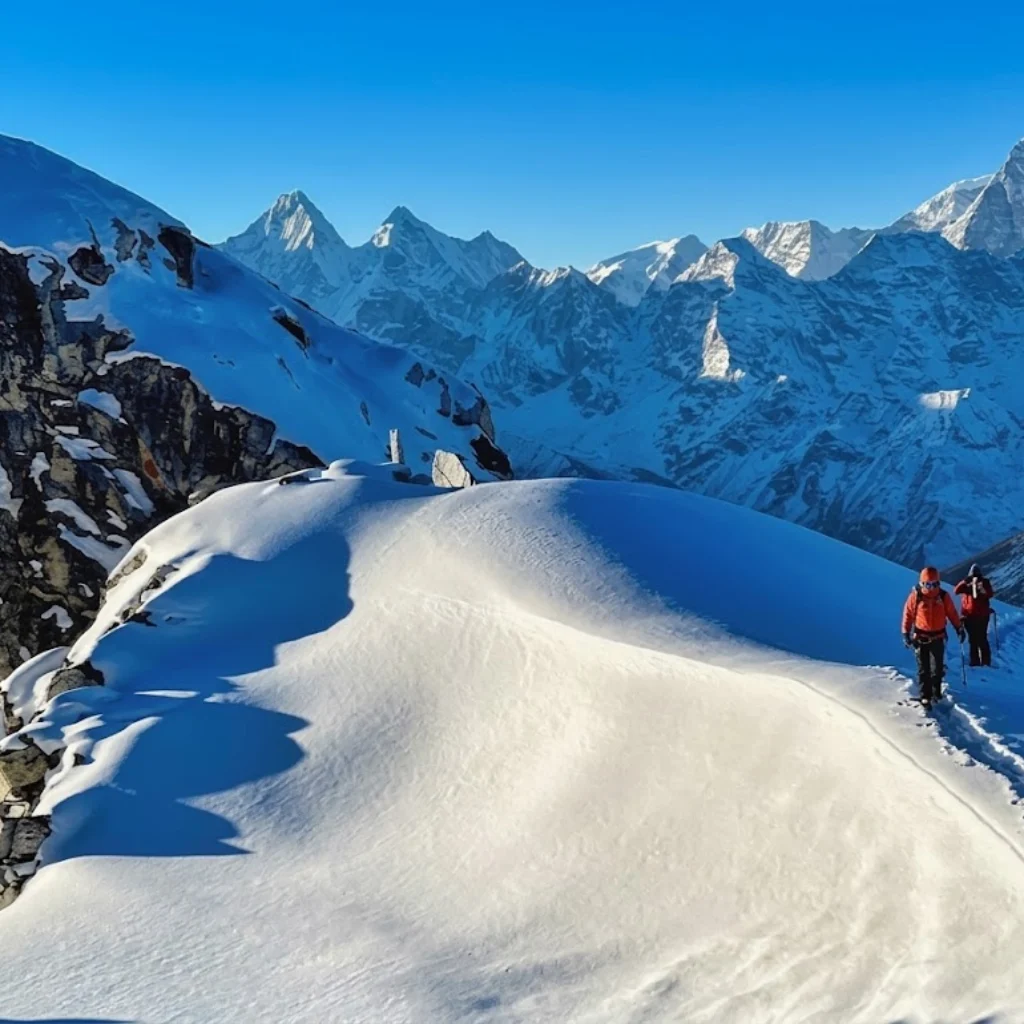

Tour Highlights
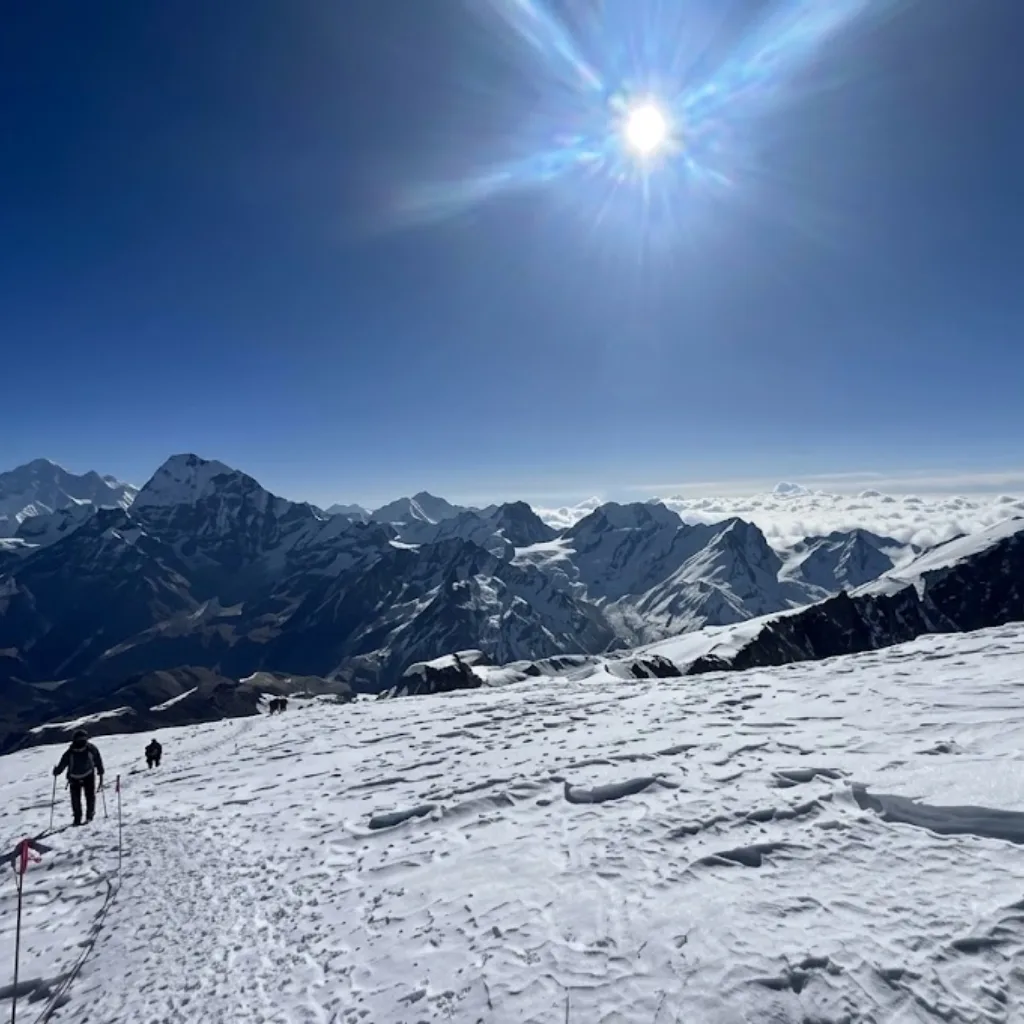
- Mera Peak Summit — 6,461 m / 21,197 ft: stands on the highest officially designated trekking peak in Nepal, with Everest, Lhotse, Makalu, Cho Oyu and Kangchenjunga on the horizon.
- The Five 8,000 m Peaks Panorama: from the summit crest, five of the world’s fourteen 8,000 m peaks are visible in one sweep on clear days.
- Hinku Valley Trekking: a quieter, wilder approach through rhododendron forest and remote teahouses, far from the Namche crowds.
- Makalu Barun National Park: walk inside one of Nepal’s largest protected areas, habitat of snow leopard, red panda and Himalayan tahr.
- Khare Climbing Training — 5,045 m / 16,552 ft: a dedicated acclimatisation and instruction day — crampons, harness, rope work and ice-axe technique.
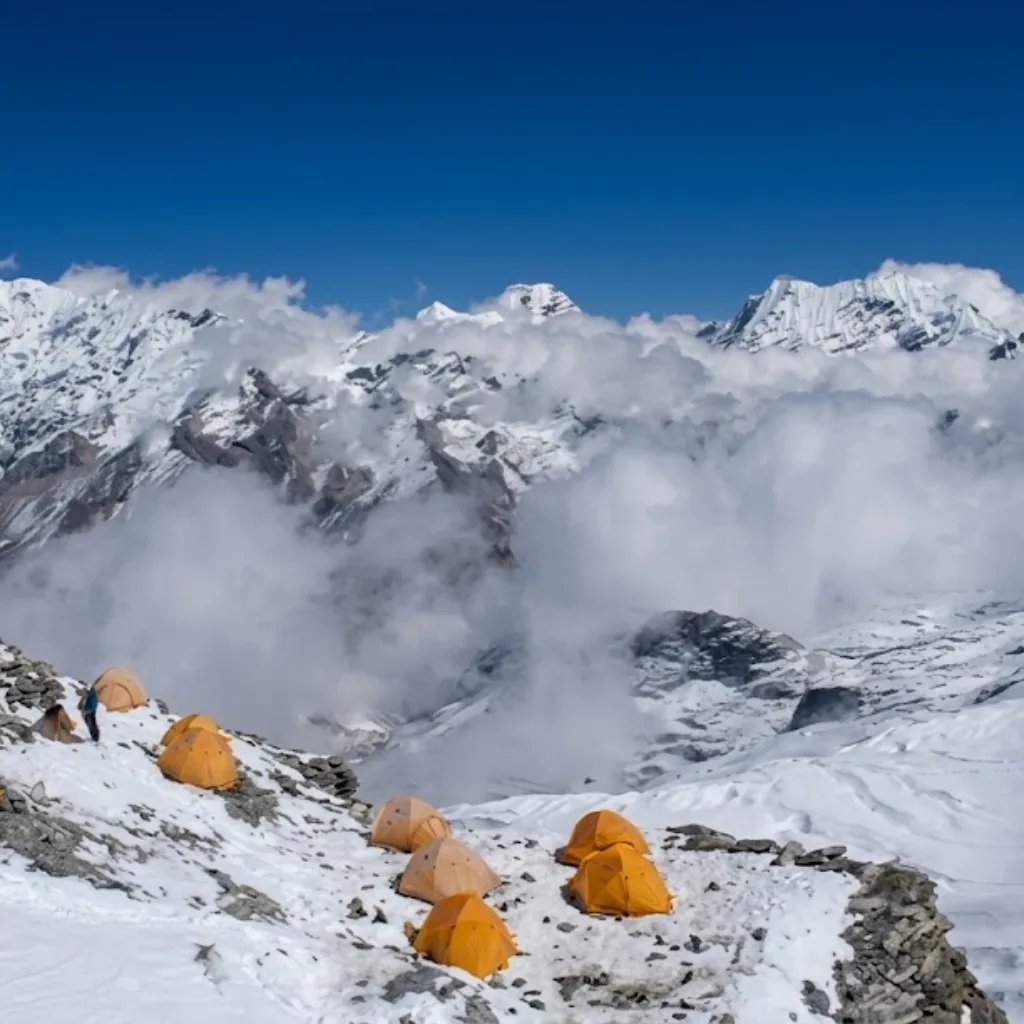
- Mera Base Camp — 5,300 m / 17,388 ft: the first tented camp, set in the moraine landscape beneath the peak.
- Mera High Camp — 5,700 m / 18,701 ft: a dramatic tented perch on the Mera Glacier with the whole panorama at sunset and dawn.
- Mera La — 5,415 m / 17,767 ft: the high pass crossed onto the Mera Glacier, the gateway to the summit plateau.
- Kathmandu Bookends: private guided valley sightseeing, welcome dinner and farewell dinner around a 30–35 minute Lukla flight.
- A True 6,000 m Peak with Support: NMA Sherpa climbing leader, group technical gear, porters (optional add-on) and tented-camp logistics included.
Mera Peak Climb Overview
The Mera Peak Climb is a 16-day peak-climbing expedition in Nepal’s Everest region that ascends 6,461 m / 21,197 ft Mera Peak — the highest of Nepal’s officially designated trekking peaks — through the wild, glaciated Hinku Valley. The route flies into Lukla, walks the quiet eastern valleys past Chutanga, Thuli Kharka, Kothe, Thaknak and Khare, then climbs through Mera Base Camp and High Camp to the broad snow plateau of the summit, where clear days reveal five 8,000 m peaks — Everest, Lhotse, Makalu, Cho Oyu and Kangchenjunga.
The expedition is structured for acclimatisation: teahouse nights through the Hinku Valley give way to an acclimatisation and training day at Khare (5,045 m / 16,552 ft), followed by tented camps at Mera Base Camp (5,300 m / 17,388 ft) and High Camp (5,700 m / 18,701 ft). The summit push begins in the small hours from High Camp and returns all the way to Khare the same day — the classic Mera pattern that keeps your sleeping altitude controlled. The descent retraces the valley to Lukla for the flight home.
With Nepal Lion Tours, the climb starts from USD 3,325 per person in the Standard tier (USD 4,489 in the Luxury tier, with group discounts on both). The package includes the Mera Peak climbing permit and Makalu Barun National Park entry, a licensed NMA Sherpa climbing leader, full-board food, all guesthouse and tented-camp accommodation, the Kathmandu–Lukla–Kathmandu flights, group climbing equipment (crampons, ropes, harnesses), airport transfers and trekking gear.
What Makes the Mera Peak Climb Special?
The summit itself is the headline: at 6,461 m / 21,197 ft, Mera Peak is usually called the highest officially designated trekking peak in Nepal — a genuine 6,000 m summit reached by non-technical snow and glacier walking rather than steep ice climbing. From the wide snow plateau of its summit crest, the panorama is among the biggest in the Himalaya: Everest, Lhotse, Makalu, Cho Oyu and Kangchenjunga all on the horizon, with Baruntse, Chamlang and Ama Dablam nearer at hand. For most climbers it is the bridge between high-altitude trekking and mountaineering.
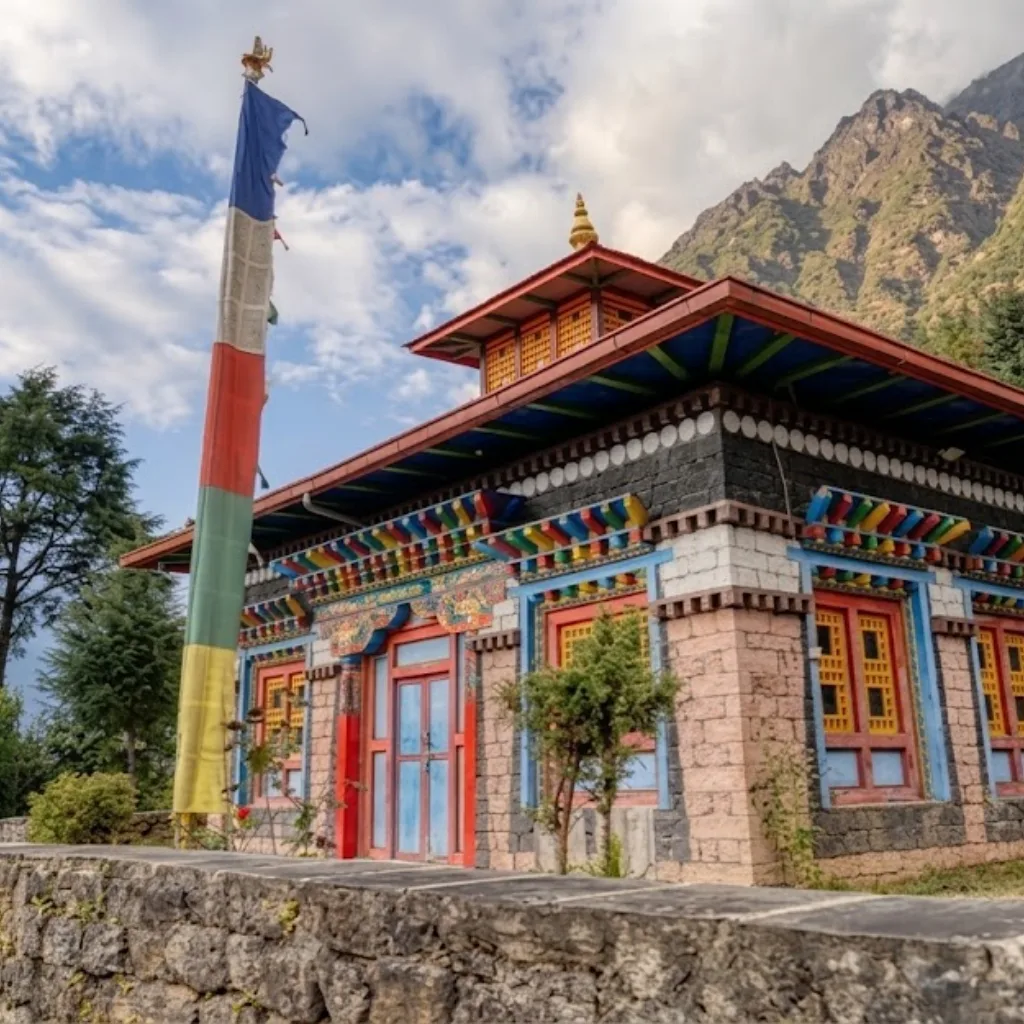
The approach is the second signature. Instead of the crowded Namche–Tengboche corridor, this route enters the Hinku Valley from Chutanga — a quieter, wilder watershed of rhododendron forest, remote teahouses and glacier-wrapped peaks inside Makalu Barun National Park. The gradual valley holds your acclimatisation, the Lungsumgba Gompa near Thaknak adds a cultural pause, and the climbing days above Khare take you past the Mera La onto the great Mera Glacier itself.
Guide’s Note — Nepal Lion Tours
From our experience running Mera Peak departures, the climbers who stand on the summit on the first attempt are almost always the ones who respect the two quiet preparation days — the training session at Khare and the early night at High Camp. The climb itself is not technically intimidating: snow-shoe-free glacier walking with crampons and a rope, led by guides who have been up the mountain many times. The mountain is long and high, not steep and hard. We recommend arriving in Khare rested, doing the practice deliberately, and treating the 2 am High Camp start as the beginning of a long, steady day rather than a race.
— Nepal Lion Tours Lead Trekking Guide
Why Choose the Mera Peak Climb?
If your goal is a 6,000 m summit in Nepal without a full expedition’s technical difficulty, Mera Peak is the classic choice. It is higher than Island Peak (6,189 m) or Lobuche East but technically gentler — the standard route is glacier and snow walking at PD grade, with no steep rock or ice climbing. Sixteen days give you the acclimatisation structure the mountain demands: two Valley teahouse weeks below 4,300 m, a monitored night at Khare, and controlled nights at Base Camp and High Camp before the summit.
The package keeps the logistics simple. Kathmandu is the start and end city; the Lukla flight (with the option to fly via Ramechhap in the busiest season) and both tented camps are handled by the team; and the NMA-licensed climbing leader plus group equipment mean you bring personal gear and fitness rather than a full expedition kitchen. For fit trekkers moving up to their first high summit, it is the most direct route above 6,000 m there is.
Who Is This 16-Day Mera Peak Climb Suitable For?
- Fit trekkers graduating to mountaineering — a first high-altitude summit without steep technical climbing
- Experienced high-altitude trekkers who have completed EBC or similar and want a true 6,000 m peak
- Time-rich adventurers with roughly three weeks (Kathmandu to Kathmandu)
- Climbers preparing for higher objectives — a proven acclimatisation route toward Island Peak, Ama Dablam or 7,000 m peaks
- Photographers and view-chasers who want the five-8,000 m-peak panorama in one frame
- Small private groups (1–10 pax) climbing as a team with their own guides
- Travellers who prefer the quieter Hinku Valley over the crowded Namche corridor
- Anyone who can commit to a training block — several weeks of regular walking, hills and endurance work before departure
This climb is not for complete beginners: you should have comfortable multi-day trekking experience, good aerobic fitness, and ideally at least one prior long trek above 3,000 m. The technical skills — crampon walking, rope work, ice-axe use — are taught and drilled at Khare, so no prior mountaineering experience is required, but the altitude and the 16-day length demand real physical and mental stamina.
Quick Facts
| Trek Fact | Details |
|---|---|
| Trek Name | Mera Peak Climb |
| Duration | 16 days / 15 nights |
| Region | Everest (Khumbu) — Hinku Valley, Makalu Barun, Nepal |
| Maximum Altitude | 6,461 m / 21,197 ft at the Mera Peak summit (Mera North rises to 6,476 m / 21,247 ft) |
| Difficulty | Challenging |
| Main Highlight | Summit of 6,461 m Mera Peak with views of Everest, Lhotse, Makalu, Cho Oyu and Kangchenjunga |
| Start / End | Kathmandu to Kathmandu |
| Route | Kathmandu — Lukla — Chutanga — Thuli Kharka — Kothe — Thaknak — Khare — Mera Base Camp — Mera High Camp — Summit — Khare — Kothe — Thuli Kharka — Lukla — Kathmandu |
| Typical Walking | 4–7 hours per day, plus the 5–7 hour summit day from High Camp |
| Best Season | Spring (Mar–May) and Autumn (Sep–Nov) |
| Price From | USD 3,325 per person (Standard) / USD 4,489 (Luxury) |
| Accommodation | Kathmandu hotels, Hinku Valley teahouses, tented camps at Mera Base Camp and High Camp |
| Guide | NMA-licensed Sherpa climbing leader plus English-speaking trekking guide |
Mera Peak Climb Route and Elevation
The route is a high, lonely arc through a country most Everest trekkers never see. From Kathmandu (1,400 m / 4,593 ft) you fly to Lukla (2,860 m / 9,383 ft), walk east over the forested ridge to the Hinku Valley, climb its full length through Chutanga, Thuli Kharka, Kothe, Thaknak and Khare to the mountain, cross the Mera La onto the glacier, and descend the same valley home after the summit. Every stage above Khare is tented, and the summit push begins from High Camp in the small hours of Day 11.
Mera Peak Climb Route at a Glance
Day | Route | Altitude | Highlights |
|---|---|---|---|
1 | Arrive Kathmandu | 1,400 m / 4,593 ft | Airport transfer, Thamel, team briefing, welcome dinner |
2 | Kathmandu Valley sightseeing | 1,400 m / 4,593 ft | UNESCO World Heritage Sites; rest before the flight |
3 | Fly to Lukla; trek to Chutanga | 2,860 m / 9,383 ft up to 3,450 m / 11,319 ft | Scenic flight, first forested climb (4 hrs) |
4 | Chutanga to Thuli Kharka | 3,450 m / 11,319 ft up to 4,200 m / 13,780 ft | Rhododendron forest, Zatrwa La crossing, Mera views (5–6 hrs) |
5 | Thuli Kharka to Kothe | Descend to 3,800 m / 12,467 ft | Into the Hinku Valley, Sanu Khola Bridge (5–6 hrs) |
6 | Kothe to Thaknak | 3,800 m / 12,467 ft up to 4,300 m / 14,108 ft | Hinku Drangka, Lungsumgba Gompa (4–5 hrs) |
7 | Thaknak to Khare | 4,300 m / 14,108 ft up to 5,045 m / 16,552 ft | Glacier views, Mera north face, acclimatisation hike (5–6 hrs) |
8 | Acclimatisation and training at Khare | 5,045 m / 16,552 ft | Crampons, harness, ropes, ice-axe practice |
9 | Khare to Mera Base Camp | up to 5,300 m / 17,388 ft | Glaciated approach, first tented night (5–6 hrs) |
10 | Mera Base Camp to High Camp | up to 5,700 m / 18,701 ft | Mera La crossing, camp on the glacier (5–7 hrs) |
11 | Summit attempt; descend to Khare | 6,461 m / 21,197 ft, back to 5,045 m / 16,552 ft | 2 am start, summit, glacier descent (6–8 hrs) |
12 | Khare to Kothe | descend to 3,800 m / 12,467 ft | Valley descent, greener terrain (5–6 hrs) |
13 | Kothe to Thuli Kharka | up to 4,200 m / 13,780 ft | Forest ascent, last mountain views (5–6 hrs) |
14 | Thuli Kharka to Lukla | descend to 2,860 m / 9,383 ft | Kongde, Numbur and Kusum Khanguru views (6–7 hrs) |
15 | Fly Lukla to Kathmandu | 1,400 m / 4,593 ft | 30–35 minute flight, free afternoon, farewell dinner |
16 | Final departure from Kathmandu | 1,400 m / 4,593 ft | Transfer to Tribhuvan International Airport |
Mera Peak Climb Elevation Profile
The profile climbs steadily and slowly at first, then steps up through three controlled camps. Kathmandu (1,400 m) to Lukla (2,860 m) by air, a day’s walk to Chutanga (3,450 m), a push over the ~4,600 m Zatrwa La to Thuli Kharka (4,200 m), a dip to the Hinku Valley floor at Kothe (3,800 m), and a long gradual climb through Thaknak (4,300 m) to Khare (5,045 m). Rest and training hold you at Khare before the two tented camps — Mera Base Camp (5,300 m) and Mera High Camp (5,700 m) — and finally the summit at 6,461 m on Day 11.
What the profile means physically: roughly ten days to reach 5,000 m (excellent acclimatisation by Himalayan standards), two nights of controlled sleeping gain after it, and a summit day that climbs about 700 m from High Camp in 5–7 hours before descending over 2,000 m back to Khare. The route never sleeps more than 700 m above the previous night once above Kothe, which is why the mountain’s success rate is high for well-prepared teams — provided the weather cooperates. Nepal Lion Tours provides an area map with the elevation profile as part of your trekking materials.
How to Get to the Mera Peak Climb
The expedition starts and ends in Kathmandu (1,400 m / 4,593 ft), and the only air legs are the Lukla flights — the route depends on getting in and out of the Khumbu by air. Everything between is walked, with a private transfer network in the city.
Kathmandu to Lukla: The Gateway Flight
| Option | Approx. Travel Time | Best For |
|---|---|---|
| Lukla flight from Kathmandu | ~30–35 minutes | Standard routing; scenic approach over the foothills |
| Lukla flight via Ramechhap | ~4-hour road transfer + ~20-minute flight | High-season (Oct–Apr) departures when Kathmandu city airport is busy |
| Helicopter sector | ~45–60 minutes | Private comfort upgrades, weather flexibility |
The Day 3 flight from Tribhuvan International Airport (or from Ramechhap’s Manthali airport in the busiest months) lifts you over the green mid-hills to the Himalaya in about half an hour. Lukla is the same gateway used by all Everest-region treks — 2,860 m / 9,383 ft, sitting on a hillside above the Dudh Koshi. Because this route turns east into the Hinku Valley rather than north toward Namche, Lukla is where the crowd’s direction splits and the trail quietens almost immediately.
From Lukla the Trek Begins
The first walking day heads up the forested ridge toward Chutanga (3,450 m / 11,319 ft), climbing through pine and rhododendron on a quieter path than the Namche corridor. Over the next stages the trail crosses the Zatrwa La into the Hinku watershed, winds down to the valley floor at Kothe, and follows the Hinku Khola north through Thaknak with the Lungsumgba Gompa marking the cultural heart of the upper valley. Above Khare the trekking ends and the climbing part of the journey begins.
Returning to Kathmandu After the Climb
After the summit you descend the same valley, arriving back at Lukla on Day 14 in time for the Day 15 flight. The return sector takes roughly 30–35 minutes, and the itinerary carries a full Kathmandu afternoon and farewell dinner afterward — so even a same-day flight delay has a designed buffer before your international departure on Day 16. Our team monitors the Lukla schedule on both legs and keeps the porters, guides and vehicle transfers coordinated around it.
Ramechhap: High-Season Airport Routing
In the peak months (October to April), Lukla flights sometimes operate from Ramechhap (Manthali) instead of Kathmandu’s city airport to reduce congestion. That means an early ~4-hour road transfer from Kathmandu to Ramechhap, a short hop to Lukla, and the same on return. Your package includes the flights and the road transfer, and our team plans the early departure so you are not unduly rushed. In quieter months the same flights leave directly from Kathmandu, and we optimise the routing for your departure dates.
A Practical Tip for International Travellers
Hold at least one spare day after the Day 15 return flight before your international departure — weather can close Lukla for hours even in the best seasons. The itinerary’s Day 16 departure gives you that margin automatically. Note that climbing itineraries are weather-managed: summit day may shift by a day, so keep your flight home flexible and your travel insurance arranged for a possible extension. Everything on the ground is coordinate-readable — one city, one mountain, straightforward logistics in between.
Guide’s Note — Nepal Lion Tours
From our experience operating Mera Peak departures, the Lukla flight is the hinge of the whole expedition, and the most common cause of a changed plan. When the weather closes Lukla, flights reroute through Ramechhap or slip to the next morning — so we build the spare-day buffer into the itinerary on purpose, and we track the schedule on both legs rather than leaving you at the airport guessing. On summit mornings the same principle applies in reverse: the day can shift by a day, so arrive with loose international connections and let the team coordinate the movement side.
— Nepal Lion Tours Lead Trekking Guide
Mera Peak Climb Difficulty, Fitness & Altitude
The climb is graded challenging, and the challenge is altitude and length rather than technical difficulty. The route is technically gentle — snow and glacier walking at PD grade with crampons and ropes — but it is one of the highest treks in Nepal at 6,461 m / 21,197 ft, demands 4–7 walking hours most days for two weeks, and reaches its highest point in the cold dark of a pre-dawn start. Fitness, patience and acclimatisation discipline matter more than climbing experience.
Where the Effort Actually Is?
Three moments concentrate on the real difficulty. First, the sustained 16-day length — even gentle days add up, and Day 4 (Chutanga to Thuli Kharka over the Zatrwa La) and Day 7 (Thaknak to Khare, roughly 700 m of ascent) feel harder than the effort looks on a map. Second, the summit day — a 2 am start from High Camp, a 5–7 hour climb of about 700 m at over 5,700 m, and a long descent of more than 2,000 m back to Khare, cold and exposed throughout. Third, the tented nights at 5,300 m and 5,700 m — sleep quality drops at altitude, and managing that fatigue is part of the expedition.
Guide’s Note — Nepal Lion Tours
The summit start is the moment that sorts good preparation from optimism. From our experience of Mera Peak departures, the 2 am departure from High Camp is deliberately early: it puts you on the summit plateau in the colder, calmer air before the sun softens the snow and before the wind builds. We recommend treating the day like a long trek, not a climb — food in your pockets from the night before, a thermos of warm drink, your headlamp charged and spare batteries in your inner pocket so the cold does not kill them. Teams that eat and drink steadily through the summit morning feel the descent far less.
— Nepal Lion Tours Lead Trekking Guide
How to Prepare for the Mera Peak Climb
- Build 3–4 months of consistent cardio — 3–5 sessions weekly: hiking, running or cycling at 45–90 minutes
- Walk with elevation gain — two or three long hill or stair sessions a week for 6–8 weeks before departure
- Do one multi-day trek above 3,000 m if possible (EBC, Annapurna Base Camp or similar) to test your altitude response
- Practice carrying a loaded pack — 8–12 kg on the hill sessions mirrors the trekking weight
- Strengthen legs, core and balance — squats, lunges, step-ups and single-leg work protect you on the descents
- Get your crampon-compatible boots early and break them in fully — blisters above 5,000 m are catastrophic
- Test altitude medication (diamox/acetazolamide) with your doctor before travel and know your tolerance
How Difficult Is This Climb Compared with Other Peaks?
Compared with Island Peak (6,189 m) and Lobuche East (6,119 m), Mera Peak is higher and longer but technically gentler — no steep headwall, no fixed-rope rock pitch, more of a walk-up under glacier conditions. Compared with Ama Dablam (6,812 m), it is dramatically easier: no rock climbing, no exposure on steep ridges, far less dependency on anchors. Compared with Everest Base Camp trekking (5,364 m), Mera adds 1,000 m of altitude and the tented high camps, but demands no climbing skills you cannot learn in the Khare training session. For most fit trekkers, Mera is the natural first true 6,000 m summit.
Altitude, Acclimatization & Safety
Altitude is the expedition’s main risk, and the programme is built around managing it. The route sleeps no higher than 4,300 m for the first eight days, holds a full acclimatisation and training day at Khare (5,045 m), and then gains sleeping altitude in controlled steps — 5,300 m Base Camp, 5,700 m High Camp — with the summit reached and descended in a single long day back to Khare.
Mera Peak Climb Altitude Profile
- Kathmandu — 1,400 m / 4,593 ft: arrival and sightseeing days
- Lukla — 2,860 m / 9,383 ft: flight-in gateway to the Hinku route
- Chutanga — 3,450 m / 11,319 ft: first trekking night
- Thuli Kharka — 4,200 m / 13,780 ft: after crossing the Zatrwa La (~4,600 m)
- Kothe — 3,800 m / 12,467 ft: valley floor, descending to recover
- Thaknak — 4,300 m / 14,108 ft: below the glacier country
- Khare — 5,045 m / 16,552 ft: acclimatisation and training day
- Mera Base Camp — 5,300 m / 17,388 ft: first tented night on the approach
- Mera High Camp — 5,700 m / 18,701 ft: summit launch pad, tented
- Mera Peak Summit — 6,461 m / 21,197 ft: the objective; no overnight
How the Body Adapts to Altitude
Acclimatisation works through exposure, rest and nutrition. The long, low Hinku approach acclimatises most climbers naturally; the Khare rest-and-train day and the two-step camp gains add deliberate control. Your climbing leader paces each day and asks each climber about sleep, appetite and headache — early amber flags, not drama. Drinking 4–5 litres a day, eating carbohydrate-dense meals (dal bhat, noodles, porridge), and sleeping at the camps each night are the three habits that get people up this mountain.
Symptoms of Altitude Sickness to Watch For
- Mild (normal at altitude, manage): headache, breathlessness on effort, disturbed sleep, reduced appetite, light dizziness
- More concerning (act immediately): severe unrelieved headache, vomiting, confusion, loss of coordination, breathlessness at rest
The rule is absolute: stop ascending, tell your leader, and descend. On Mera Peak a descent is always downhill from camp to the valley — that remedy is part of the route design. Your climbing leader carries the protocol, a first-aid kit and communication, and will turn the team if conditions or health say so; the decision to descend is final, never a debate.
How Nepal Lion Tours Supports Altitude Safety
- Gradual, valley-led route progression with controlled sleeping gains above Khare
- NMA-licensed Sherpa climbing leader with a strong personal track record on Mera
- Daily health checks — sleep, appetite, headache and pulse-ox monitoring where useful
- Training before the summit — crampon and rope skills drilled at Khare, not learned on summit morning
- Descent-ready design — the summit-day return to Khare means no night above 5,700 m and an early beachhead for any evacuation
Best Time to Climb Mera Peak
The best time is generally spring (March to May) and autumn (September to November), the two windows of stable high-pressure weather that give the summit and the five-8,000 m-peak panorama their best chance. The climb runs year-round, but outside these windows the snow, wind and cold raise the difficulty and reduce the weather margin on summit day.
| Season | Months | Weather & Snow Conditions | Summit Conditions | Overall |
|---|---|---|---|---|
| Autumn | Sep–Nov | Clearest and most stable; settled snow | Excellent success rates | Best overall |
| Spring | Mar–May | Warmer, drier; drier snow on glacier | Very good; more teams | Highly recommended |
| Winter | Dec–Feb | Extremely cold above 4,000 m, deep snow | Possible with preparation, cold | Good for experienced teams |
| Monsoon | Jun–Aug | Heavy cloud, wet trails, more crevasse risk | Frequently poor | Not recommended |
Autumn — September to November
Autumn is the most reliable season for the whole expedition. Post-monsoon skies are clear and stable, daytime temperatures at valley level are pleasant, the glacier holds well-packed snow, and the summit success rate is typically the highest of the year. October in particular offers the classic conditions: cold dawns, warm walking days, and the crisp visibility that makes the far 8,000 m panorama stand out. It is also when the NMA climbing permit costs the low seasonal rate, making autumn the best season by most measures.
Spring — March to May
Spring is the other peak season, with milder temperatures and generally good snow after the winter. The trails and teahouses are busy, the rhododendron along the Hinku approach blooms in April, and the longer days give the summit push a comfortable start. Success rates are high, though the mountain sees more teams; note that the climbing permit is at its spring-peak price of USD 350 per person.
Winter — December to February
Winter is a committed mountaineer’s season: brilliant clear air, almost no other teams, but bitter cold above 4,000 m, deep snowfall on the glacier and short windows of stable weather. Walking days must be efficient, the tented camps need serious cold-weather kit, and summit success depends on snow conditions through the Mera La. It is feasible for well-prepared, experienced groups but not a first-choice season for early peak climbers.
Monsoon — June to August
The monsoon is not recommended for Mera Peak. Cloud and rain sit over the Hinku Valley, the teahouse trails turn to mud, and upper-mountain weather becomes unpredictable — with soft snow and increased crevasse risk through the glacier route. Some operators run reduced departures with constant weather watching; if your dates fall in these months, insist on flexible summit scheduling and full insurance coverage.
Which Season Should You Choose?
Choose autumn (September to November) for the best summit odds, the calmest weather and the lower permit rate. Choose spring (March to May) for milder temperatures, rhododendron flowers and long daylight — accepting the higher peak-season permit price. Choose winter only if you are experienced and want solitude. Avoid the monsoon unless your dates are fixed and your leader confirms the route is safe. Whichever you pick, verify the NMA permit price for your season at booking and keep at least one spare day after the summit for weather.
Guide’s Note — Nepal Lion Tours
From our experience of Mera Peak departures, autumn is the season we recommend for first-timers within reason: the post-monsoon air is clear, the Hinku sky holds its walk, and the summit window behaves. Spring is a close second and runs warmer with longer daylight, but the mountain sees more teams and the climbing permit is at its peak price. The honest advice we give every enquiry is to pick the season that fits your schedule and your fitness, then hold one spare day at the end — weather, not the calendar, decides the summit.
— Nepal Lion Tours Lead Trekking Guide
Mera Peak Climb Permits & Regulations
Climbing Mera Peak requires a climbing permit for the peak itself — issued by the Nepal Mountaineering Association (NMA) — plus an entry permit for Makalu Barun National Park, whose protected ground the Hinku Valley sits inside. Nepal Lion Tours arranges both as part of the pre-expedition paperwork; you travel with your original passport and the documents ride with the climbing leader.
Mera Peak Climb Permits at a Glance
| Requirement | Who Needs It? | Who Arranges It? |
|---|---|---|
| Mera Peak Climbing Permit (NMA) | Every climber attempting the summit | Nepal Lion Tours |
| Makalu Barun National Park Entry Permit | All trekkers and climbers entering the park | Nepal Lion Tours |
Mera Peak Climbing Permit (NMA)
The Mera Peak climbing permit is issued by the Nepal Mountaineering Association and is the authorisation for the ascent itself. For foreign climbers the 2025–2026 season fees are USD 350 per person in spring, and USD 175 in autumn, winter and summer — the figures were revised by the NMA effective autumn 2025, and the fee structure can change again. Permit processing is done through a licensed operator (Nepal Lion Tours) in advance, and the permit is checked by the local authorities with your technical gear on the approach. Include your passport details, estimated dates and group composition at booking so registration is complete before you leave Kathmandu.
Makalu Barun National Park Entry Permit
The Makalu Barun National Park Entry Permit covers the protected-area entry for the Hinku Valley route, which the trail lies inside from the Chutanga ridge onward. The entry fee is approximately NPR 3,000 (around USD 23–25) per foreign visitor — the park is one of Nepal’s largest protected areas, holding snow leopard, red panda and Himalayan tahr habitat, and the fee funds its conservation work. The permit is arranged alongside the climbing permit and checked at the park boundary; your guide presents the documents so you simply show your passport and continue.
Do You Need a TIMS Card or Local Municipality Fee?
A TIMS card is not required on the Hinku Valley route. The Sagarmatha National Park permit does not apply because this itinerary never enters the Namche–Tengboche park zone. Depending on the season and routing, local authorities may also collect a Khumbu Pasang Lhamu Rural Municipality fee at the Lukla entry point, and some operators add a refundable garbage deposit for higher-camp waste management — both are modest and returned or passed on transparently. Our team confirms exactly which local fees apply to your departure dates at booking, so there are no surprises on the trail.
Who Arranges the Permits?
Nepal Lion Tours arranges all applicable permits — the NMA climbing permit, the Makalu Barun entry and any local municipality fee — as part of your pre-expedition preparation. Bring your original passport with at least 6 months’ validity; photocopies are kept with the kit in case of checks. Because permit prices and regulations are revised seasonally, the amounts above are the 2025–2026 guidelines and are confirmed in writing at booking — they are included in your package price, so a fee change never lands on your mid-trip.
Food & Accommodation on the Mera Peak Climb
Accommodation follows the expedition structure: Kathmandu hotels at bookends, teahouse lodges through the Hinku Valley, then tented camps from Mera Base Camp upward. Food is full board throughout — breakfast, lunch and dinner with tea or coffee — with teahouse menus below Khare and expedition-style cooked meals at the camps, including seasonal fresh fruit as listed in the inclusions.
Accommodation on the Mera Peak Climb
- Kathmandu (Days 1, 2, 15): comfortable city hotels with breakfast, welcome and farewell dinners — tour-standard properties, private rooms
- Hinku Valley teahouses (Days 3–8, 12–14): locally run lodges at Chutanga, Thuli Kharka, Kothe, Thaknak, Khare and Lukla, with private twin rooms and shared or attached bathrooms depending on the stop
- Mera Base Camp (Day 9–10): a tented camp at 5,300 m / 17,388 ft in the moraine landscape, with proper expedition tents, sleeping mats and cooking crew
- Mera High Camp (Day 10–11): the dramatic tented perch at 5,700 m / 18,701 ft on the Mera Glacier, the launch point for the summit
- Throughout: rooms and tents are twin-sharing; the provided sleeping bag and down jacket cover the cold nights; the higher the stop, the firmer the reality of expedition life
Teahouses in the Hinku Valley are simpler than the Namche-side lodges — warm dining rooms, solid beds and honest food, with facilities varying by village. From Khare downward the lodge is the social heart of the evening; from Mera Base Camp upward, the tent and the mess tent become home and the team cooks full hot meals at altitude.
What Food Is Available on the Mera Peak Climb?
The menus below Khare mirror the classic Nepal itinerary — dal bhat (rice, lentils and curry), momos, noodles, thukpa, fried rice, pasta, soups, omelettes, porridge and pancakes — with bakery bread pocketable fuel from the bigger lodges. At the tented camps the crew prepares hot expedition meals designed for altitude: high-energy breakfasts before the summit start, soups and pastas in the evenings, plus seasonal fresh fruit as listed in the inclusions. Dal bhat is the climber’s staple for a reason, and vegetarian options are widely available; vegan, gluten-free and allergy needs require advance notice to Nepal Lion Tours so the team can provision the camps accordingly.
What Food and Accommodation Are Included?
Included in the Climb Package | Usually Paid Separately |
|---|---|
Full-board food on trek and climb (B, L, D + tea/coffee + seasonal fruit) | International flights and Nepal visa fees |
All teahouse accommodation through the Hinku Valley | Extra Kathmandu hotel nights beyond the itinerary (note: “Hotel in KTM/Night” appears as an optional add-on on the page) |
Tented camps at Mera Base Camp and High Camp with crew | Travel insurance (mandatory; include helicopter evacuation cover) |
Kathmandu–Lukla–Kathmandu flights (guest + guide) | Personal expenses: laundry, drinks, hot showers where charged |
Mera climbing permit and Makalu Barun entry permit | Tips for guides, porters and drivers |
NMA climbing leader, group technical gear, first aid and rescue arrangements | Optional porter hire to carry your personal luggage |
The package is unusually complete: permits, flights for both you and your guide, full board, all lodging and the group climbing equipment are bundled. What you add personally is insurance, visa, tips, small cash for valley purchases, and — if your back prefers it — a porter via the optional add-on on the booking page.
Drinking Water on the Climb
At teahouses, use boiled or treated water only, and from Base Camp the crew boils and filters water for the group — never drink untreated meltwater or stream water. Carry a reusable bottle of 1–2 litres with purification tablets or a filter for the trail sections, and drink 4–5 litres a day at altitude, topping up with hydration salts after long walking days. Water discipline is one of the quietest, most effective altitude habits on this mountain.
Staying Comfortable on a High-Altitude Climb
- Assign your summit gear the night before — headlamp with spare batteries, crampons, harness, insulated gloves and thermos ready at High Camp
- Use the provided sleeping bag liner inside the camp bag — two sleeping-bag layers handle the 5,700 m cold
- Keep a warm layer in the tent — 5,700 m nights fall to around -15°C in spring and autumn
- Carry 3,000–5,000 NPR for valley stops — drinks, extra snacks and wind-down purchases at the teahouses
- Eat even without appetite — the camp cooks make dal bhat and porridge specifically to fuel the next day
- Tell Nepal Lion Tours your dietary needs at booking so Base Camp and High Camp are provisioned before you leave
Why Book with Nepal Lion Tours?
Nepal Lion Tours builds and runs high-altitude climbing itineraries from a Kathmandu base, which matters most on a peak like Mera — where permits, flights, tented logistics and the climbing leadership are all arranged well before the trail begins. The team that answers your WhatsApp is the same team that coordinates your guides, flights and camp crews.
- Licensed, NMA-certified climbing leadership.
Your high-altitude Sherpa climbing leader is licensed by the Nepal Mountaineering Association, with repeated Mera Peak experience, and is joined by an English-speaking trekking guide. The Khare training session, the summit-day rope system and the descent decisions all sit with people who have summited Mera multiple times.
- A registered trekking company you can verify.
Nepal Lion Tours is a registered Nepali trekking company, and its licences and company documents are provided on request. Climbing peaks in Nepal require a licensed operator to process the NMA permit — which is exactly the layer this package covers.
- Private departures from two trekkers.
Your climb runs as your own team, not a joined expedition. Two friends, a couple, or a family group share one plan, one pace and one summit day with guides dedicated to your group.
- A genuinely high 6,000 m objective, handled properly.
Mera Peak at 6,461 m is a real expedition objective — hauling you above 6,000 m — but the route’s gentle technical grade, the long valley acclimatisation and the camp structure make it the most achievable first high summit in Nepal.
- Complete, honest logistics.
Permits, NMA leader, guest-and-guide flight tickets, both tented camps, full board, group gear, first aid and rescue coordination are itemised in the inclusions — so what you see is what the climb costs.
- Budget-visible pricing without cutting safety.
The Standard tier (from USD 3,325) and Luxury tier (from USD 4,489) share the same route, permit set and climbing leadership; the difference is hotel grade and some comfort levels, never safety or support.
- A local team you can reach before and during the climb.
From visa questions to the summit-night weather outlook, your Kathmandu operations team is on WhatsApp at +977-9851039020 throughout the expedition.
Book the Mera Peak Climb
Sixteen days to the highest trekking peak in Nepal — a quiet valley approach, a day of crampon and rope practice, two tented nights above 5,000 m, and a pre-dawn summit start that ends with Everest, Lhotse, Makalu, Cho Oyu and Kangchenjunga in one frame. This is mountaineering’s most honest first summit.
Trek at a Glance
- Duration: 16 days / 15 nights, Kathmandu to Kathmandu
- Price: From USD 3,325 per person (Standard); USD 4,489 (Luxury) — group discounts from 2 pax
- Difficulty: Challenging — glacier and snow walking (PD), the challenge is altitude and length
- Maximum Altitude: 6,461 m / 21,197 ft at the Mera Peak summit
- Accommodation: Kathmandu hotels, Hinku Valley teahouses, tented camps at Mera Base Camp and High Camp
- Meals: Full board on trek and climb, plus tea/coffee and seasonal fresh fruit
- Permits & Registration: Mera Peak climbing permit (NMA) and Makalu Barun National Park entry arranged by Nepal Lion Tours
- Transportation: Kathmandu–Lukla–Kathmandu flights for guest and guide, private transfers and airport pick-up/drop-off
- Guide: NMA-licensed Sherpa climbing leader plus English-speaking trekking guide (assistant guide for groups over 5)
- Cancellation: Free cancellation up to 14 days before departure (subject to booking terms)
Ready to Start Your Everest Region Adventure?
Send us your preferred dates, group size and tier — Standard or Luxury — through the booking form or WhatsApp at +977-9851039020, and we’ll confirm flight slots, the NMA permit for your season and your exact price before you commit. Whether you are a pair of friends taking the step up from trekking or a family with mountain ambitions, we’ll help you prepare — training pointers, gear lists and honest expectations — for a smooth expedition. Your 6,000 m summit is waiting — choose your season and start planning your Mera Peak climb today.
Related Everest Region Climbs and Treks
If Mera Peak is the step up you are aiming for, these Nepal Lion Tours routes in the Everest region sit at different rungs of the ladder.
Climb / Trek | Duration | Difficulty | Max Altitude | Best For |
|---|---|---|---|---|
Everest Base Camp Trek via Kala Patthar | 12 days | Moderate | 5,545 m | Classic high-altitude trek, ideal Mera prep |
Everest Base Camp Luxury Trek | 10 days | Moderate | 5,545 m | Premium EBC trek with Kala Patthar |
Gokyo Lake Trek | 10 days | Moderate | 5,357 m | Turquoise lakes and the Gokyo Ri panorama |
Mera Peak Climb (this package) | 16 days | Challenging | 6,461 m | First true 6,000 m summit |
Island Peak Climbing | 18–20 days | Challenging | 6,189 m | First Himalayan climbing peak with steep sections |
Everest Three Passes Trek | 18–21 days | Challenging | 5,535 m | Full high-altitude Khumbu traverse |
Mera Peak sits naturally between the high treks and the harder climbs: complete an EBC-level trek first to confirm your altitude response, then step onto Mera for the 6,000 m milestone — and Island Peak or beyond from there. The routes combine easily around a single Lukla trip, and our team can build the sequence into one itinerary if you have the weeks for it.
Trip Essentials
Packing advice, required equipment & gear recommendations
Essential
Packing for Mera Peak has two layers: standard trekking kit for the valley, and cold-weather expedition kit for the 5,700 m camp and the summit. Nepal Lion Tours provides a down jacket, an all-season sleeping bag, a duffel bag and an area map (returned after), and the group climbing equipment — ropes, ice screws, snow bars, harnesses, carabiners and figure-of-eight belay devices. What you bring is personal: your boots, layers, personal climbing hardware and the small comforts of two tented nights.
Hiking Gear
- Broken-in, crampon-compatible mountaineering boots — a stiff, insulated model that fits your crampons (rentals exist in Kathmandu, but break-in at home)
- Trekking poles — two poles for the valley stages, stowed for the glacier
- 25–35 litre daypack for daily use and a 60–70 litre duffel or backpack for porters/crew
- Water bottles or hydration system (2–3 litres) with purification
- Headlamp (mandatory — with spare batteries in an inner pocket) for the 2 am summit start
- Waterproof stuff sacks to keep sleeping bag and clothing dry in camp
- Light camp shoes or sandals for evenings at teahouses and tents
Clothing: Use Layers Rather Than Bulk
Base layers: merino or synthetic long-sleeve tops and bottoms — never cotton at altitude.
Mid-layers: a fleece or soft-shell for walking, plus a warmer insulated jacket for evenings.
Outer layers: a wind- and waterproof shell jacket and trousers; your down jacket (provided) rides over everything for the summit start.
Trekking clothes: 2–3 pairs of quick-dry trousers, 3–4 lightweight shirts, and warm sleepwear for the 5,700 m nights.
Headwear and gloves: a warm beanie, a lightweight sun hat, glacier sunglasses (obligatory above snow), a buff or neck gaiter, and two pairs of gloves — a light pair for walking and an insulated pair for the summit.
Sleeping and Evening Comfort
- Silk or cotton sleeping bag liner inside the provided sleeping bag
- Warm base-layer sleepwear and warm socks for the tented nights
- A second warm layer or down booties for High Camp — the evening temperature at 5,700 m drops well below freezing
- Earplugs and an eye mask for the camp and teahouse nights
Toiletries and Personal Health Items
- Personal medication and a doctor’s letter for prescription items
- Altitude medication (diamox/acetazolamide) — discuss with your doctor before travel
- Sunscreen (SPF 50) and high-factor lip balm — the glacier sun is brutal even in cloud
- Blister kit — plasters, moleskin, tape; thoroughly broken-in boots are the priority
- Personal first-aid basics — paracetamol, rehydration sachets, throat lozenges for dry air
- Hand sanitiser, biodegradable soap and wet wipes
- Toothbrush, toothpaste, small toiletries in travel sizes
- Small quick-dry towel
- Insect repellent (valley sections only, low risk)
Electronics
- Power bank (20,000 mAh) — the camps charge nothing; teahouse sockets are modest
- Universal adapter — Nepal uses three-round-pin sockets, so bring one before you fly
- Phone and spare charging cable in a zip-lock bag
- Camera or phone camera with spare batteries and memory — cold drains battery fast at 5,700 m and above
Documents and Money
- Passport with 6+ months validity — required for permits and checks at the park boundary
- Passport photos (2–3) and photocopies of passports and insurance
- Travel insurance documents and emergency contact number
- NPR 15,000–25,000 cash for valley drinks, tips and small shopping; ATMs effectively stop at Lukla
- Credit card as a Kathmandu backup
How Much Should You Pack?
Keep the weight tight — lighter is safer. A personal load of roughly 15–20 kg in the duffel (shared with a porter if you take the optional add-on) plus a 4–6 kg daypack is the sensible envelope for a 16-day climb. Everything carried is carried by you or your porter at some point, and the two tented camps mean you must pack, unpack and repack at every stop. The provided down jacket and sleeping bag absorb most of the bulk; your own contribution should be lean — layers for warmth, no extras. If in doubt, the diagram is simple: light boots, light pack, warm heart.
Read Before You Book
Permits, terms, medical considerations & advisory guidelines
Advisory
A Mera Peak climb is a real expedition — feasible, supported and hugely rewarding, but honest about the demands of altitude. These notes set expectations before you commit.
Accommodation and Facilities
Your nights split between Kathmandu hotels, Hinku Valley teahouses and the tented camps at 5,300 m and 5,700 m. Teahouse standards vary with altitude but all provide beds, warmth and meals; the camps are proper expedition camps with twin tents, mats and a kitchen. Electricity exists at the bigger teahouses and not at all in the camps — charge in Kathmandu and carry a large power bank. Wi-Fi is available at some valley lodges and virtually non-existent at the camps; treat the upper valley as a digital detox by design.
Food and Dietary Requirements
Full-board food runs from teahouse menus (dal bhat, momos, noodles, pasta) to cooked expedition meals at the camps, with seasonal fresh fruit included. Vegetarian is naturally strong everywhere; vegan, gluten-free and allergy requirements must be in to Nepal Lion Tours at booking so the tents are provisioned and the lodges are briefed in advance.
Altitude, Health and Insurance
This climb reaches 6,461 m / 21,197 ft — altitude is the expedition’s central challenge. You need honest cardiovascular fitness, a sensible previous trekking history, and a willingness to follow the acclimatisation schedule without shortcuts. Travel insurance is mandatory and must cover trekking and climbing to above 6,000 m, helicopter evacuation and medical treatment — this is non-negotiable on Mera Peak. Bring personal medication, altitude-plan documents and a mental commitment to the two-point rule: stop ascending, tell the leader, descend.
Money and Tipping
USD figures on the page convert to Nepali rupee at payment time; carry NPR 15,000–25,000 cash for valley drinks, snacks and shopping. Tipping is customary for the climbing leader, guides, porters and camp crew — a fair guideline is USD 10–15 per day for the guide and USD 5–8 per day for porters, settled with your group at the farewell dinner.
Culture and Responsible Trekking
- Respect the monasteries and mani walls — walk clockwise around structures and ask before photographing
- Reduce plastic — treated water in reusable bottles instead of bottled water at the camps
- Camp hygiene — no washing in streams, no waste left at Base Camp or High Camp
- The garbage deposit many operators add exists to keep the Hinku Valley clean — earn it back
- Dress conservatively in villages and support Sherpa-run teahouses where you stop
- Leave no trace on the glacier — carry out everything you carried up
Route Options
The 16-day Hinku Valley route is the classic Mera itinerary, but alternatives exist. Island Peak Climbing (18–20 days) offers a steeper, more technical first summit with the classic Chukung approach. Lobuche East and Ama Dablam scale up the difficulty further for climbers with prior experience. If your dates are short, the itinerary can be trimmed on the descent (returning via the Hongu side and Amphu Labtsa, or adding a heli-out from Khare — both customisable). If you want more training days, we can extend Khare to a second night. Ask Nepal Lion Tours to tailor either direction.
Booking and Before You Arrive
- Choose your season carefully — spring and autumn give the summit its best odds; the NMA permit costs USD 350 (spring) or USD 175 (autumn/winter/summer)
- Confirm the “hotel in Kathmandu nights” detail — the itinerary includes arrival, sightseeing and farewell-night hotels, but the page lists KTM hotel nights as an optional add-on; get your exact night tally in writing
- Decide on the optional porter at booking — personal gear adds weight and the porter split helps
- Send passport details in advance for the NMA permit and park entry
- Verify your insurance’s altitude limit covers 6,461 m and reference your policy number in your profile
- Book flights with a flexible return and hold a spare Kathmandu night for weather
- Train through the month before — 3–4 cardio sessions weekly and hill walks are the difference between enjoying and surviving Day 11
A Few Final Tips
The summit is the trophy, but the expedition is the value — the quiet valley, the training day, the camp arguments and the team dinners are the memories. On summit morning, one ordinary step at a time; the leaders will set the rope and the pace. And when you are high above the cloud line with five 8,000 m peaks in a semicircle and nowhere else to be, you will understand why the Hinku Valley route keeps its devotees coming back.
Day-by-Day Itinerary
Explore each day's route, trekking elevation, and activities
Morning
Arrive at Tribhuvan International Airport in Kathmandu, where our representative will meet you outside the arrival terminal. After a warm welcome, you will be transferred to your hotel in the city.
Midday
Check into the hotel and take some time to rest after your journey. Depending on your arrival time, you may explore the nearby streets of Thamel, a lively tourist district filled with shops, cafés, restaurants, and trekking stores.
Afternoon
Use the afternoon to relax and prepare for your upcoming Mera Peak climbing adventure. Your trekking team can also provide important information about the itinerary, equipment, permits, and upcoming mountain journey.
Evening
In the evening, enjoy a traditional welcome dinner with the team. This provides an opportunity to meet your guides and fellow trekkers and learn more about the adventure ahead.
Overnight at a hotel in Kathmandu.
Morning
After breakfast, begin a guided sightseeing tour of the Kathmandu Valley, a cultural and historical center known for its temples, monasteries, palaces, courtyards, and traditional architecture.
Visit some of the valley's important UNESCO World Heritage Sites, learning about the history, art, religion, and traditions of Nepal.
Midday
Continue sightseeing through the historic areas of Kathmandu and stop for lunch at a local restaurant. Depending on the sightseeing schedule, you may visit important cultural landmarks and traditional neighborhoods.
Afternoon
Continue exploring the cultural heritage of the valley, observing ancient temples, shrines, statues, and architectural details that reflect Nepal's diverse religious and artistic traditions.
Return to the hotel after completing the sightseeing tour.
Evening
Spend the evening relaxing at the hotel and preparing for the early departure toward Lukla the following morning.
Overnight at a hotel in Kathmandu.
Morning
After an early breakfast, transfer to the airport for your flight to Lukla, the gateway to the Everest and Mera Peak regions.
The short flight offers beautiful aerial views of the Himalayan foothills, valleys, rivers, and mountain landscapes before landing at Lukla.
Midday
After arriving in Lukla, meet your trekking crew, organize your equipment, and begin your first day of trekking toward Chutanga.
The trail gradually climbs through peaceful mountain terrain and passes through areas covered with pine and rhododendron forests.
Afternoon
Continue hiking through the forested landscape toward Chutanga. The trail involves a gradual uphill climb, providing your first experience of the mountain terrain and increasing elevation.
Take regular breaks and enjoy the surrounding scenery as you make your way higher.
Evening
Arrive at Chutanga, settle into your teahouse, and enjoy dinner. Rest well and prepare for the more demanding sections of the trail ahead.
Overnight at a teahouse in Chutanga.
Morning
Start the day with breakfast before beginning the trek toward Thuli Kharka. The trail climbs through lush mountain forest, with sections of rhododendron and pine creating a beautiful natural environment.
Midday
Continue ascending through the forest, enjoying the peaceful surroundings and mountain scenery. Stop for lunch along the route and take time to rest before continuing toward the higher elevations.
Afternoon
Continue through the rhododendron forest toward Thuli Kharka. As you gain elevation, the vegetation begins to change and the mountain landscape becomes more open.
From the surrounding viewpoints, you can enjoy impressive views toward the Mera Peak range.
Evening
Arrive at Thuli Kharka and check into your teahouse. Enjoy dinner and rest after the day's uphill trek.
Overnight at a teahouse in Thuli Kharka.
Morning
After breakfast, begin the descent from Thuli Kharka toward the Hinku Valley. The trail passes through forested terrain and gradually reaches the river valley.
Continue toward Majang Khola and follow the route alongside the Hinku Khola.
Midday
Continue through the peaceful valley landscape, passing through forest and remote mountain settlements. The trail follows the river and provides beautiful views of the surrounding hills.
Stop for lunch and take a short rest before continuing toward Kothe.
Afternoon
Continue along the Hinku Khola and pass through Tashing Ongma. Cross the Sanu Khola Bridge before continuing along the trail toward Kothe.
The valley gradually opens as you approach the settlement.
Evening
Arrive at Kothe, check into your teahouse, and enjoy dinner. Take time to rest and prepare for the gradual ascent toward Thaknak.
Overnight at a teahouse in Kothe.
Morning
Begin the trek from Kothe and follow the trail along the edge of the Hinku Khola. The route gradually climbs deeper into the mountain valley.
Continue toward Hinku Drangka, surrounded by dramatic mountain landscapes.
Midday
Pass Lungsumgba Gompa, an important cultural site along the trail. Take time to observe the surroundings before continuing through the increasingly rugged high-altitude terrain.
Stop for lunch and rest before completing the final section toward Thaknak.
Afternoon
Continue walking through the valley until reaching Thaknak, a small mountain settlement with several teahouses and shops.
The surrounding landscape becomes increasingly rugged as you move toward the Mera Peak climbing area.
Evening
Check into your teahouse and enjoy dinner. Rest well because the following days will involve significant altitude gain.
Overnight at a teahouse in Thaknak.
Morning
After breakfast, leave Thaknak and follow the trail toward Dig Kharka. The route climbs gradually through rugged mountain terrain while offering increasingly impressive views of the surrounding peaks.
The trail provides excellent views of Charpate Himal as you move toward the higher sections of the valley.
Midday
Continue ascending toward the Hinku Nup Glacier and Shar Glacier. The terrain becomes steeper and more challenging as you approach Khare.
Stop for lunch along the route and take time to recover before completing the final ascent.
Afternoon
Continue the steep climb toward Khare, situated at approximately 5,045m. From the settlement, you can enjoy impressive views of the northern face of Mera Peak.
After settling into the teahouse, take a short acclimatization hike around Khare if conditions permit.
Evening
Return to the teahouse for dinner and rest. The following day is dedicated to acclimatization, climbing preparation, and technical training.
Overnight at a teahouse in Khare.
Morning
Spend the morning acclimatizing at Khare. This rest day is important for allowing your body to adjust to the high altitude before moving toward Mera Base Camp and the higher climbing camps.
Midday
Your climbing guides will provide practical instruction on the use of essential mountaineering equipment. Training may include the correct use of crampons, harnesses, ropes, ice axe, and climbing equipment, depending on the planned route and current conditions.
Afternoon
Continue with practical climbing exercises under the supervision of experienced guides. You will also receive guidance on movement techniques, rope safety, and how to use your equipment effectively on snow and ice.
Use the remaining time to rest, hydrate, and prepare your personal equipment.
Evening
Enjoy dinner at the teahouse and receive a briefing about the next day's trek toward Mera Base Camp.
Overnight at a teahouse in Khare.
Morning
Begin the trek from Khare toward Mera Base Camp after breakfast. The trail gradually enters more rugged and glaciated terrain as you leave the lower valley behind.
Follow your climbing guide carefully, particularly where the terrain becomes rocky, icy, or uneven.
Midday
Continue through the high-altitude landscape toward the Mera climbing zone. Take regular breaks to manage the altitude and maintain a steady pace.
Stop for lunch along the route before continuing toward Base Camp.
Afternoon
Reach Mera Base Camp, situated at approximately 5,300m. After arriving, settle into camp and take time to rest.
Your climbing team will review equipment, climbing techniques, and the plan for the upcoming ascent.
Evening
Enjoy dinner at camp and prepare your equipment for the higher-altitude climb. Rest early because the following days will require significant physical effort.
Overnight at a tented camp at Mera Base Camp.
Morning
Start early from Mera Base Camp and begin ascending toward the higher camp. The route enters increasingly rocky and snowy terrain as you move toward the high mountain environment.
Continue carefully under the supervision of your climbing guides.
Midday
Ascend toward Mera La, crossing increasingly glaciated terrain. Depending on snow and ice conditions, crampons, ropes, and other technical climbing equipment may be required.
Take regular breaks and maintain a controlled pace at high altitude.
Afternoon
Continue toward Mera High Camp, where you will establish camp at a high elevation. From the camp, enjoy spectacular views of the surrounding Himalayan peaks and the dramatic mountain landscape.
Your climbing team will make final preparations for the summit attempt.
Evening
Enjoy an early dinner and receive a detailed briefing about the summit climb. Prepare your climbing equipment, clothing, headlamp, and personal gear before resting for the night.
Overnight at a tented camp at Mera High Camp.
Morning
Begin the day very early according to the climbing team's schedule. If a summit attempt is included in the climbing plan, the team will proceed according to weather, snow, route, and safety conditions before beginning the descent.
After completing the planned high-altitude activities, begin descending from the upper camp.
Midday
Continue carefully through the snow and rocky terrain toward the lower sections of the Mera climbing route. The descent is generally easier on the lungs than the ascent, but the steep and uneven terrain still requires concentration.
Take lunch and regular breaks along the route.
Afternoon
Continue descending toward Khare. As you lose elevation, the air becomes progressively easier to breathe and the surrounding landscape becomes more familiar.
Reach Khare by afternoon or later in the day, depending on conditions and the pace of the group.
Evening
Check into your teahouse, enjoy a warm dinner, and rest after the demanding high-altitude section of the expedition.
Overnight at a teahouse in Khare.
Morning
After breakfast, leave Khare and begin descending toward the lower Hinku Valley. Follow the familiar mountain trail through the rugged landscape.
As you lose elevation, the surrounding environment gradually becomes greener.
Midday
Continue along the trail through the mountain valleys and past the areas you crossed during the ascent. Stop for lunch and take a short rest before continuing toward Kothe.
Afternoon
Follow the trail along the Hinku Valley toward Kothe. The lower elevation and increasingly green surroundings provide a welcome change after several days at high altitude.
Evening
Arrive in Kothe and settle into your teahouse. Celebrate the successful completion of the major Mera Peak climbing section with your guides and trekking team.
Overnight at a teahouse in Kothe.
Morning
After an early breakfast, begin trekking from Kothe toward Thuli Kharka. The trail gradually climbs through beautiful forested terrain.
As you ascend, you will once again encounter rhododendron forests and peaceful mountain surroundings.
Midday
Continue along the forest trail, taking regular breaks during the uphill sections. Stop for lunch and enjoy the quiet atmosphere of the remote mountain region.
Afternoon
Continue toward Thuli Kharka while enjoying broader views of the surrounding mountains. Weather permitting, you may also catch views toward Mera Peak from sections of the trail.
Evening
Arrive at Thuli Kharka, check into your teahouse, and enjoy dinner. Rest well before the final trekking day toward Lukla.
Overnight at a teahouse in Thuli Kharka.
Morning
Leave Thuli Kharka after breakfast and begin the final trekking section toward Lukla. The trail passes through forested terrain and gradually descends toward the lower valleys.
Midday
Continue along the trail while enjoying views of the surrounding Himalayan landscape. Depending on weather and visibility, you may see peaks such as Kongde, Numbur Himal, and Kusum Khanguru.
Stop for lunch along the route before continuing toward Lukla.
Afternoon
Continue through the Lukla Valley, passing mountain settlements and forested sections before reaching the outskirts of Lukla.
The final stretch marks the completion of your trekking journey through the Mera region.
Evening
Arrive in Lukla and check into your teahouse. Celebrate the completion of the Mera Peak climbing adventure with your trekking and climbing crew.
Overnight at a teahouse in Lukla.
Morning
After breakfast, transfer to Tenzing-Hillary Airport for your return flight from Lukla to Kathmandu.
The flight provides one final opportunity to enjoy aerial views of the Himalayan foothills and mountain valleys.
Midday
Upon arrival in Kathmandu, meet your representative and transfer to your hotel. Check in and take time to relax after the long mountain journey.
Afternoon
Enjoy a free afternoon in Kathmandu. You may rest at the hotel or explore the nearby streets of Thamel and purchase souvenirs if desired.
Evening
In the evening, join the team for a farewell dinner celebrating the successful completion of your Mera Peak climbing adventure.
Overnight at a hotel in Kathmandu.
Morning
Enjoy your final breakfast at the hotel and prepare for your departure from Nepal.
Our representative will meet you at the hotel and transfer you to Tribhuvan International Airport approximately three hours before your scheduled international flight.
Midday
Arrive at the airport and complete the required check-in, security, and immigration procedures for your international departure.
Afternoon
Board your flight and depart Kathmandu, carrying memories of your Mera Peak climbing adventure and your journey through the Himalayan landscapes of Nepal.
Evening
Your 16-day Mera Peak Climbing itinerary officially comes to an end. We wish you a safe journey and hope to welcome you again for another Himalayan adventure.
Want to customize this itinerary?
Tailor duration, lodges, acclimatization days, or add private helicopter flights.
Inclusions & Exclusions
Everything that is covered and what you'll need to budget separately
What is Included
Fully covered in your package price
- Airport pick up and drop off, upon arrival and departure in Kathmandu (International and domestic both).
- Mera Peak climbing permit fee and Makalu Barun National Park entrance fee.
- Food during the trek and climb (full board with breakfast, lunch and dinner with tea/coffee and seasonal fresh fruits).
- All guesthouse accommodation during the trekking period.
- High altitude climbing leader (Sherpa guide) licensed by Nepal Mountaineering Association (NMA).
- Domestic flight Kathmandu / Ramechhap - Lukla - Kathmandu / Ramechhap for guest and guide inclusive with all taxes and transfers.
- First aid, worst case help with all rescue and evacuation arrangements.
- Sleeping bag and down jacket, duffel bag, area map.
- Well experienced English speaking assistant guide if the group size exceeds 5+ persons.
- Group climbing equipment including ropes, ice screws, snow bars, harness, carbine, eight figure etc.
- All applicable taxes as per the government rules and regulations.
Optional Addons
- Porter
- Hotel in KTM/Night
What is Excluded
Personal expenses & optional extras
- Nepal visa (USD 25 for 15 days and USD 40 for 30 days).
- Your international flight to and from Nepal.
- Travel insurance (for helicopter evacuation if needed whilst trekking / climbing).
- Porters to carry luggage (you can add a porter when booking).
- Personal expenses such as laundry, telephone, internet/e-mail, etc.
- Tips for guide, porter, driver.
Our Customer Reviews
Authentic experiences and feedback from our travelers
Write a Review
Share your adventure experience with other travelers
Thank You!
Your review has been submitted and is awaiting approval.
Please Wait
You've submitted several reviews recently. Please wait a few minutes before trying again.
Lucas Lehman
I was nervous about the helicopter, but the views made me forget that quickly. The scale of Chutanga is hard to capture in a photograph. We had a lot of fun with The Five 8,000 m Peaks Panorama, more than the itinerary suggested. The little tea houses along the way were often better than the bigger stops. A good rain jacket and warm layers were the most useful things we brought. Weather delayed us by a morning, but the team handled the change well. Absolutely worth it, and I would go back tomorrow if I could.
Ida Nilsson
We ate better than expected, especially once we got away from the main tourist strip. I had seen Mera La on a documentary, and the real thing was better. I did not know much about Descend before the trip, and now it is one of my favourite memories. The local food was one of the unexpected highlights. We ate our way through the route and enjoyed every bit of it.
Noah Van Dijk
We usually plan everything ourselves, so this was a nice change of pace. Even the drive to Thuli Kharka had good views, which set the tone for the day. We almost skipped Kathmandu Bookends because we were tired, and I am glad we did not. It was clear that the team had done this route many times. I would happily do the same route again with a few extra days added on. The small details made a difference, from the morning tea to the evening briefing. The rooms were colder than we expected, but the blankets were warm enough. There was less noise, less screen time and more conversation. The flight was smooth, and the pilot pointed out landmarks along the way. It was not cheap, but it saved us days and gave us views we would not have seen otherwise.
Elise Meijer
I was nervous about the helicopter, but the views made me forget that quickly. The guide knew a lot about Mera Peak and told us the kind of details you do not find in guidebooks. I still think about A True 6,000 m Peak with Support more than anything else. The landing sites were more remote than I expected, which made the whole thing feel special. We were lucky with visibility, and the views were sharp most days. The team clearly cared about the places we visited, not just the schedule. Better than expected. Tip: Carry a reusable water bottle and a way to treat water.
Sophia Lindner
We travelled with our two kids, so I was a little worried about the pace. Mera High Camp was worth the early start. Mera Base Camp gave us the clearest view of the mountains on the whole trip. The flight was smooth, and the pilot pointed out landmarks along the way. A great option if your time is limited but your curiosity is not.
Frequently Asked Questions
Essential information on preparation, route specifics, safety standards, and logistical details.