Langtang Valley Heli Return Trek — 8 Days | Nepal Lion Tours
Langtang Valley Heli Return Trek Overview The Langtang Valley Helicopter Return Trek is an 8-day walk in the Langtang region of Nepal that ends with the region’s best trick: after...
Langtang Valley Helicopter Return Trek From Kynajing

Tour Highlights
The Langtang Valley Heli Return Trek is a full Himalayan valley experience with a fast and scenic exit — and these are the moments that make it memorable.
- Kyanjin Gompa and the cheese factory — 3,870 m / 12,697 ft: the Tibetan-flavoured settlement at the valley’s head, with its historic monastery and the famous yak-cheese dairy that has been running for decades.
- The viewpoint day on Tserko Ri or Kyanjin Ri — up to 4,985 m / 16,355 ft: an acclimatization hike with the payoff of Langtang Lirung, Dorje Lakpa and the great glacial rim laid out around you.
- Langtang Lirung and the giant peaks — 7,227 m / 23,711 ft: the sacred mountain dominating the upper valley, with Ganesh Himal and Shishapangma visible on clear days.
- The oak, rhododendron and pine forest trail: the lower valley’s deep forest — suspension bridges, waterfalls and birdlife between Syabrubesi and Lama Hotel.
- Langtang Village and its rebuild — 3,430 m / 11,253 ft: the valley’s ancient settlement, its Tamang culture and its remarkable rebuilding story, welcoming trekkers again.
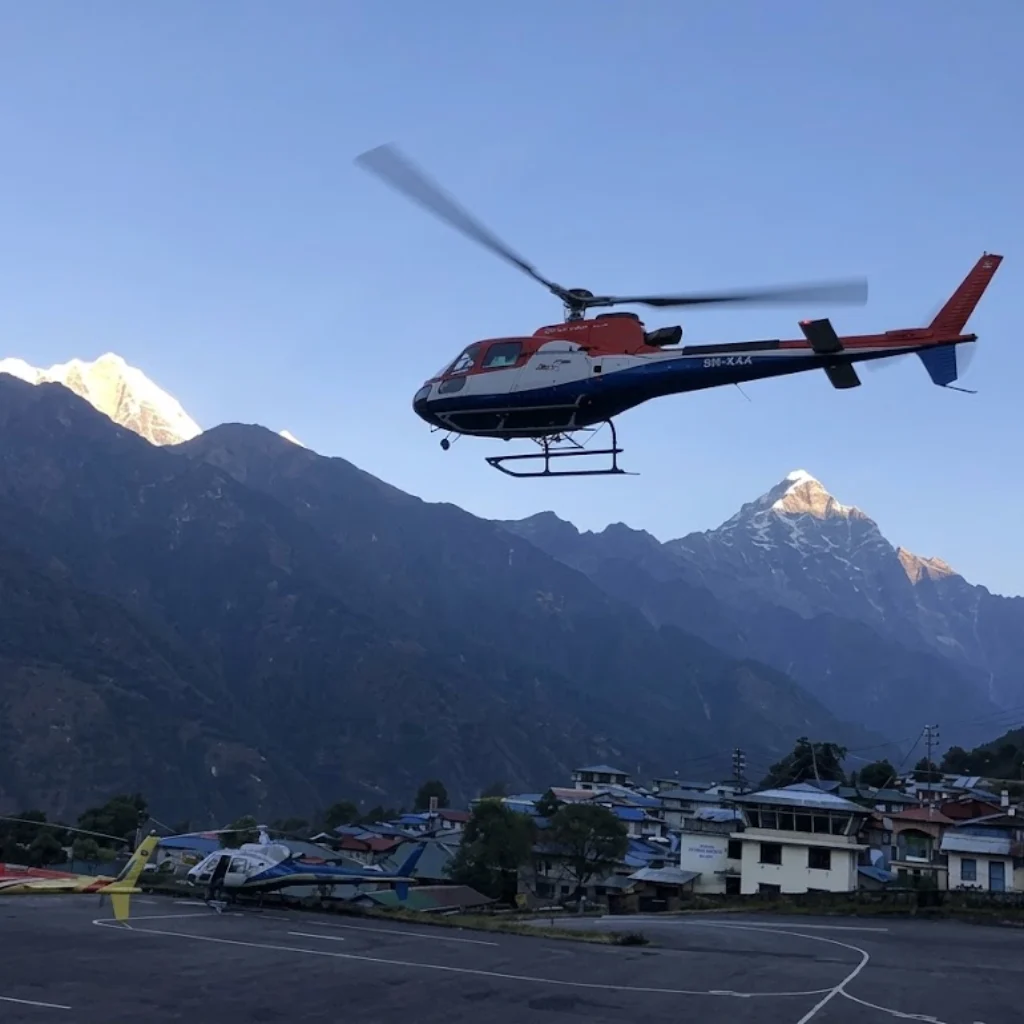
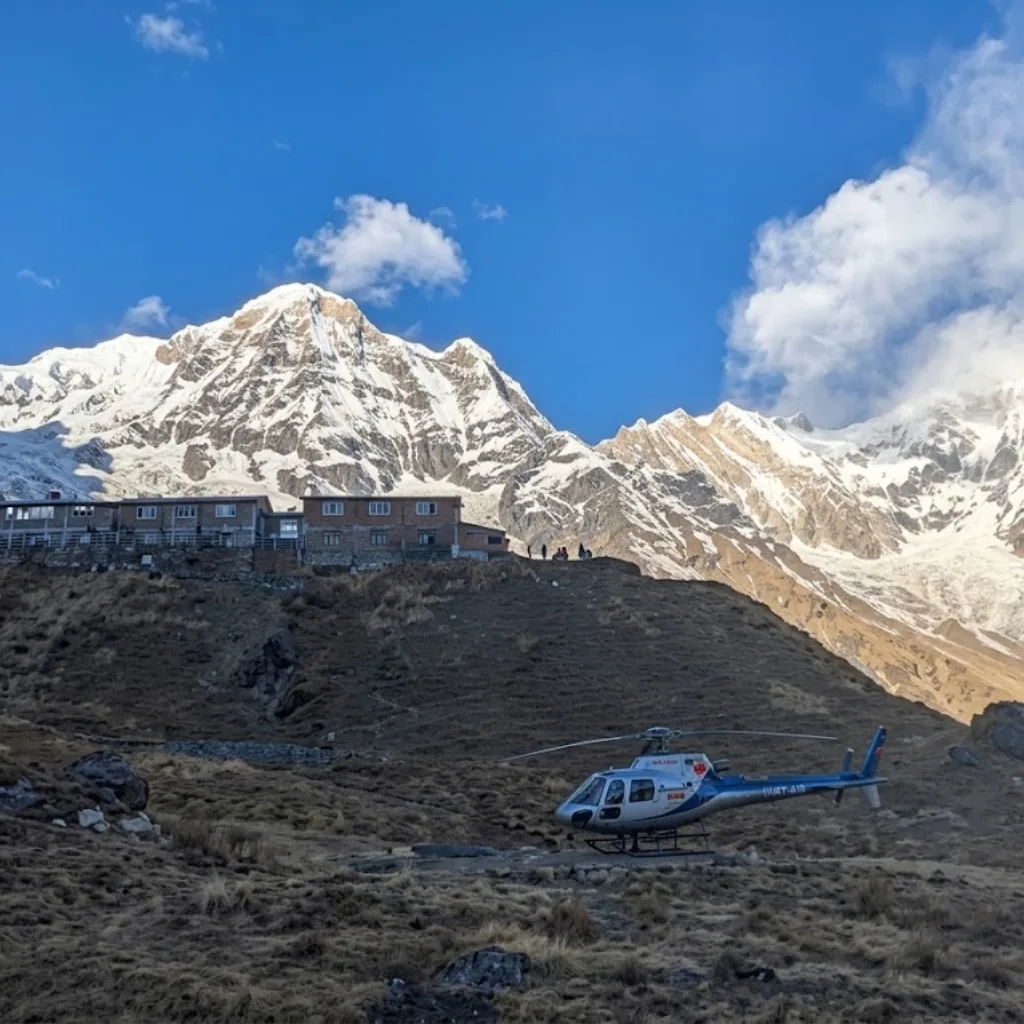
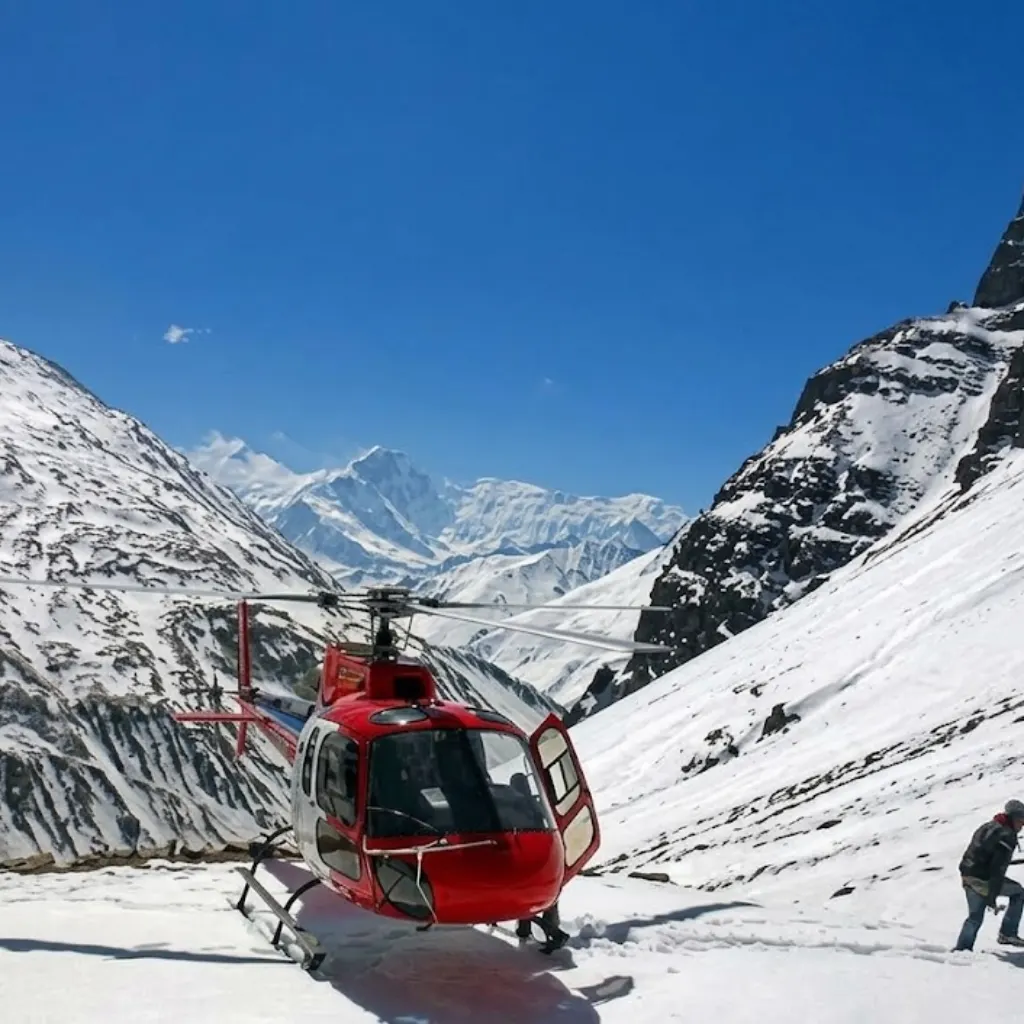
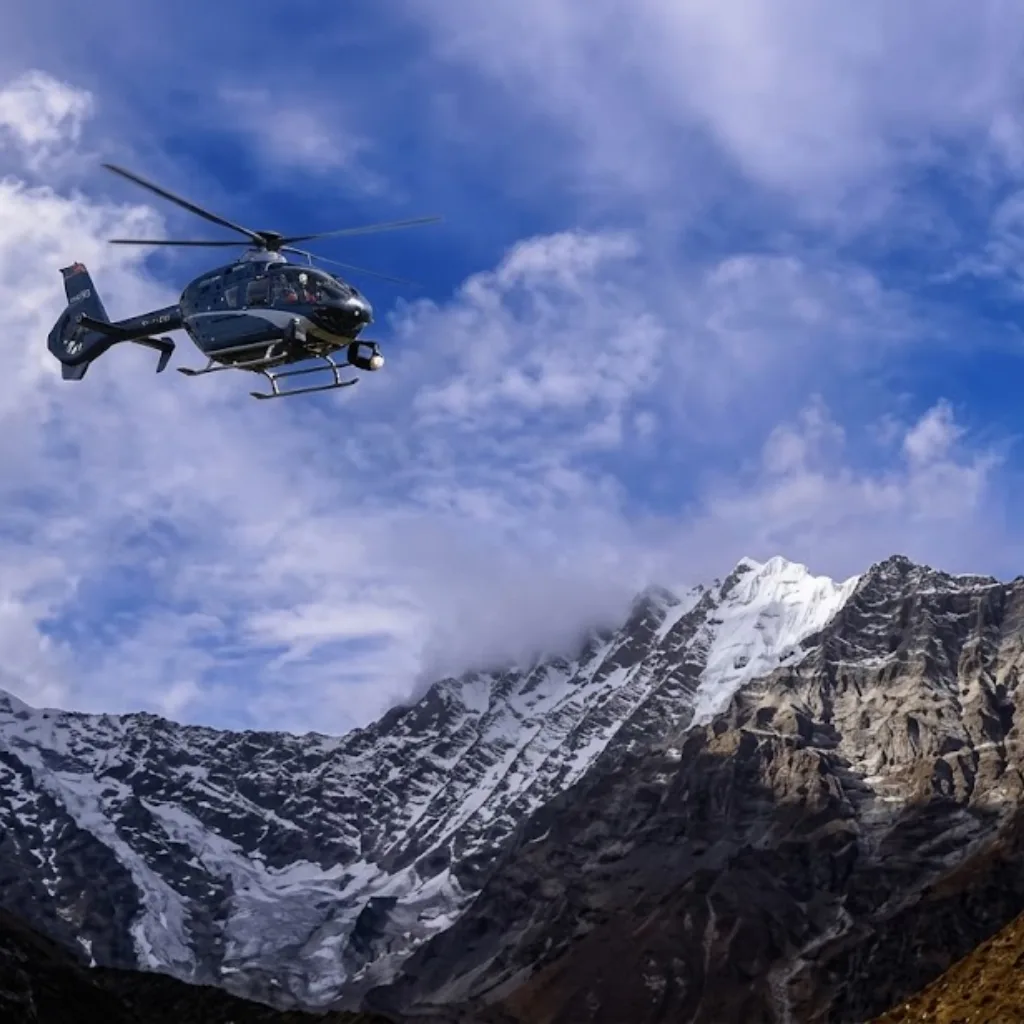
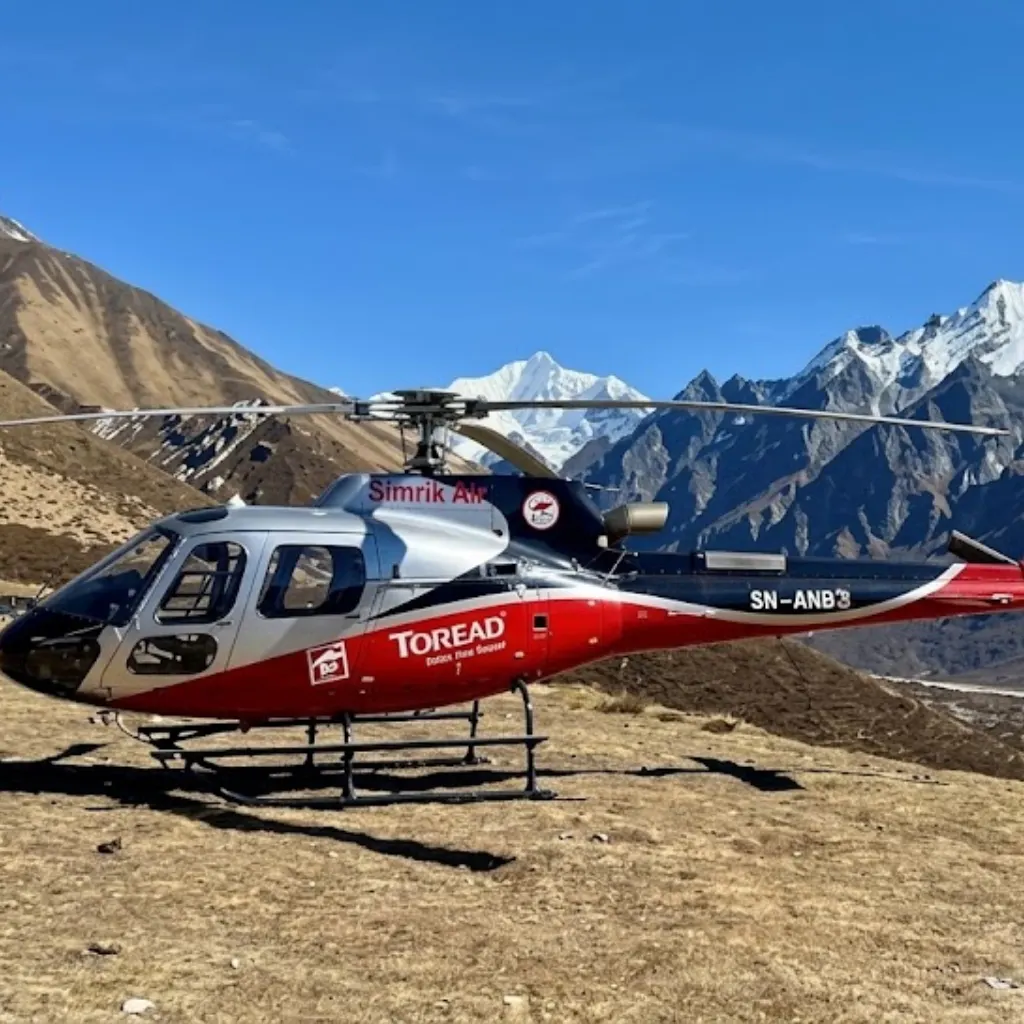
- The helicopter returned from Kyanjin Gompa: approximately 40–50 minutes in the air over the valley you spent six days walking through, descending into Kathmandu on the same morning.
- Suspension bridges and river corridors: the physical rhythm of the trek — crossing the milky Langtang River again and again beneath green ridges.
- Full-service trekking with a licensed guide: permits arranged, tea-houses booked, meals provided, and a porter for every two trekkers carrying the main weight.
Langtang Valley Heli Return Trek Overview
The Langtang Valley Helicopter Return Trek is an 8-day walk in the Langtang region of Nepal that ends with the region’s best trick: after climbing the valley to Kyanjin Gompa (3,870 m / 12,697 ft) and taking an acclimatization viewpoint hike to Tserko Ri or Kyanjin Ri (up to about 4,985 m / 16,355 ft), you fly back to Kathmandu instead of retracing six days of downhill trail. It is graded moderate — long trekking days on a straightforward mountain trail, no technical ground — and it suits trekkers who want the classic Langtang Valley experience with a scenic helicopter exit.
The route runs from Kathmandu to Syabrubesi by private jeep, then on foot up the Langtang River through Lama Hotel, Langtang Village and Kyanjin Gompa, the elegant Tamang and Tibetan-influenced heart of the valley with its monastery and cheese factory. A viewpoint day explores the ridges above Kyanjin, and on the final mountain day a one-way shared helicopter lifts you from the upper valley straight back to Kathmandu — a flight over the glaciers, forests and settlements you spent six days walking through.
With Nepal Lion Tours, the package starts from USD 1,805 per person on the Standard tier (5% off the USD 1,900 list price) or USD 2,437 per person on the Luxury tier, with group discounts at every level. It includes two nights in a 4-star Kathmandu hotel, the private jeep transfer, the shared helicopter return, a government-licensed English-speaking guide, porter support at one porter per two trekkers, teahouse lodging, three meals a day on trek, the Langtang National Park permit and TIMS card, and the emergency-coordination support of a local team at +977-9851039020.
What Makes the Langtang Valley Heli Return Trek Special?
The helicopter return is the headline — walking all the way in, then flying out — but the valley itself is the reason the walk is worth it. Langtang is the closest big Himalayan valley to Kathmandu, a day’s drive along the Trisuli road, yet it delivers the full high-altitude sequence: dense oak, rhododendron and pine forest on the lower trail, the dramatic upper valley beneath Langtang Lirung (7,227 m / 23,711 ft) and its glaciers, and the golden Gurung-and-Tamang settlements that have hosted trekkers for decades. On the final morning the helicopter converts the scenery you walked through into one last aerial panorama, and lands you in Kathmandu in time for a proper evening in the city.
Why Choose the Langtang Valley Heli Return Trek?
Most trekkers choose it for the same two reasons: the exit and the altitude math. Walking out of Langtang turns an 8-day trip into a 13-day trip or a full-loop marathon; the helicopter converts the return into a single shared flight, which suits trekkers with fixed dates, families, and anyone who finds downhill retracing boring or hard on the knees. The package also bundles everything — permits, transfers, guide, porter, accommodation, the helicopter itself — into one price, so the classic Langtang route plus a scenic exit ends up simpler to book and manage than stitching the pieces together yourself.
Who Is This Trek Suitable For?
- First-timers to Nepali mountain trekking who want a managed route with a guide, porter support and full hospitality included.
- Trekkers with fixed dates or an international flight to catch — the helicopter removes the multi-day walk-out uncertainty and returns you to Kathmandu on the final trek day.
- Families and older trekkers of good fitness who want a classic valley route without the long descent at the end.
- Photographers and mountain-lovers chasing Langtang Lirung, Dorje Lakpa and the great glaciers, plus the aerial pass on the way home.
- Travellers short on leave who want a full Himalayan valley experience in eight days rather than two weeks.
- Trekkers pairing Langtang with other Nepal travel — Gosaikunda, a Poon Hill trek, or Kathmandu sightseeing afterwards.
- Solo walkers and couples who prefer a licensed guide and porter system over arranging permits and logistics alone.
- Anyone who likes a comfortable exit — hotel nights at both ends, a jeep to the trailhead, and a helicopter home.
A reasonable general fitness is all that is required — no technical climbing skill, no ice experience. Consecutive 4–7-hour walking days at altitude are the real preparation, and the guide manages the pace for you.
Guide’s Note — Nepal Lion Tours — From our experience running Langtang departures, the helicopter return is what trekkers remember long after the walking days blur: the aircraft climbs past the ridges of Tserko Ri and the valley opens like a map beneath the skids, then Kathmandu appears out of the green hills. We book the shared return for the morning after the viewpoint day so trekkers walk into the helipad calmly, and we recommend keeping the camera genuinely ready from take-off — the glacial section is gone in minutes. — Nepal Lion Tours
Quick Facts
Langtang Valley Heli Return Trek at a Glance
| Tour Fact | Details |
|---|---|
| Tour Name | Langtang Valley Helicopter Return Trek |
| Duration | 8 days / 7 nights |
| Region | Langtang, Bagmati, Nepal |
| Maximum Altitude | 4,985 m / 16,355 ft at Tserko Ri (viewpoint option) |
| Difficulty | Moderate |
| Main Highlight | The Langtang Valley by trail, then a helicopter flight back from Kyanjin Gompa |
| Start / End | Kathmandu to Kathmandu |
| Route | Kathmandu – Syabrubesi – Lama Hotel – Langtang Village – Kyanjin Gompa – Kathmandu (heli) |
| Typical Walking | 4–7 hours per trek day |
| Best Season | Spring (March–May) and Autumn (October–November) |
| Price From | USD 1,805 per person |
| Accommodation | Teahouse lodges; 2 nights in a 4-star hotel in Kathmandu |
| Meals | Daily breakfast, lunch and dinner on the trek; breakfast in Kathmandu |
| Guide | Licensed English-speaking trekking guide; porter for every two trekkers |
Langtang Valley Heli Return Trek Route and Elevation
The itinerary is a straight line up a valley with a flying finish. After a relaxed first day in Kathmandu and a long scenic jeep day to Syabrubesi (1,550 m / 5,085 ft), the trail climbs gently alongside the Langtang River through forest to Lama Hotel (2,470 m / 8,104 ft), then up through the broadening valley to Langtang Village (3,430 m / 11,253 ft) and the head of the trail at Kyanjin Gompa (3,870 m / 12,697 ft). A viewpoint day lifts to the Tserko Ri/Kyanjin Ri ridges before the shared helicopter takes over for the return to Kathmandu — turning what would be a multi-day walk-out into a single morning flight.
Route at a Glance
| Day | Route | Altitude | Highlights |
|---|---|---|---|
| Day 1 | Arrive Kathmandu | 1,400 m / 4,593 ft | Airport pickup, hotel, trek briefing in the capital |
| Day 2 | Drive Kathmandu → Syabrubesi | 1,400 → 1,550 m | 7–8-hour scenic jeep ride through green hills and villages |
| Day 3 | Trek Syabrubesi → Lama Hotel | 1,550 → 2,470 m | Forest trail, suspension bridges, the Langtang River |
| Day 4 | Trek Lama Hotel → Langtang Village | 2,470 → 3,430 m | Forest thinning, yak grazing, first big-valley views |
| Day 5 | Trek Langtang Village → Kyanjin Gompa | 3,430 → 3,870 m | Cheese factory, monastery, the valley’s alpine heart |
| Day 6 | Acclimatization: Tserko Ri or Kyanjin Ri | 3,870 → ~4,985 m | Panorama viewpoint hike, glaciers and giant peaks |
| Day 7 | Helicopter Kyanjin Gompa → Kathmandu | 3,870 → 1,400 m | Scenic shared flight home; hotel in the capital |
| Day 8 | Depart Kathmandu | 1,400 m / 4,593 ft | Airport transfer and international departure |
Elevation Profile
The profile is a slow staircase up and a fast elevator down. From the Kathmandu Valley at 1,400 m the road climbs into the hills to a trailhead at 1,550 m, then the walking day-by-day adds roughly 500–900 m a day up to the Kyanjin plateau at 3,870 m — a gentle gradient you feel in the air but rarely in the legs, because the Langtang trail gains height gradually through a valley floor rather than over a pass. The one real altitude day is the viewpoint excursion, which climbs more than 1,000 m from Kyanjin toward the Tserko Ri ridges before returning to sleep at the plateau. Physically the design is deliberate: sleep low, climb high, and let the helicopter complete the descent while you watch. Nepal Lion Tours provides a full route map and elevation profile with your trek materials.
How to Get to the Langtang Valley Heli Return Trek
The trek is road-based from Kathmandu — one of the great practical advantages of Langtang, which needs no flight leg and no weather-dependent approach. The package’s own transfers handle the entire route: airport pickup on arrival, the private jeep to the trailhead, and the helicopter back, so trekkers only ever “get there” once, on Day 2, in a comfortable 4x4.
The Kathmandu to Syabrubesi Transfer: Private Jeep or Bus?
| Option | Approx. Travel Time | Best For |
|---|---|---|
| Private jeep (this package) | 7–8 hours, 123 km | Comfort, stops on demand, no luggage juggling |
| Tourist bus | 7–9 hours | Budget travellers arranging the trek independently |
The package uses a private jeep or vehicle for the whole 123 km of mountain highway, with the driver stopping for lunch and photo breaks and the guide sharing the day. The road runs via Trisuli Bazaar and the Pasang Lhamu Highway, following river valleys through terraced farmland and forested hills; it is scenic all the way, and rough in places — bumpy in the wet season, when landslide repairs are common, so travel in season and let the jeep do the work.
The Departure-Day Routine
Day 2 begins after breakfast in Kathmandu, usually around 7–8 a.m. The guide confirms the pick-up time and the roadheads in the briefing the evening before. Plan for the drive to fill most of the day — 7–8 hours with stops — and the first trek day starts fresh at Syabrubesi the next morning. The same guide stays with the group throughout, and the porter’s load is set at the teahouse in Syabrubesi.
Guide’s Note — Nepal Lion Tours — From our experience with this specific package, the trickiest part of the whole trek is saving energy on Day 2: the jeep ride is long, the villages are tempting, and trekkers who skip hydration on the highway pay for it on the Day 3 climb. We advise treating the drive as a rest day with scenery — arrive at Syabrubesi, eat well, sleep early, and let the forest do the talking from the morning. — Nepal Lion Tours
Returning to Kathmandu After the Helicopter
The shared helicopter from Kyanjin Gompa lands the group back at the Kathmandu helipad late on Day 7, and the included transfer takes you to the hotel for a proper evening — shower, dinner and sleep after the altitude come-down. Because the helicopter flies in the morning window and the flight itself is short, trekkers are normally off the mountain and in the city by early afternoon, with Day 8 free for a slow breakfast and the airport run.
A Practical Tip for International Travellers
Book your international departure for the day after the trek ends — the helicopter lands you in Kathmandu on Day 7, and a same-evening international connection is possible but tight if the morning window shifts. The natural way to run this trip is to arrive a day early (the package’s Day 1), trek, fly home on Day 7, and depart internationally on Day 8, which is exactly how the itinerary is built.
Langtang Valley Heli Return Trek Difficulty, Fitness & Altitude
The trek is graded moderate, and the honest version is that Langtang is easier on joints than the Kathmandu-to-everywhere alternatives because it is a valley-following trail with a gradual gradient — but it is still a mountain trek: consecutive 4–7-hour walking days, altitude up to about 4,985 m on the viewpoint day, and trail that is rocky, rooted and occasionally steep in the forest sections. Nothing is technical, but the daily rhythm and the height do the grading, and a guide-led pace is the difference between a holiday and a climb.
Where the Effort Actually Is?
The genuinely demanding moments are the long forest day from Syabrubesi to Lama Hotel (6–7 hours), which is steeper and warmer in the lower trail than trekkers expect; the climb out of the forest toward Langtang Village, where the valley opens and the altitude is unmistakable; and the viewpoint day, which rises from 3,870 m toward 4,985 m and back — the one day where the height, not the gradient, is the challenge. The drive day, the Kyanjin-to-Kathmandu flight and the hotel days carry almost no physical load, which is precisely what makes the package moderate overall.
How to Prepare for the Trek
- Walk 4–6 hours with a daypack on consecutive days before you travel, including hills and stairs.
- Build comfortable leg strength — the Day 3–4 climbs reward quadriceps and a steady rhythm.
- Practise gentle uphill pacing — Langtang rewards patience far more than speed.
- Take one or two longer outings with the boots you’ll wear — break them in properly.
- Prepare for the viewpoint-day altitude — walk slowly, hydrate heavily, and trust the guide’s pace from 3,870 m up.
- Avoid overtraining in the final week — arrive rested; the acclimatization day is part of the plan, not a bonus.
How Does This Trek Compare with Longer Langtang Routes?
Against the classic Langtang Valley Trekking (11 days, walk both ways), this package is two things: shorter, because the helicopter compresses the return; and comparable on trail, because the walking section is identical until the flight. Against the Tserko Ri viewpoint treks it adds the acclimatization day on the same ridges and then removes the walk-out entirely. The result is the full valley experience with about four days of the average itinerary handed back to your schedule — the standard trade this package exists to make.
Altitude, Acclimatization & Safety
Langtang Valley Heli Return Trek Altitude Profile
- Kathmandu — 1,400 m / 4,593 ft: arrival and return base; no altitude consideration.
- Syabrubesi — 1,550 m / 5,085 ft: trailhead at the park boundary; a comfortable first night.
- Lama Hotel — 2,470 m / 8,104 ft: forested river stop; height is building but still mild.
- Langtang Village — 3,430 m / 11,253 ft: the big step — sleep here and the altitude becomes real.
- Kyanjin Gompa — 3,870 m / 12,697 ft: the two-night high point of the trek; full acclimatization takes hold.
- Tserko Ri / Kyanjin Ri — about 4,985 m / 16,355 ft: the viewpoint apex, climbed high and slept low.
How the Body Adapts to Altitude
The itinerary is built around the standard mountain rule — climb high, sleep low. The gradual valley gradient gives six days to acclimatize before the 3,870 m plateau, the viewpoint day pushes to 4,985 m and returns to sleep at Kyanjin, and the helicopter converts the descent into a single flight. The practical advice is unchanged from every mountain: keep a conservative pace, drink more than you think you need, eat well at the teahouses, and tell the guide about any symptom rather than working through it.
Symptoms of Altitude Sickness to Watch For
Watch for the mild signals of altitude — headache, loss of appetite, mild nausea, unusual tiredness, disturbed sleep — which most trekkers feel to some degree at Kyanjin and usually manage with rest and fluids. The more concerning symptoms are persistent vomiting, a severe headache that medicines don’t ease, confusion, clumsiness or breathlessness at rest, and any fluid on the lungs; any of these is the signal to descend immediately and inform the guide. Altitude sickness deserves respect but not fear — the protocol is simply stop, descend, and communicate.
How Nepal Lion Tours Supports Your Safety
- Licensed, government-registered trekking guide with practical Langtang route knowledge, present every trek day.
- Gradual valley profile with a sleep-at-3,870 m structure — no sleeping above the plateau, and the viewpoint day is exactly the climb-high-sleep-low rhythm.
- The helicopter returns itself — shortening high-altitude exposure on descent and giving trekkers a comfortable, fast exit.
- First-aid kit including an Aarogya PC-303 vital-signs monitor carried by the guide for on-trail monitoring.
- Emergency evacuation coordination — the guide and base team arrange evacuation when needed, with the costs covered by your travel insurance as the package specifies.
Guide’s Note — Nepal Lion Tours — In our experience the hardest hour of the whole Langtang Heli Return Trek is the final push on the viewpoint ridge, and it is over sooner than trekkers expect: the switchbacks above Kyanjin reward you with the full valley in one glance, and the descent back to 3,870 m restores the energy the summit stretch takes. The altitude protocol we run on this trek is deliberate — sleep low at Kyanjin, climb high in the morning, and treat symptoms like a signal rather than a test of will — and our guides pace the ridgeline so everyone reaches the top together. — Nepal Lion Tours
Best Time to Take the Langtang Valley Heli Return Trek
The package’s official season is spring–autumn, and both windows are excellent for Langtang. Autumn (October–November) brings the clearest skies of the year, stable mornings and the best mountain visibility; spring (March–May) offers warmer days, the rhododendron flowering in the lower forest, and only slightly more haze. The valley trek itself runs year-round in practice — teahouses stay open through winter — but the helicopter return and the viewpoint day both reward the stable weather windows.
| Season | Months | Weather & Trail Conditions | Mountain Views | Overall |
|---|---|---|---|---|
| Autumn | Oct–Nov | Stable, dry, clear mornings; busy but manageable trails | Excellent | Best overall |
| Spring | Mar–May | Warm days, rhododendrons, some late haze | Very good | Highly recommended |
| Winter | Dec–Feb | Cold nights, clear days, snow possible at Kyanjin and above | Good on clear days | Good with preparation |
| Monsoon | Jun–Aug | Wet trails, low cloud, landslide risk on the Syabrubesi road | Frequently limited | Less suitable |
Autumn — September to November
Autumn is Langtang’s flagship season. October and November give the driest days and the steadiest flying mornings, so the helicopter window from Kyanjin is at its most reliable and Tserko Ri’s panorama of Langtang Lirung and the Tibetan border peaks is at its sharpest. Expect busier teahouses — reserve early and book the helicopter window with your trek date confirmed.
Spring — March to May
Spring is the strong second season: the forested lower trail blazes with rhododendrons, the valley warms quickly, and the mornings remain clear. The only trade is a little afternoon haze in the valley and more water on the trail in May. It is the gentlest season for first-time trekkers, with comfortable walking temperatures from the first forest day to the Kyanjin plateau.
Winter — December to February
Winter treks on cold, crisp days with snow possible from Langtang Village upward and serious cold at Kyanjin. The views are often superb, the trails are quiet, and the helicopter still flies on clear mornings — but trekkers need real winter kit, a flexible schedule, and comfort with frozen teahouse mornings. Good with preparation, and best for experienced cold-weather walkers.
Monsoon — June to August
Monsoon is the least reliable season for Langtang: the trails are wet, leeches appear in the forest, low cloud limits the viewpoint day, and the Syabrubesi road can suffer landslide damage. The helicopter return becomes morning-window-dependent. It is trekkable for flexible travellers with waterproof gear, but it is not the season this package is built around.
Which Season Should You Choose?
Choose autumn for the most reliable views, flying windows and overall comfort; choose spring for colour and warmth; pick winter only with proper cold-weather experience and slack in your dates. Whenever you go, book the helicopter-backed return with your preferred lanes early — the shared seats sell out in the favoured months — and keep a day of margin before any fixed international departure.
Guide’s Note — Nepal Lion Tours — On clear autumn mornings the upper Langtang valley performs like clockwork: the mist sits in the forest below Kyanjin while the ridges above 4,000 m stand out, and the helicopter window from the plateau is usually open by mid-morning. In our experience the camera comes out twice — at the cheese-factory slopes for Langtang Lirung, and again from the aircraft door the next morning. — Nepal Lion Tours
Langtang Valley Heli Return Trek Permits & Regulations
The trek enters Langtang National Park, and the permit set is the standard Langtang pair: the Langtang National Park Entry Permit and a TIMS Card (Trekkers’ Information Management System) — required in Langtang, unlike the Khumbu where the municipality permit replaces it. Both are included in the package and arranged by Nepal Lion Tours as pre-trek paperwork, so trekkers carry originals on the trail and pay nothing extra at the entry checkpoints.
Langtang Permits at a Glance
| Requirement | Who Needs It? | Who Arranges It? |
|---|---|---|
| Langtang National Park Entry Permit | Foreign and SAARC trekkers entering the park | Nepal Lion Tours |
| TIMS Card (Trekkers’ Information Management System) | Trekkers in Langtang | Nepal Lion Tours |
| Restricted-area permit | Not required on this route | — |
| Original passport | All trekkers, for permit registration and checks | Traveller carries |
Langtang National Park Entry Permit
The Langtang National Park Entry Permit is the primary entry document for the valley, currently NPR 3,000 for foreign trekkers / NPR 1,500 for SAARC / NPR 100 for Nepali nationals — a one-time entry, valid for the whole trek. It is issued through authorized channels and Nepal Lion Tours arranges it for every trekker before the trip; the original permit and passport travel with you and are checked at the park entrance near Syabrubesi.
TIMS Card
The TIMS Card is the trekker registration for Langtang, currently around NPR 2,000 for solo foreign trekkers / NPR 1,000 for group-agency trekkers / NPR 1,000 for SAARC — Nepal Lion Tours processes it within the standard guide-led paperwork, so the walk-in is fully registered before Day 3. TIMS exists so every trekker has a recorded itinerary and emergency contact; the guide also holds the trail-side details. (Unlike the Khumbu, where a municipality permit replaces TIMS, Langtang keeps the classic TIMS system — “where applicable” in the inclusions simply reflects this region.)
Do You Need a Restricted-Area Permit?
No. The Langtang Valley route through Syabrubesi, Lama Hotel, Langtang Village and Kyanjin Gompa is a national park trail, not a restricted area, so no special-area permit applies. Trekkers who extend toward Gosaikunda or the higher side valleys stay within manageable permit territory as part of longer itineraries; for this 8-day valley-and-heli package, the two permits above are the complete set.
Who Arranges the Permits?
Nepal Lion Tours arranges the Langtang National Park Entry Permit and TIMS card for every trekker as part of pre-trek preparation, against your passport details, and delivers the documents before the drive to Syabrubesi. Carry the original passport on the trail — registration rules require it — and note that government fees and rules can be revised, so confirm the current figures with the team at booking.
Food & Accommodation on the Langtang Valley Heli Return Trek
The food and lodging on this trek are the comforting, well-run teahouse system that Langtang is known for, topped and tailed by two nights in a 4-star hotel in Kathmandu with daily breakfast. The guide coordinates every meal stop and overnight, and the porter keeps the main bags moving between teahouses.
Teahouse Accommodation on the Trek
- Twin-sharing rooms in the best-available deluxe teahouses throughout the route — the standard Langtang arrangement.
- Shared or private bathrooms depending on the lodge and the village; Syabrubesi and Kyanjin are the better-equipped stops.
- Hot showers are usually available at a small fee, almost always at the bigger villages.
- Dining rooms with wood or yak-dung stoves — the warm heart of every teahouse evening.
- Electricity for charging in most lodges, at a small fee in smaller villages; carry a power bank.
- Wi-Fi at some lodges, primarily Kyanjin and Syabrubesi; treat the trail as a digital break elsewhere.
- Blankets and basic bedding provided, with a sleeping bag liner recommended for warmth and comfort.
What Food Is Available on the Trek?
The Langtang menu is the classic Nepali trek roster with a Tibetan accent: dal bhat (the energising staple, and the answer to most trekking days), momos, noodle soups, fried rice, pasta dishes, potato preparations, eggs, porridge, pancakes and toast. Langtang also does dairy — the Kyanjin cheese factory’s yak cheese is a genuine highlight, fresh at the source. Vegetarian food is widely available, and trekkers with vegan, gluten-free or allergy needs should tell Nepal Lion Tours in advance so the lodges and meal planning adapt. Fresh seasonal fruit is included during the trek, a small luxury between teahouses.
What’s Included vs Usually Paid Separately
| Included in the Trek Package | Usually Paid Separately |
|---|---|
| Three daily meals on the trek (breakfast, lunch, dinner) | Lunch and dinner in Kathmandu |
| Breakfast in Kathmandu at the 4-star hotel | Drinks, bottled water, snacks beyond the meals included |
| Welcome/farewell dinner at a cultural restaurant | Hot showers, Wi-Fi, battery charging fees |
| All teahouse overnight stays, twin-sharing | Laundry and personal expenses |
| Guide, porter and their full costs | Tips for guides, porters and helicopter crew |
| Permits, transfers, the shared helicopter return | Additional Kathmandu nights from weather delays |
| Fresh fruit during the trek | Evacuation or rescue costs outside the included coordination |
Nepal Lion Tours confirms the exact inclusion detail at booking; the departures block above reflects the package’s published lists in full.
Drinking Water on the Trek
Do not assume tap water is safe — the standard mountain practice applies all the way to Kyanjin: buy boiled or bottled water at the teahouses, or treat your own with a filter or purification tablets in a reusable bottle. Tea and hot drinks are always available and always a good call at altitude. Drink regularly through every walking day — thirst is the first thing trekkers miss — and reducing single-use plastic by refilling from lodge boilers is both a health and a courtesy win.
Staying Comfortable at the Teahouses
Carry a reusable bottle, a sleeping bag liner (or the NLT sleeping bag), a power bank, small-note cash, your layer system, and any dietary notice for the guide. Evening routine matters more than the day at altitude: eat properly, drink fluids, charge what you need, and sleep early — the Kyanjin cold is honest, and the helicopter morning rewards rest.
Why Book with Nepal Lion Tours?
This package bundles the classic Langtang walk with a helicopter exit, and Nepal Lion Tours brings everything to it that it brings to its longer routes: an operator you can verify, people you can contact, and logistics that hold together across the weather of an 8-day trip.
- Local, licensed English-speaking guides — government-licensed professionals with genuine Langtang route knowledge, on the trail with you from Syabrubesi to Kyanjin Gompa.
- A registered trekking company you can verify — located in Kathmandu with company and licence details available on request, so your booking is with a real Nepali operator, not a forwarding desk.
- Private departures from two trekkers — your own dates, your own pace, and a guide-porter team sized to your group.
- The itinerary feature that stands out — a walking-in, flying-out Langtang — the full valley by trail plus a shared helicopter return from Kyanjin Gompa, the package’s signature combination.
- Straightforward end-to-end transfers — a private jeep to the trailhead, a helicopter home, airport pickups and hotel nights both ends, all inside one booking.
- Budget-friendly pricing without removing the core — from USD 1,805 with group discounts, with permits, guide, porter, meals, hotels, transfers and the flight all inside the price — not stacked on as extras.
- A local team contactable before, during and after — WhatsApp +977-9851039020 from booking through the helicopter landing, with emergency-coordination muscle behind the crew.
Book the Langtang Valley Heli Return Trek
Eight days. One valley. One unforgettable flight home. The Langtang Valley Heli Return Trek gives you the gentle classic climbing trail, the Kyanjin cheese days, the ridge-top viewpoint morning — and then the helicopter does your walking for you, straight back to Kathmandu. Book the Standard tier for the full package experience, upgrade to Luxury for an upgraded Kathmandu stay, and hold your dates with a team that answers.
Langtang Valley Heli Return Trek Pricing at a Glance
| Tier | 1 Pax | 2–4 Pax | 5–9 Pax | 10+ Pax |
|---|---|---|---|---|
| Standard | USD 1,805 | USD 1,715 | USD 1,625 | USD 1,534 |
| Luxury | USD 2,437 | USD 2,315 | USD 2,193 | USD 2,071 |
- Duration: 8 days / 7 nights, with 4 trekking days, a viewpoint day and the helicopter return.
- Price: from USD 1,805 per person (Standard, 5% off the USD 1,900 list price); Luxury from USD 2,437 per person. Group discounts apply at every tier.
- Difficulty: moderate — 4–7 walking hours per day on a non-technical valley trail.
- Maximum altitude: 4,985 m / 16,355 ft at Tserko Ri (viewpoint option).
- Accommodation: deluxe teahouses twin-sharing; two nights 4-star hotel in Kathmandu.
- Meals: breakfast, lunch and dinner on the trek; breakfast in Kathmandu; welcome/farewell dinner.
- Permits: Langtang National Park Entry Permit and TIMS card, arranged by Nepal Lion Tours.
- Transportation: airport transfers, private jeep to Syabrubesi, shared helicopter Kyanjin Gompa → Kathmandu.
- Cancellation: free cancellation up to 14 days before departure, subject to booking terms.
Ready to Start Your Langtang Adventure?
Send us your preferred dates and group size through the booking form or WhatsApp at +977-9851039020, and we will confirm the teahouses, the permit paperwork and the helicopter window for your departure. Whether you’re a first-time trekker, a couple chasing Langtang Lirung, a family giving Kathmandu a flying finish, or a group holding international connections, we’ll prepare the trail and the return to match. The cheese factory, the ridge-top viewpoints and your helicopter home are waiting — choose your dates and start planning today.
Related Langtang Region Treks
Langtang is one of the most accessible Himalayan valleys from Kathmandu, and these packages pair naturally with the valley-and-helicopter rhythm of this trek.
| Trek | Duration | Difficulty | Max Altitude | Best For |
|---|---|---|---|---|
| Langtang Valley View Trek | 5–6 days | Easy–Moderate | 3,870 m (Kyanjin option) | A short road-access taste of the valley |
| Short Tamang Heritage Trail | 7 days | Easy–Moderate | 3,160 m (Nagthali) | Culture-first Tamang villages at lower elevation |
| Langtang And Tserko Ri View Treks | 8 days | Moderate | 4,985 m | The valley trek with the summit viewpoint |
| Langtang Valley Trekking | 11 days | Moderate | 3,870 m | The classic full valley, walked both ways |
| Langtang Gosainkunda & Helambu Round Trek | 16 days | Moderate–Challenging | 4,610 m | The full Langtang–Gosainkunda–Helambu loop |
The helicopter-return trek is the fastest full-valley option in the Langtang line-up, and it combines naturally with Gosaikunda extensions for fit trekkers, with a Ghorepani Poon Hill trek via Kathmandu, or with city sightseeing around the capital — each combination making excellent use of the extra days the flying return saves you.
Trip Essentials
Packing advice, required equipment & gear recommendations
Essential
Pack for a mountain valley that ranges from warm forest at 1,500 m to cold clear air at nearly 5,000 m on the viewpoint day — and for a helicopter ride out. Nepal Lion Tours provides the down jacket, sleeping bag, duffel bag and trekking map, so your own list focuses on personal warmth, comfort and documentation.
Hiking Gear
- Sturdy, broken-in trekking boots with ankle support for the rocky forest trail.
- Trekking poles — genuinely useful on the long Days 3 and 4 climbs and the viewpoint descent.
- A quality daypack — water, layers, camera and documents carried by you.
- Water bottles or a hydration system — at least 1.5 litres when you set out.
- Water treatment or purification tablets (boiled water is available at every teahouse).
- Headlamp with spare batteries — for early starts, teahouse evenings and the viewpoint dawn.
- Small dry bag — to keep down gear and electronics dry on the walk.
Clothing: Layers for a Langtang Day
Base layers: light merino or synthetic tops — one set worn, one spare.
Mid-layers: a fleece or insulated jacket — the workhorse from Lama Hotel upward.
Outer layer: a waterproof/windproof shell for rain, snow and the morning breeze at Kyanjin.
Trekking clothes: two pairs of comfortable trousers, and shorts only for the warm lower trail.
Headwear and gloves: a warm beanie, sun hat and light gloves for the Kyanjin mornings — plus sunglasses for the brilliant high-valley light.
Sleeping and Evening Comfort
- Sleeping bag liner (or the NLT sleeping bag, which you can use along with the liner).
- A warm set of sleepwear or clean base layers for the night at Kyanjin.
- Earplugs if you are a light sleeper in shared walls.
- A small flask or cup for the evening tea ritual at the dining stove.
Toiletries and Personal Health Items
Soap, hand sanitizer and wet wipes; toothbrush and toothpaste; sunscreen with high SPF and lip balm — the solar glare at 4,000 m is fierce; moisturizer for dry mountain air; personal medication including any altitude-sensitive prescriptions; a small kit for blisters and minor cuts (the guide carries the fuller first-aid kit, including the vital-signs monitor); and any daily personal-care basics. Note that teahouse bathrooms are mostly shared and hot water costs extra.
Electronics
Your camera is the essential device for the Langtang Lirung mornings and the helicopter leg — keep it charged and within reach. A power bank covers the teahouse charging gaps; a phone with the NLT WhatsApp line handles confirmations and check-ins; and a small charger with the correct adapter works in the lodges. Solar is abundant but the lodge sockets are the practical source at village stops.
Documents and Money
Original passport (required for permit registration and checks), the permits arranged by Nepal Lion Tours, and your travel insurance details on paper or clearly on your phone. Cash in Nepali rupees in small denominations is essential — most teahouse purchases, hot showers, drinks and tips are cash-only — plus a card as backup for Kathmandu. Leave other valuables at the hotel.
How Much Should You Pack?
Aim for a trek pack of roughly 10–12 kg plus your daypack — the porter carries the main load, but the trail is long and the helicopter has its own baggage rules, so lighter is genuinely kinder to the journey. Keep your camera and layers accessible, your documents on your person, and your packing list disciplined: everything you carry, you carry up a valley and into an aircraft. Nepal Lion Tours’ provided duffel handles the volume; your personal daypack holds the day.
Read Before You Book
Permits, terms, medical considerations & advisory guidelines
Advisory
The Langtang Valley Heli Return Trek is generous with scenery and logistics, but a few points are worth absorbing before you book so the eight days run exactly as planned.
Accommodation and Facilities
Twin-sharing teahouse rooms are the standard on the trail, with shared bathrooms common and hot showers and charging metered at the smaller lodges. The two Kathmandu nights are in a 4-star hotel with breakfast — a comfortable bracket around the mountain days. Facilities thin out toward Kyanjin, so lodge-level expectations (hot water into a bucket, kettle-powered charging) are the right mindset.
Food and Dietary Requirements
The three trek meals are the reliable dal-bhat-momo-noodle roster with Langtang’s dairy bonus, and fresh fruits are included. Baked goods and bakery-style snacks appear at Syabrubesi and Kyanjin. Tell Nepal Lion Tours about vegan, gluten-free or allergy needs in advance so the guide’s meal planning and lodge communication adjust before the first dinner.
Altitude, Health and Insurance
The itinerary sleeps at 3,870 m and climbs near 4,985 m on the viewpoint day, so altitude awareness is genuine even though the gradient is gentle. Travel insurance covering high-altitude trekking and helicopter evacuation is mandatory — the package’s paid-for coordination and the helicopter return both presume you hold it. Confirm your policy’s altitude limits and exclusions before departure.
Money and Tipping
The package covers permits, guide, porter, transfers, hotels, trek meals and the helicopter; your money is for visas, lunches and dinners in Kathmandu, drinks and bottled water, hot showers, extras, and tips. Tipping at the standard Nepali rate — guides and porters at the customary daily amounts, adjusted to service — is a contribution to salaries that genuinely matter; the helicopter crew appreciate a modest gratuity too.
Culture and Responsible Trekking
- Photograph people with permission and respect — the Tamang and Tibetan-influenced villages are living communities, not scenery.
- Buy locally — the teahouses and shops season your walk; dal bhat at the village lodge beats imported snacks every time.
- Leave no trace — carry out wrappers, avoid single-use plastic where you can, and use lodge boilers for refills.
- Dress modestly in villages and monasteries and remove shoes at gompas.
- Support the famous cheese factory at Kyanjin — its yak cheese and dairy are the valley’s proudest products.
- Stay on the trail — the ford-and-bridge river crossings keep the fragile slopes intact.
Route Options
The core itinerary is fixed and short, but options exist for the ambitious: an extension toward Gosaikunda’s sacred lakes for trekkers with extra days, the Tserko Ri sunrise alternative for very early risers, and the Luxury tier for upgraded Kathmandu and lodge arrangements. The helicopter leg itself is one-way shared from Kyanjin Gompa — private charter and other pickup points are possible at extra cost on request.
Booking and Before You Arrive
Make sure you understand before you confirm: the exact inclusions and exclusions; the mandatory insurance requirement with helicopter-evacuation cover; the shared (not private) nature of the return flight; the teahouse facility level; the permit and TIMS arrangements; the altitude profile to nearly 5,000 m; the weather-hold behaviour of the helicopter window; and the free-cancellation rule of 14 days. A detailed trek briefing on Day 1 in Kathmandu covers the operational side, and the WhatsApp line stays live through the whole trip.
A Few Final Tips
Treat Day 2 as a rest day with scenery; eat the dal bhat; charge at every opportunity; walk slowly after 3,000 m. The viewpoint day is the physical peak — go gently, come down happy — and the helicopter morning is the reward: have the camera in your hand before take-off, because the glacial run to Kathmandu is over faster than any trekking day you spent earning it.
Day-by-Day Itinerary
Explore each day's route, trekking elevation, and activities
Morning
Arrive at Tribhuvan International Airport in Kathmandu, where our representative will welcome you and assist with your transfer to the hotel. After check-in, take time to settle in and recover from your international journey.
Midday
Enjoy a relaxed lunch and use the afternoon to rest or prepare your trekking equipment. You can also review your personal gear and make any final preparations before heading into the Langtang region.
Afternoon
Attend a detailed trek briefing covering the Langtang Valley route, trekking conditions, altitude awareness, safety procedures, and the planned helicopter return from Kyanjin Gompa.
Evening
Enjoy dinner at the hotel and have a restful evening. Staying well-rested before the trek helps you begin the journey comfortably and allows your body to adjust to Kathmandu’s altitude.
Morning
After breakfast, begin the scenic drive from Kathmandu toward Syabrubesi. The route gradually leaves the Kathmandu Valley and follows winding mountain roads through green hills and rural settlements.
Midday
Continue through terraced farmland, traditional villages, rivers, and forested hills. Stop along the way for lunch and enjoy the changing landscapes as you approach the Langtang region.
Afternoon
Resume the drive toward Syabrubesi, passing waterfalls, suspension bridges, and riverside settlements. The road becomes increasingly mountainous as you travel deeper into the Himalayan foothills.
Evening
Arrive in Syabrubesi and check into your teahouse. Enjoy dinner and prepare your trekking equipment for the following morning. Since the elevation remains relatively moderate, focus on hydration and a good night's rest.
Morning
After breakfast, begin trekking from Syabrubesi along the Langtang River. The trail enters forested terrain and gradually climbs through a peaceful landscape of oak, rhododendron, and pine trees.
Midday
Continue across suspension bridges and along the river valley, passing small settlements and teahouses. Stop for lunch along the trail before continuing deeper into Langtang National Park.
Afternoon
The trail becomes progressively steeper as you make your way toward Lama Hotel. The surrounding forest provides a peaceful trekking environment, with opportunities to see local wildlife and birds along the route.
Evening
Reach Lama Hotel and settle into your teahouse. Enjoy dinner and rest after the day's moderate uphill trekking. As elevation begins to increase, maintain a comfortable pace and stay well hydrated.
Morning
After breakfast, continue trekking through dense rhododendron and pine forests. The trail follows the Langtang River while gradually gaining elevation toward the upper valley.
Midday
As the forest begins to thin, the landscape opens into wider Himalayan valleys. Enjoy lunch along the route while taking in increasingly impressive views of Langtang Lirung and surrounding peaks.
Afternoon
Continue toward Langtang Village, passing yak grazing areas and traditional Tamang settlements. The scenery becomes more alpine as you approach the higher reaches of the valley.
Evening
Arrive at Langtang Village and check into your teahouse. Enjoy dinner and rest for the night. The increase in altitude may bring some fatigue, so a slow pace, hydration, and adequate rest are important.
Morning
After breakfast, leave Langtang Village and follow the trail deeper into the upper valley. The shorter trekking distance allows you to gain elevation gradually while enjoying the spectacular mountain scenery.
Midday
Continue through alpine landscapes with views of Langtang Lirung, surrounding glaciers, and snow-covered peaks. Stop for lunch along the route before continuing toward Kyanjin Gompa.
Afternoon
Reach Kyanjin Gompa, a beautiful Himalayan settlement surrounded by high peaks and glaciers. After settling into your teahouse, explore the area and visit the local cheese factory and historic monastery.
Evening
Enjoy dinner and spend a quiet evening at Kyanjin Gompa. Prepare for the following day's acclimatization hike and rest well before ascending to higher elevations.
Morning
After an early breakfast, begin your acclimatization hike toward Tserko Ri or Kyanjin Ri, depending on weather, trail conditions, and your guide's recommendation. The trail climbs steadily above Kyanjin Gompa.
Midday
Continue toward the viewpoint, taking regular breaks as the altitude increases. From the higher elevations, enjoy panoramic views of Langtang Lirung, Dorje Lakpa, glaciers, and the surrounding Himalayan peaks.
Afternoon
Descend carefully back toward Kyanjin Gompa after spending time at the viewpoint. The descent allows your body to recover after the high-altitude climb while still providing valuable acclimatization.
Evening
Return to the teahouse, enjoy dinner, and rest for the night. Drink plenty of fluids and allow your body to recover before the helicopter journey back to Kathmandu.
Morning
After breakfast, prepare for your helicopter departure from Kyanjin Gompa. The helicopter flight provides a spectacular aerial perspective of the Langtang Valley, glaciers, rivers, forests, and surrounding Himalayan peaks.
Midday
Fly from Kyanjin Gompa toward Kathmandu, enjoying panoramic views of the dramatic mountain landscape from above. The helicopter return avoids the need to retrace several days of downhill trekking.
Afternoon
Arrive in Kathmandu and transfer to your hotel. After checking in, take time to rest and recover following the high-altitude trekking experience.
Evening
Enjoy a relaxed dinner and a comfortable evening in Kathmandu. The rapid descent from the Langtang highlands to the Kathmandu Valley provides a significant change in altitude, allowing your body to recover from the mountain environment.
Morning
Enjoy your final breakfast at the hotel and prepare your luggage for departure. Depending on your flight schedule, you may have some free time before leaving for the airport.
Midday
Your representative will arrange a comfortable transfer from your hotel to Tribhuvan International Airport. Allow sufficient time for check-in, security procedures, and international departure formalities.
Afternoon
Complete your airport formalities and prepare for your flight home. If your departure is scheduled later in the day, additional free time in Kathmandu may be available.
Evening
Depart Kathmandu on your international flight, concluding your Langtang Valley trekking adventure with a scenic helicopter return from Kyanjin Gompa.
Want to customize this itinerary?
Tailor duration, lodges, acclimatization days, or add private helicopter flights.
Inclusions & Exclusions
Everything that is covered and what you'll need to budget separately
What is Included
Fully covered in your package price
- Pre-trek briefing in Kathmandu.
- Airport pick-up and drop-off services in Kathmandu.
- Two nights’ accommodation in a 4-star category hotel in Kathmandu on a twin-sharing basis, with daily breakfast included.
- Scenic overland transfer from Kathmandu to Syabrubesi by private jeep or vehicle.
- One-way shared helicopter flight from Kyanjin Gompa to Kathmandu.
- Experienced, government-licensed, English-speaking trekking guide.
- Porter service with one porter assigned for every two trekkers.
- Complete guide and porter expenses, including salaries, insurance, meals, accommodation, and required equipment.
- Twin-sharing accommodation in the best available deluxe teahouses or lodges throughout the trek.
- Three daily meals during the trek, including breakfast, lunch, and dinner.
- Fresh seasonal fruits during the trekking period.
- Langtang National Park entry permit.
- TIMS Card, where applicable.
- Support for acclimatization and exploration hikes to Kyanjin Ri or Tserko Ri viewpoints.
- First Aid Medical Kit carried by the guide, including an Aarogya PC-303 Portable Vital Signs Monitor.
- Government taxes and office service charges.
- Emergency evacuation coordination assistance, with evacuation expenses covered by the traveler’s travel insurance.
- Complimentary welcome or farewell dinner in Kathmandu at a cultural restaurant.
What is Excluded
Personal expenses & optional extras
- Nepal entry visa fee.
- International airfare to and from Nepal.
- Mandatory travel insurance, including coverage for high-altitude trekking, emergency medical treatment, and helicopter evacuation.
- Lunch and dinner in Kathmandu.
- Personal trekking equipment and clothing.
- Personal expenses such as laundry, Wi-Fi, battery charging, hot showers, telephone calls, and similar services.
- Alcoholic beverages, soft drinks, bottled water, and snacks not specified in the itinerary.
- Additional accommodation in Kathmandu caused by weather delays or itinerary changes.
- Tips and gratuities for guides, porters, and helicopter crew, which are optional but appreciated.
- Emergency evacuation or rescue expenses not covered by the standard package.
- Any other services, costs, or expenses not specifically listed under Package Includes.
Our Customer Reviews
Authentic experiences and feedback from our travelers
Write a Review
Share your adventure experience with other travelers
Thank You!
Your review has been submitted and is awaiting approval.
Please Wait
You've submitted several reviews recently. Please wait a few minutes before trying again.
Jonas Nilsson
The flight in was a highlight before the trip had even properly started. The weather changed completely at Lama Hotel, which made it feel like a different day. The guide made Suspension bridges and river corridors much more interesting with the background story. The guide gave us honest advice about what was worth doing and what was not. Good value overall.
Oliver Hansen
The flight in was a highlight before the trip had even properly started. I would recommend giving Take Time more time rather than less. We had read about The oak, rhododendron and pine forest trail, but seeing it in person was different. Having a fixed plan made the trip feel relaxed rather than rigid. I appreciated the small gestures, like remembering how we liked our tea. Bring more storage than you think you need.
Arthur O'Connor
There is something about being away from routine for a while that resets your perspective. There was a lot of uphill before Assist, but the descent afterwards was gentle. I took a hundred photos during The viewpoint day on Tserko Ri or Kyanjin Ri and kept about ten. The best parts were often the unplanned ones, like a longer stop for tea or an extra walk before dinner. I liked that the food was local rather than international hotel fare. Weather delayed us by a morning, but the team handled the change well. I would do the helicopter version again without hesitating.
Martin Bergstrom
We had limited time, so flying in and walking out was the perfect compromise. Langtang Village and its rebuild was a good reminder of why we booked this trip in the first place. Where Our Representative Will Welcome You was one of those places that made the long travel 8 feel worthwhile. The routes were adjusted sensibly around the weather. The quiet parts were just as important as the big views. The kitchen handled our dietary requests without any fuss. I appreciated the small gestures, like remembering how we liked our tea. I would bring a little more cash than we did for small snacks and drinks along the way. I liked that we stopped at places that were not on the main tourist route. A proper adventure. Tip: Download offline maps and a translation app before you leave.
Frequently Asked Questions
Essential information on preparation, route specifics, safety standards, and logistical details.