Lhasa Tour 6 Nights 7 Days | Nepal Lion Tours
Discover the spiritual heart of Tibet on a 6-night, 7-day journey through Lhasa’s ancient monasteries, sacred landmarks, rich Tibetan culture, and breathtaking Himalayan landscapes.
Lhasa Tour 6 Nights 7 Days

Tour Highlights
Seven days and roughly 810 km / 503 miles of Tibetan road, from the Potala Palace to the causeway of Yamdrok Lake — the fullest short circuit of central Tibet reachable from Nepal.
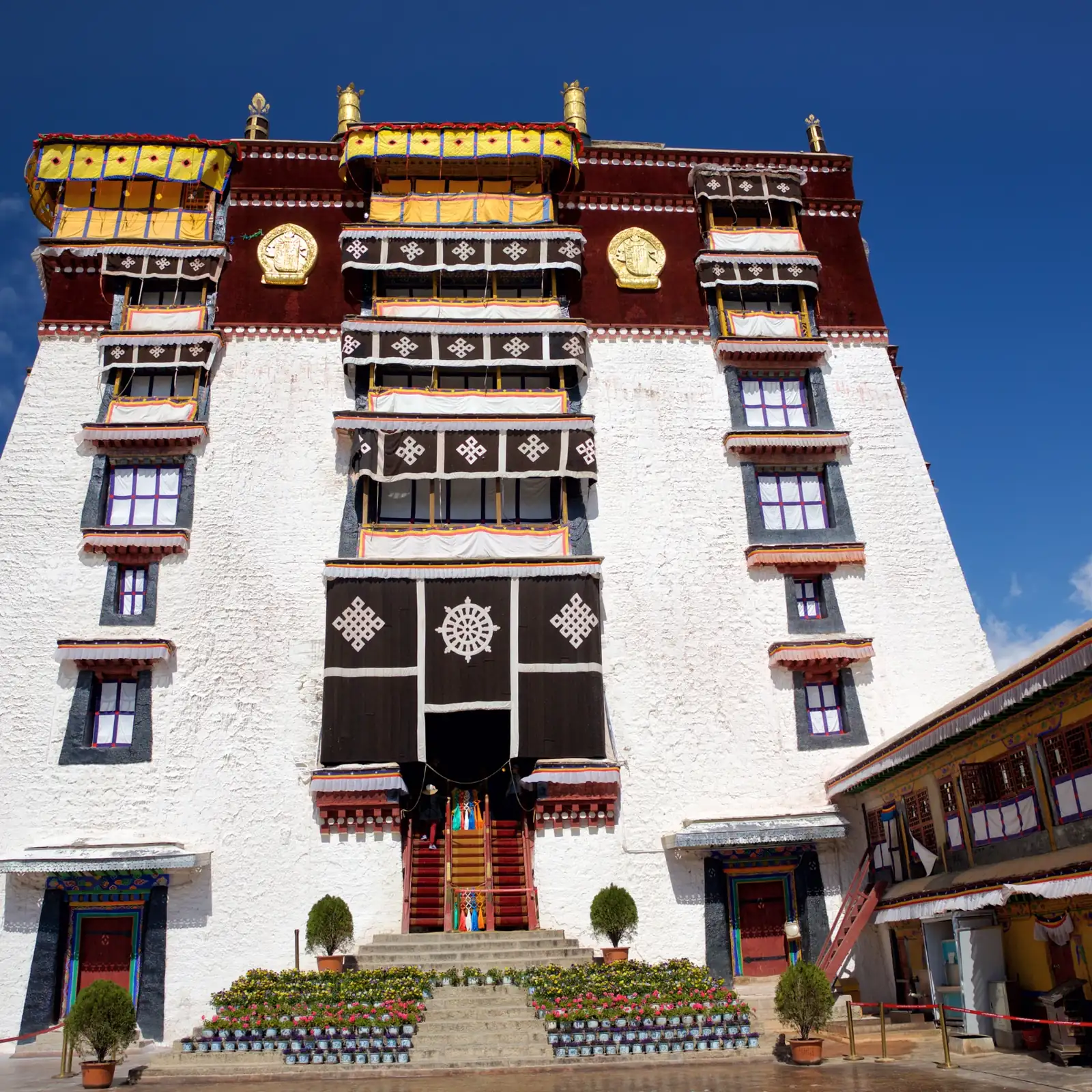
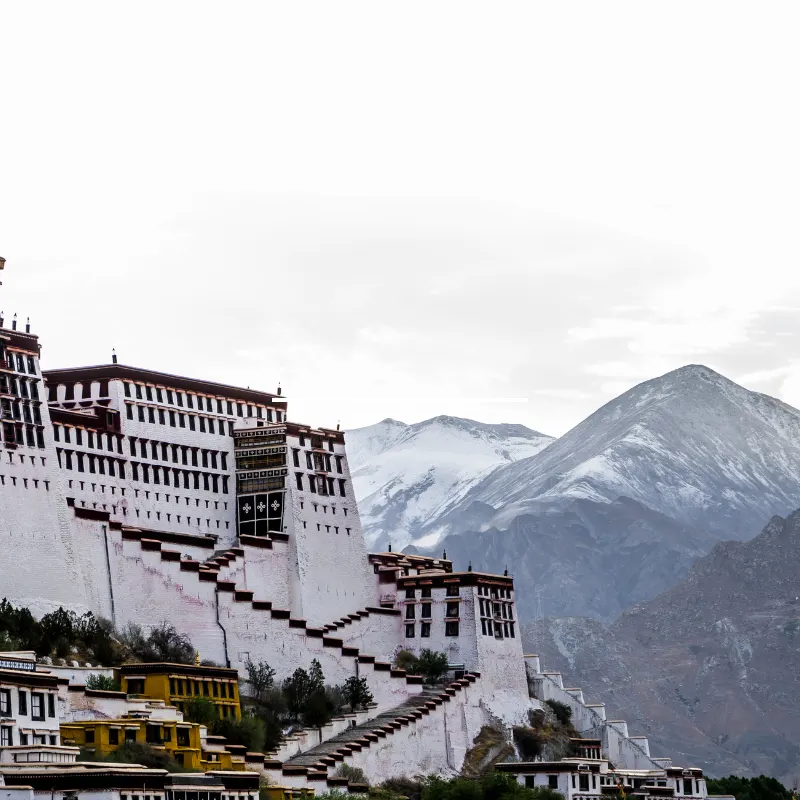
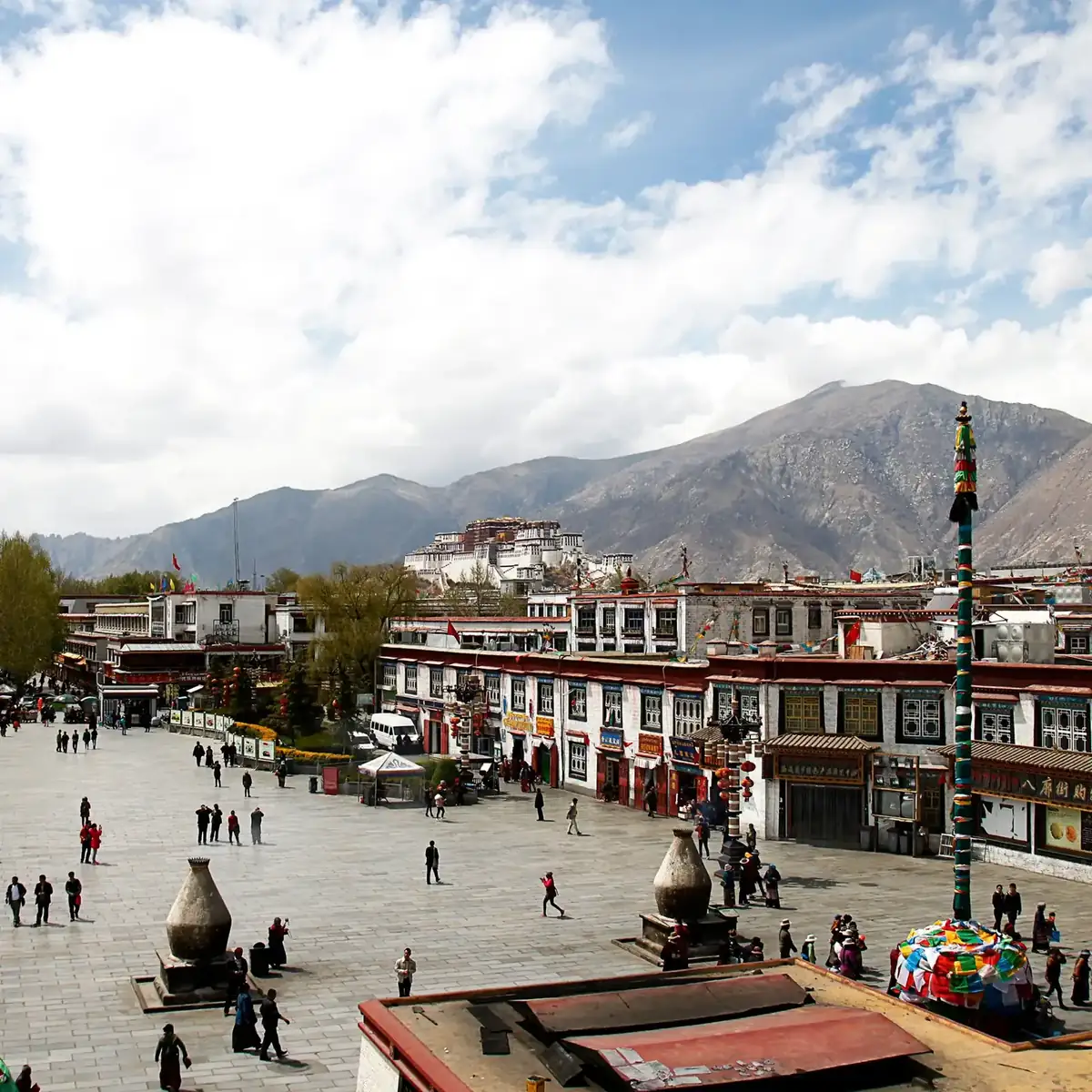
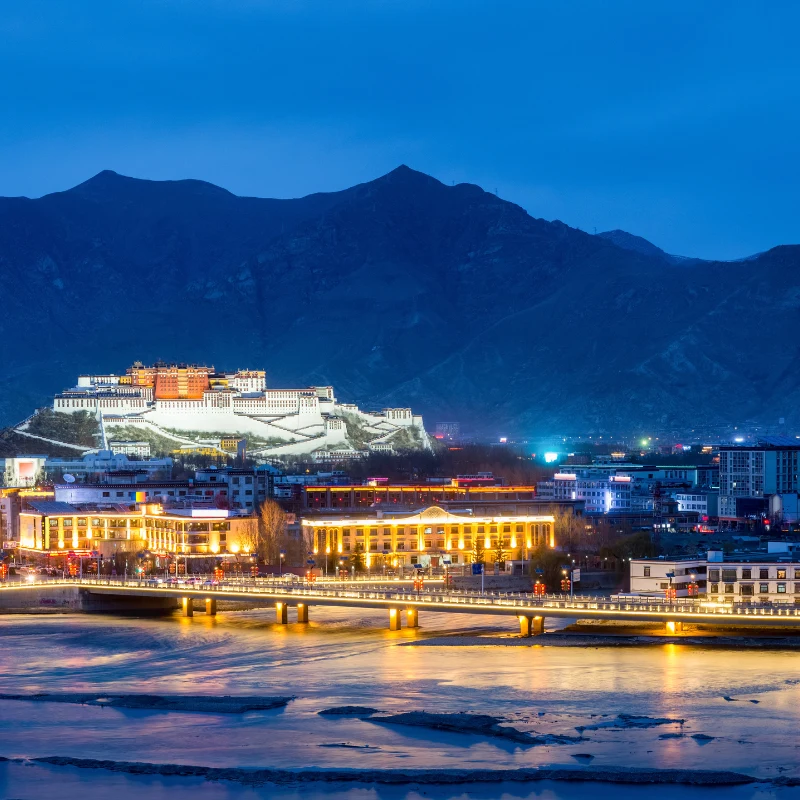
- Potala Palace — about 3,700 m / 12,139 ft: the 13-storey red-and-white citadel on Marpori (Red Hill), begun in 1649 by the 5th Dalai Lama and a UNESCO World Heritage Site since 1994.
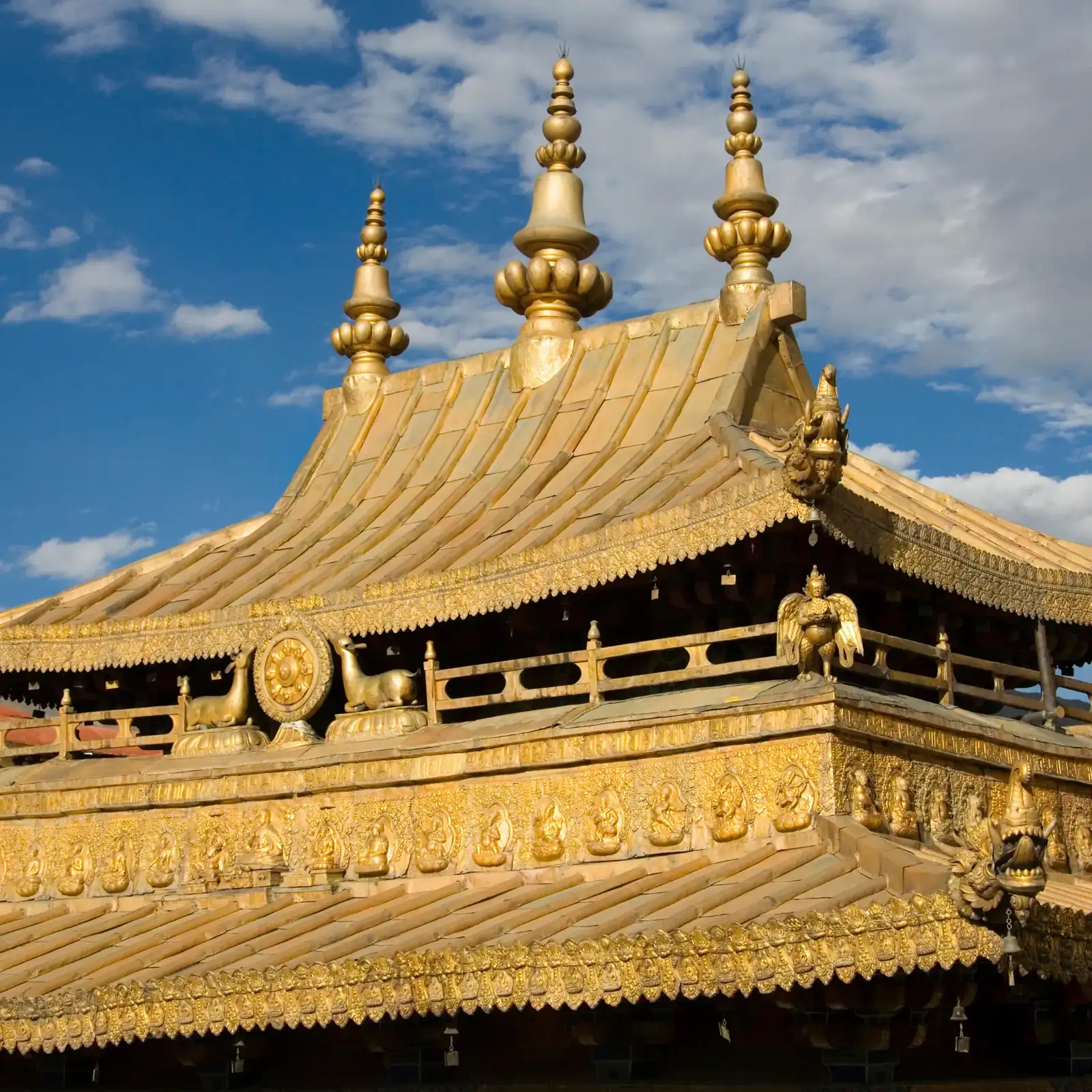
- Jokhang Monastery — about 3,650 m / 11,975 ft: Tibet’s most sacred temple, founded in the 7th century and ringed by pilgrims circulating without pause.
- Barkhor Bazaar — about 3,650 m / 11,975 ft: the kora path becomes a market for prayer flags, thangka frames, butter lamps and khatag scarves.
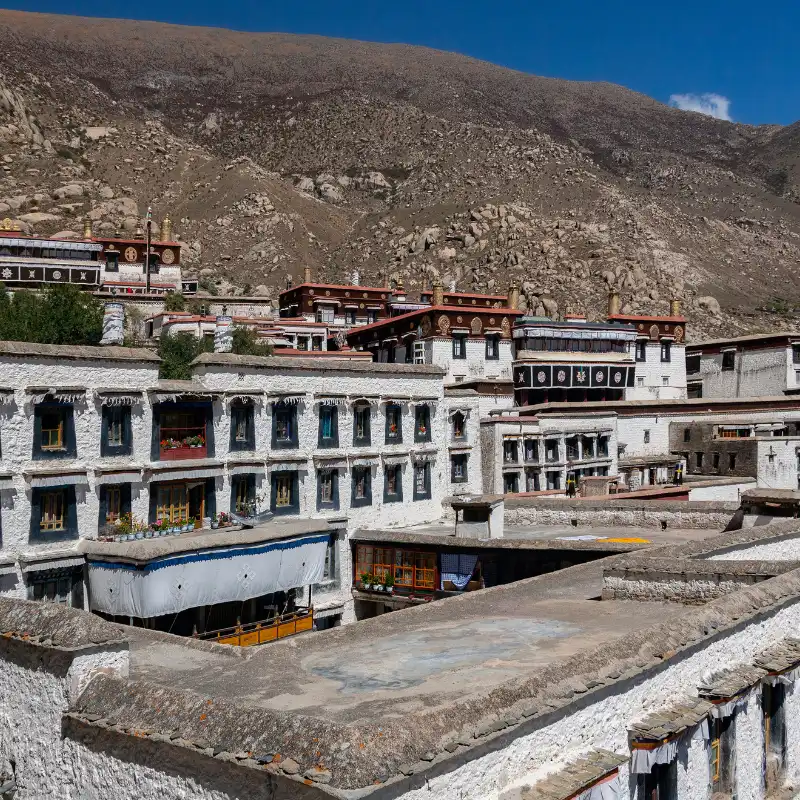
- Sera Monastery — about 3,600 m / 11,811 ft: founded in 1046, once home to thousands of monks, in courtyards that still feel lived in.
- Drepung Monastery — about 4,300 m / 14,108 ft: the largest Gelug monastery in Tibet by resident population, spread across a broad hillside northwest of the city.
- Tashilhunpo Monastery — about 3,900 m / 12,795 ft: the largest monastery in Tibet and the seat of the Panchen Lama, in Shigatse, Tibet’s second-largest city.
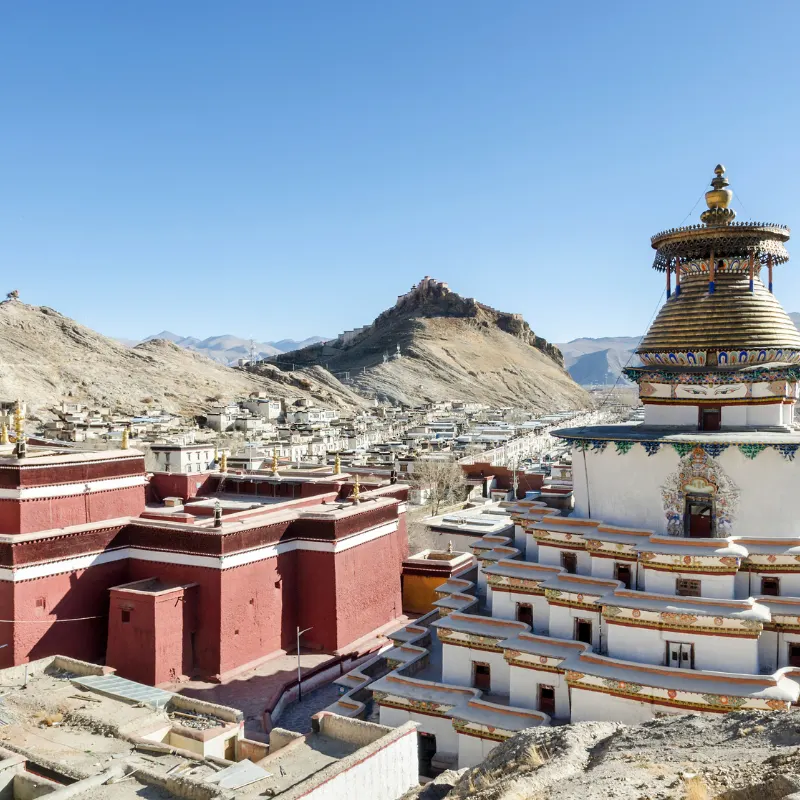
- Kumbum Stupa — about 3,100 m / 10,171 ft: a whitewashed, hundred-spired stupa at Ta’er Monastery near Gyantse, one of the most photographed Buddhist structures in China.
- Pelkor Monastery — about 3,900 m / 12,795 ft: a 14th-century Sakya-school monastery above Gyantse, holding a rare multi-storey mandala.
- Yamdrok Lake — 4,441 m / 14,570 ft: one of Tibet’s most sacred lakes, reached by a road causeway built across the water itself.
- Karola Pass — 5,010 m / 16,437 ft: the highest point of the tour, with the classic Yamdrok panorama and, on clear mornings, distant Everest.
- Yumbulakhang — about 3,700 m / 12,139 ft: a ninth-century fortress-monastery on a crag above Tsetang, widely described as Tibet’s oldest surviving building.
- The Yarlung Tsangpo (Brahmaputra) Valley: the route follows the river from Lhasa to Shigatse and on toward the Grand Canyon country — the agricultural heartland of Tibet.
- Four Monasteries in Seven Days: Jokhang, Sera, Drepung, Tashilhunpo, Ta’er and Pelkor — six major seats of Tibetan Buddhism on one circuit.
- Private Throughout: your own vehicle and guide from arrival to departure, at 2+ travellers.
Lhasa Tour 6 Nights 7 Days | Nepal Lion Tours
Lhasa Tour 6 Nights 7 Days Overview
The Lhasa Tour 6 Nights 7 Days is a 7-day overland cultural circuit through central Tibet, flying out of Kathmandu on Day 01 and flying home on Day 07, with six nights between. It is not a city break. It leaves Lhasa behind on Day 04 and drives west through the Yarlung Tsangpo valley to Shigatse, Gyantse and the turquoise Yamdrok Lake, reaching the Tsangpo Grand Canyon country around Tsetang before turning back.
That makes it the single best value route into Tibet from Nepal. The circuit commonly called the Golden Circle — Lhasa, Shigatse, Gyantse, Yamdrok Lake and Tsetang — collects almost everything that makes Tibet worth the flight, and it all sits inside the standard permitted zone. The published rating is Normal difficulty: there is no trekking and no climbing, but there are long road days and two genuine high passes.
The altitude story is the thing to understand before you book. You sleep at 3,650 m / 11,975 ft in Lhasa, at 3,900 m / 12,795 ft in Shigatse, and at 3,950 m / 12,959 ft in Gyantse. Then on Day 06 the road crosses Karola Pass at 5,010 m / 16,437 ft and Kambala Pass at 4,794 m / 15,728 ft on the way to Yamdrok Lake. The published Day 06 itinerary lists the overnight altitude in Tsetang as 3,400 m / 11,155 ft, which is a useful and accurate descent — but the maximum you touch that day is the pass itself, not the town.
With Nepal Lion Tours, the package starts from USD 1,819 per person and includes the Tibet travel permit, an English-speaking Tibetan guide, private jeep transportation throughout, hotel accommodation on a twin-sharing basis, daily breakfast, and all monastery entrance fees. One item is deliberately not included and it matters: the Kathmandu–Lhasa flights are not in the price. You book those yourself, and we explain exactly how in How to Get to the Lhasa Tour.
What Makes the Lhasa Tour 6 Nights 7 Days Special?
The headline is the range of Tibet you see in a single week. Most travellers reach Lhasa and never leave it. This tour gives you two full days in the capital, then four days of genuinely different Tibet: the Panchen Lama’s enormous Tashilhunpo Monastery in Shigatse, the whitewashed Kumbum Stupa and the hilltop Pelkor Monastery at Gyantse, and then Yamdrok Lake — one of the most beautiful and most sacred lakes in Tibet, at 4,441 m / 14,570 ft, with the road threading the causeway between it and the mountains.
The second highlight is Karola Pass. At 5,010 m / 16,437 ft you stand above Yamdrok Lake at the highest point of the tour, looking down on water the colour of polished turquoise and, on a clear morning, at the summit of Mount Everest from one of the few places in the world where you can see it. This is the sort of altitude that makes the trip memorable rather than merely pleasant.
The third is Yumbulakhang, the small fortress-monastery on a crag above Tsetang, widely described as Tibet’s oldest surviving building. Standing in a ninth-century chapel in the Yarlung valley, after driving through two 5,000 m passes to get there, is an oddly moving end to the week.
Why Choose the Lhasa Tour 6 Nights 7 Days?
Because it solves the two problems that stop most people visiting Tibet. The first is paperwork: independent travel is not permitted in Tibet, and every visitor travels on a permit arranged through a registered agency, with a guide attached. The second is altitude: Lhasa sits high enough that arriving and walking around immediately is a bad idea. This itinerary handles both — the permit is in the price, and the schedule builds acclimatisation into Days 01 to 03 before the road climbs.
It also fixes the geography. Reaching Yamdrok Lake independently is not practical; it is a restricted, permit-controlled region reachable only by road through two high passes, on roads with limited services. As a guest of a licensed operator with a Tibetan guide, you drive it, stop where it is worth stopping, and someone who knows the road is driving.
And the effort is genuinely modest. Every transfer is by private jeep, the walking is at street level, and there is no daypack, no camping, and no night above 3,950 m / 12,959 ft. For anyone who wants the cultural and visual heart of the Tibetan Plateau without committing to a trekking expedition, this is the most complete short route available from Nepal.
What’s Included and What Isn’t?
As published, the inclusions are private transportation by jeep as per the itinerary, the Tibet travel permit, an English-speaking Tibetan guide, accommodation on a twin-sharing room basis, daily breakfast, and all monastery entrance fees as per the itinerary. That is a stronger inclusion list than most comparable tours manage, because the permit and the entrance fees are precisely the two things independent visitors get wrong.
The exclusions are lunch and dinner, travel insurance of any kind, train or air fare of any sector, personal expenses such as drinks, tips and porterage, and anything arising from natural or political disturbance beyond our control.
Read that third exclusion carefully: the Kathmandu–Lhasa return flight is not in the published price. We will tell you exactly what you need to book and when, but the fare is yours. That is the single most common misunderstanding about this package, so it has its own section and several FAQs.
Who Is This 7-Day Lhasa Tour For?
- First-time visitors to Tibet who want the capital and the wider country, not just the Potala Palace.
- Travellers with seven to eleven days available — the tour plus the international travel either side.
- Photography-focused travellers. Karola Pass, Yamdrok Lake, Tashilhunpo and the Yamdrok causeway are among the most photographed places in Tibet.
- Buddhist pilgrims and students of Tibetan Buddhism — this route visits four major monasteries and one of the most sacred lakes in the tradition.
- Travellers combining Nepal and Tibet, since the flight departs from Kathmandu and slots neatly onto a Nepal trek or a city break.
- Couples and small private groups, who get their own vehicle and guide throughout rather than joining a coach.
No previous high-altitude experience is required, and there is no trekking. The two honest caveats are passenger-flight logistics (you must book the Kathmandu–Lhasa seats yourself, and the schedule is limited) and altitude (you sleep above 3,900 m / 12,795 ft for three nights and drive over 5,000 m / 16,404 ft twice). If you have heart or respiratory conditions, speak to your doctor first and tell your guide on arrival.
Guide’s Note — Nepal Lion Tours We get a handful of bookings a week from guests who extended our Lhasa Tour 4 Nights 5 Days after realising they had only seen the capital. Those guests almost always ask the same question: should we have done the Golden Circle instead? Usually yes, if the flights were already booked — and the answer is to keep the same flight out and the same flight back, and let us run the overland days between. That is the whole trick of this package: it is the 5-day tour with four extra road days and no extra international flying. If you are weighing the two, send us your dates and we will tell you honestly which one fits. — Nepal Lion Tours
Quick Facts
Lhasa Tour 6 Nights 7 Days at a Glance
| Tour Fact | Details |
|---|---|
| Tour Name | Lhasa Tour 6 Nights 7 Days |
| Duration | 7 days / 6 nights |
| Region | Tibet Autonomous Region, China — Lhasa, Shigatse, Gyantse, Yamdrok Lake, Tsetang |
| Maximum Altitude | 5,010 m / 16,437 ft at Karola Pass; 4,794 m / 15,728 ft at Kambala Pass |
| Difficulty | Normal; long road days and two high passes, no trekking |
| Main Highlight | Karola Pass at 5,010 m overlooking Yamdrok Lake |
| Signature Stops | Potala Palace, Jokhang Monastery, Tashilhunpo, Kumbum Stupa, Yamdrok Lake |
| Start / End | Kathmandu to Kathmandu, via direct flight |
| Route | Kathmandu – fly – Lhasa – Shigatse – Gyantse – Karola Pass – Yamdrok Lake – Tsetang – fly – Kathmandu |
| Total Road Distance | Approximately 810 km / 503 miles of overland driving |
| Typical Walking | 1–3 hours per day on level or paved ground |
| Best Season | March–November; April–May and September–October best |
| Price From | USD 1,819 per person (Standard tier) |
| Luxury Tier | From USD 2,456 per person |
| Accommodation | Hotel, twin-sharing basis |
| Meals | Daily breakfast included |
| Group Size | Published 2+; solo travel on request at the 1-pax rate |
| Guide | English-speaking Tibetan guide |
Lhasa Tour Route and Elevation
The route is a westward arc rather than a loop, which is what makes the Golden Circle work in seven days. You fly into Lhasa, spend two days in the capital, then drive west along the Yarlung Tsangpo to Shigatse and on to Gyantse, climb to Karola Pass for Yamdrok Lake, descend to Tsetang in the Yarlung valley, and drive east to Lhasa’s airport for the flight home.
The elevation profile is not flat, and it is not a climb either. It is a staircase held at altitude — you sleep high every night and you touch your maximum on a single day.
Lhasa Tour Route at a Glance
| Day | Tour Route | Altitude | Highlights |
|---|---|---|---|
| Day 01 | Kathmandu → fly → Lhasa | 3,650 m / 11,975 ft | About 1-hour flight, airport meet and greet, transfer to hotel, full rest day |
| Day 02 | Lhasa → Jokhang → Barkhor | 3,650 m / 11,975 ft | Tibet’s most sacred temple and the pilgrim market on its kora path |
| Day 03 | Lhasa → Potala → Sera → Drepung | Up to 4,300 m / 14,108 ft | The 13-storey palace and the two great Gelug monasteries |
| Day 04 | Lhasa → Shigatse | 3,900 m / 12,795 ft | 280 km / 174 mi west along the Yarlung Tsangpo valley |
| Day 05 | Shigatse → Gyantse | 3,950 m / 12,959 ft | 90 km / 56 mi; Tashilhunpo, Kumbum Stupa, Pelkor Monastery |
| Day 06 | Gyantse → Karola Pass → Yamdrok Lake → Tsetang | 5,010 m / 16,437 ft | 290 km / 180 mi; Kambala Pass, Yamdrok causeway, Yumbulakhang, Thandruk |
| Day 07 | Tsetang → Lhasa airport → fly → Kathmandu | 3,400 m / 11,155 ft | About 2 hours by road, departure flight |
Lhasa Tour Elevation Profile
| Point | Altitude | Note |
|---|---|---|
| Kathmandu | About 1,400 m / 4,593 ft | Tribhuvan Airport at about 1,338 m / 4,390 ft |
| Lhasa city | 3,650 m / 11,975 ft | Nights 1–3 |
| Potala Palace | About 3,700 m / 12,139 ft | Day 03 |
| Sera Monastery | About 3,600 m / 11,811 ft | Day 03 |
| Drepung Monastery | About 4,300 m / 14,108 ft | Highest overnight-adjacent point on Day 03 |
| Shigatse | 3,900 m / 12,795 ft | Night 4 |
| Gyantse | 3,950 m / 12,959 ft | Highest overnight altitude of the tour, night 5 |
| Kambala Pass | 4,794 m / 15,728 ft | Day 06 |
| Karola Pass | 5,010 m / 16,437 ft | Highest point of the tour, Day 06 |
| Yamdrok Lake | 4,441 m / 14,570 ft | Day 06 |
| Tsetang (Yarlung valley) | 3,400 m / 11,155 ft | Night 6 — a real descent |
You gain roughly 2,250 m / 7,385 ft in the hour it takes to fly from Kathmandu to Lhasa, which is why Day 01 is empty and Days 02 and 03 do the real acclimatisation work. From there the profile climbs in steps: 3,650 m to 3,900 m to 3,950 m, holding there for three nights, before the Day 06 excursion to 5,010 m — about 1,050 m / 3,445 ft above Gyantse — and then a descent of more than 1,600 m / 5,249 ft into the Yarlung valley.
That Day 06 swing is the defining physical fact of this tour. You sleep at 3,950 m and drive to 5,010 m and back down to 3,400 m in one day. It is completely manageable if you move slowly and drink water, and it is the day to tell your driver in advance if you are sensitive to altitude.
A travel map and elevation summary can be provided with your travel materials so you can follow the daily route and the two passes before you arrive.
How the Lhasa Tour Days Unfold
Day 01 — Kathmandu to Lhasa, transfer and rest: you fly for about an hour over the highest Himalayan ranges to the capital of Tibet. Lhasa sits at 3,650 m / 11,975 ft, roughly 60 km / 37 miles from Lhasa Gonggar Airport, so the transfer is short. Your guide meets you, you transfer to the hotel, and the rest of the day is free. This is not wasted time — it is the single most important day of the week.
Day 02 — Jokhang and Barkhor: your first full day in Lhasa, and a gentle one. You walk the kora around Jokhang Monastery, the most sacred temple in Tibetan Buddhism, and join the flow of pilgrims turning butter lamps. In the afternoon the same devotion becomes commerce in Barkhor Bazaar, a dense market of prayer flags, thangka supplies and jewellery.
Day 03 — Potala, Sera and Drepung: the palace first, ideally mid-morning. Potala Palace rises 100 m / 328 ft above Lhasa on Marpori (Red Hill), and climbing its stairways is the most physical thing you do in the city. The afternoon goes north to Sera and Drepung, the two great Gelug monasteries, with Drepung reaching about 4,300 m / 14,108 ft.
Day 04 — Lhasa to Shigatse, 280 km: you leave the capital west and follow the Yarlung Tsangpo — the Brahmaputra — along the northern road through a wide agricultural valley. This is a long but beautiful driving day with the river, farmland and distant ranges for company. You arrive in Shigatse, Tibet’s second-largest city, and sleep at 3,900 m / 12,795 ft.
Day 05 — Shigatse to Gyantse, 90 km: a short transfer that opens with Tashilhunpo Monastery, the largest monastery in Tibet and the seat of the Panchen Lama. Then 90 km / 56 miles to Gyantse for the Kumbum Stupa at Ta’er Monastery and the hilltop Pelkor Monastery. You sleep at 3,950 m / 12,959 ft, the highest overnight stop of the tour.
Day 06 — Gyantse to Yamdrok Lake to Tsetang, 290 km: the long day, and the best. You cross Kambala Pass at 4,794 m / 15,728 ft and then Karola Pass at 5,010 m / 16,437 ft, which is the highest point of the whole week. Below you is Yamdrok Lake, and the road runs out onto a causeway built across the water. You descend to the Yarlung valley for Yumbulakhang and Thandruk Monastery, then sleep in Tsetang at 3,400 m / 11,155 ft.
Day 07 — Tsetang to Kathmandu: an early start and roughly 2 hours by road back toward Lhasa Gonggar Airport for your departure flight. You are back in Kathmandu the same day, with time to connect onward.
How to Get to the Lhasa Tour
Getting to Tibet from Nepal is done by air, and for this tour it is something you arrange and pay for yourself. The published exclusion list reads train or air fare of any sector, so the Kathmandu–Lhasa flights are not part of the package price. That is not a caveat buried in the fine print — it is the first thing to sort, because the seat count is limited and it shapes your whole itinerary.
The good news is that the requirement is simple and we will walk you through it. You need two one-way sectors on the same routing: Kathmandu to Lhasa on the morning of Day 01, and Lhasa to Kathmandu on Day 07.
Kathmandu to Lhasa: Flight or Road?
Air, without question. The direct flight from Tribhuvan International Airport (KTM) to Lhasa Gonggar Airport (LXA) takes roughly 1 hour and flies over the highest Himalayan ranges — Everest, Makalu and Lhotse are all within sight on a clear day. The road does not exist as a practical alternative: there is no drivable connection between Nepal and Tibet, and the only land crossings are restricted border crossings at Zhangmu and Nathu La that require specific permits and cannot support this itinerary.
Practical consequences of flying: there is a limited number of daily rotations between Kathmandu and Lhasa, and the schedule is thinner outside peak season. Seats on the Lhasa sector sell out well ahead of the Nepal sector. If you are planning around fixed international dates, book the Kathmandu–Lhasa flights before you commit to the rest of the trip.
Lhasa Gonggar Airport to Your Hotel
Lhasa Gonggar Airport sits at about 3,570 m / 11,713 ft, roughly 60 km / 37 miles northwest of Lhasa city. The drive takes about 1 hour and climbs roughly 100 m / 328 ft into the city — your first real taste of the altitude, and it arrives before you have even checked in.
Your English-speaking Tibetan guide meets you inside the terminal, and private transportation is included from the airport to your hotel on arrival and back on departure. You will also be collected from Tsetang on Day 07 for the roughly 2-hour transfer to the same airport. Both ends are handled; you are never left to find a cab with a suitcase at 3,600 m.
Returning to Kathmandu After the Tour
Day 07 is a transfer day, not a sightseeing day. You leave Tsetang early — typically around mid-morning — for Lhasa Gonggar Airport, and fly home to Kathmandu the same afternoon. Because the drive and the flight are on the same day, we recommend not booking a onward international departure out of Kathmandu until late evening. A reasonable buffer is a late-night or next-morning connection; anything tighter than that turns a small delay into a missed flight.
If your onward travel goes by road from Kathmandu, do not schedule it for the same evening either. The Kathmandu–Lhasa leg operates on its own schedule and is not linked to your onward connection.
A Practical Tip for International Travellers
Most guests arrive in Kathmandu from a long-haul flight and connect straight through to Lhasa. The temptation is to treat Kathmandu as a transit point. Don’t — build in at least one full day in Kathmandu before your Day 01 Lhasa flight, and preferably one after as well.
Two reasons. First, jet lag at 1,400 m / 4,593 ft compounded by an abrupt climb to 3,650 m / 11,975 ft is a rough combination, and a spare day in Kathmandu makes the altitude adjustment far gentler. Second, if the Kathmandu–Lhasa flight is cancelled for weather — which happens, as Lhasa is one of the world’s highest airports — a buffer day is the difference between losing a day and losing your connection home.
Guide’s Note — Nepal Lion Tours When we brief guests on this tour, the flight booking is the part we spend most time on. The single biggest mistake is booking the Lhasa flights late and treating them as an afterthought, then discovering that the only seat left is a late departure that forces you to cut Karola Pass short — which we will never do. Book Lhasa first, tell us your flight numbers, and we will build the ground itinerary around your actual arrival time. If your flight lands early in the day, you may get a gentle walk around the Barkhor kora on Day 01 instead of nothing. If it lands late, you rest. Either way the schedule bends around you rather than the other way round. — Nepal Lion Tours
Lhasa Tour Difficulty, Fitness & Altitude
The published difficulty is Normal, and that rating is accurate. This is not a trek: you never carry more than a daypack, the terrain underfoot is paved or graded, and every transfer is by private jeep. What it is, is a high-altitude road trip with two real passes, and the honest description is that the difficulty is in the thin air and in the length of the vehicle days, not in your legs.
The single most important thing to understand is the shape of the week. You sleep at 3,650 m / 11,975 ft, then 3,900 m / 12,795 ft, then 3,950 m / 12,959 ft — three nights at altitude with no spare nights below. Then on Day 06 you drive from 3,950 m to 5,010 m / 16,437 ft, about 1,050 m / 3,445 ft higher, and back down to 3,400 m / 11,155 ft. That is the day to pace.
Where the Effort Actually Is?
It falls into four places, and only one of them is about fitness.
The road days. Days 04, 05 and 06 cover 280 km, 90 km and 290 km — roughly 660 km / 410 miles of driving, plus the Day 07 return to the airport. Day 06 is a long day even by Tibetan standards. Road surfaces vary, and stretches between Gyantse and Yamdrok Lake are slow. You are in a vehicle for hours, and being a good passenger matters: read, look out of the window, and do not spend the day on your phone.
The Potala Palace stairs. The Potala Palace sits about 100 m / 328 ft above Lhasa and its internal stairways and terraces are steep, switchbacked, and taken at altitude. Expect 60 to 90 minutes of climbing inside. It is the most physical walking of the week in the capital, and it happens on Day 03 when you are well acclimatised.
The monastery courtyards. Sera, Drepung, Tashilhunpo, Ta’er and Pelkor are all large complexes on slopes and stairs, with no golf carts. Walking a monastery at 3,900 m / 12,795 ft is slow going, and the Kumbum Stupa’s exterior staircases are long. Budget one to two hours per site.
Karola and Kambala Passes. The two passes are driven, not walked. But you will get out at Karola, you will be at 5,010 m / 16,437 ft, and you will be expected to stand at a viewpoint and take in one of the great panoramas in Tibet. That is fine if you have acclimatised and walk slowly. It is a bad idea if you run.
How to Prepare for the Lhasa Tour
Two weeks of cardiovascular work helps, and not for the reasons most people expect. Your heart and lungs benefit from fitness, but the limiting factor above 4,000 m / 13,123 ft is not fitness — it is acclimatisation, and no amount of training in a gym shortens that. What fitness does buy you is recovery capacity: fitter guests sleep better, tolerate the drive days better, and generally feel less wrecked at altitude.
Practically:
- Walk daily for two to three weeks before departure, ideally on hills. You are training your body to work at a lower oxygen delivery rate.
- Do not use alcohol in the week before you fly. It worsens sleep at altitude, and sleep is what does the acclimatisation.
- Arrive in Kathmandu a day early, as noted above, and do not treat the Lhasa flight as a same-day connection.
- Start any doctor-prescribed medication before you fly, not after you feel something.
- Plan to be a passenger. The best-prepared guests on this tour are the ones who brought books and accepted that Days 04 to 06 are travel days.
How Does the Lhasa Tour Compare with Longer Himalayan Treks?
It is a different category of trip and should not be compared on distance.
A Nepal trekking route such as the Annapurna Circuit or Everest Base Camp involves two to three weeks, daily elevation gains of 500 m to 1,000 m plus, carrying your own load, sleeping in teahouses or tents, and putting you on passes in the 5,000 m to 5,500 m range on foot after a proper acclimatisation ladder.
This tour involves seven days, a private jeep on every single transfer, overnights in hotels at 3,650 m to 3,950 m, and a maximum altitude of 5,010 m / 16,437 ft reached by road rather than on foot.
What you give up: the trail, the solitude, the physical narrative of walking to somewhere. What you get: six major monasteries and Tibet’s most sacred lake in one week, at a normal-to-easy physical demand. Guests who have trekked in Nepal regularly tell us this is the ideal way to see Tibet without adding another two weeks to the trip. Guests who have never trekked can complete it comfortably. Both are true.
Altitude, Acclimatization & Safety
We state this plainly: altitude is the only genuine safety consideration on this tour, and it is manageable but not ignorable. At 3,650 m / 11,975 ft you have roughly 60 to 70 per cent of the oxygen available at sea level; at 5,010 m / 16,437 ft it is closer to 50 per cent.
Lhasa Tour Altitude Profile
| Day | Sleep Altitude | Highest Point Reached |
|---|---|---|
| Day 01 | 3,650 m / 11,975 ft | 3,650 m / 11,975 ft (Lhasa) |
| Day 02 | 3,650 m / 11,975 ft | 3,650 m / 11,975 ft (Jokhang, Barkhor) |
| Day 03 | 3,650 m / 11,975 ft | 4,300 m / 14,108 ft (Drepung) |
| Day 04 | 3,900 m / 12,795 ft | 3,900 m / 12,795 ft (Shigatse) |
| Day 05 | 3,950 m / 12,959 ft | 3,950 m / 12,959 ft (Gyantse) |
| Day 06 | 3,400 m / 11,155 ft | 5,010 m / 16,437 ft (Karola Pass) |
| Day 07 | — | 3,570 m / 11,713 ft (Lhasa Gonggar Airport) |
Note the Day 03 row: your sleeping altitude stays at 3,650 m while you reach 4,300 m at Drepung. That is a well-managed day. Day 06 is the one worth thinking about — you sleep at 3,950 m and reach 5,010 m.
How the Body Adjusts at High Altitude
Adaptation is not instant, and the pattern is predictable enough to plan around. In the first 24 to 48 hours above 3,500 m / 11,483 ft you may get a headache that worsens in the afternoon, breathe faster especially at night, feel slightly unsteady on stairs, and sleep badly. This is normal.
From roughly day three the body begins producing more red blood cells and adjusting acid balance, symptoms ease, and most people feel broadly well. That is why this itinerary spends three nights in Lhasa before climbing, and why the Day 06 pass excursion comes after five nights of steady acclimatisation rather than on Day 02.
The framework we work to is simple: climb high, sleep low, and never symptom-chase. Guest who feels genuinely unwell at Karola Pass says so, and the vehicle moves.
Symptoms of Altitude Sickness to Watch For
Common and expected: headache, mild nausea especially on waking, reduced appetite, fatigue, breathlessness on exertion, and disturbed sleep. Treat with rest, fluids and time. Do not push through these.
Moderate — stop climbing and tell your guide: persistent or worsening headache not relieved by rest, repeated vomiting, marked loss of balance or coordination, unusual breathlessness at rest, or confusion. The correct response is descent, not medication.
Emergency — descend immediately and seek medical help: ataxia — stumbling or falling — together with altered mental state, breathlessness at rest, persistent cough with frothy sputum, or a severe headache that will not settle. These indicate High Altitude Cerebral Oedema (HACE) or High Altitude Pulmonary Oedema (HAPE).
Our drivers carry oxygen and know the descent points on the Day 04 to 06 roads. There is no reason to be brave about this. Altitude illness is not a test of character, and the descent from Karola Pass is short.
Two more ordinary but important points. Alcohol at altitude is a bad idea — it suppresses the sleep that is doing the acclimatisation. And if you have a history of heart or respiratory problems, high-altitude travel above 3,500 m / 11,483 ft** may not be appropriate at all; check with your doctor before booking, not at the airport.
How Nepal Lion Tours Supports Altitude Safety
Our guide travels with you for all seven days in a private vehicle, so the person who knows how you are feeling is the person who can act on it. Drivers carry supplementary oxygen and first-aid supplies. We brief guides specifically on the Day 06 pass crossing, including which guests should be offered the descent option, and we build the itinerary with the acclimatisation-first order deliberately rather than for convenience.
If any guest becomes seriously unwell, our ground team will drive them down immediately and coordinate onward medical care, and we will re-plan the affected day rather than lose the week.
Guide’s Note — Nepal Lion Tours The Day 06 pass crossing is the part we plan most carefully with every guest on this tour. Our rule is that nobody goes up to Karola to prove a point. If you have had a rough night in Gyantse, if you have a headache that has not settled, if you are simply not enjoying it — you can skip the pass, sit in the vehicle with the engine running, take photographs of Yamdrok Lake from the lower road, and rejoin the group at the lake. That happens routinely and no one thinks less of you for it. What we want to avoid is the guest who forces themselves up a pass at 5,010 metres because they feel they should, gets ill, and turns the rest of a very good week into a recovery. — Nepal Lion Tours
Best Time for the Lhasa Tour
The published season is March to November, and that is the window you should be planning inside. Nepal Lion Tours runs this circuit across those months, and we consider April to May and September to October the best of the window — good visibility at the passes, settled weather on the Yarlung valley roads, and the kind of light that makes Yamdrok Lake look the way you have imagined it.
There is one specific point that matters more for this tour than for a Lhasa-only trip. Karola and Kambala Passes can carry snow into late spring and early autumn. A pass closure or a temporary road block will not only delay you — it can shorten or reroute the Yamdrok Lake day entirely. If Yamdrok Lake and Karola Pass are the reason you are booking this package rather than the 4-night tour, tell us that at booking so we can be more careful about your dates and more honest with you about the risk.
Spring — March to May
March, April and May are the strongest months of the window. The winter cold has eased, the air is clearer than it will be in summer, and you get excellent visibility at 5,010 m / 16,437 ft on Karola Pass. The Lhasa roads are dry. Yamdrok Lake is often still partly frozen in early March, which photographs beautifully, though the causeway can remain closed for a short period.
Spring crowds are lighter than October and hotels are easier to secure, which matters in a tour with four separate hotel changes. Wind is the main annoyance — Lhasa sits in a valley and spring afternoons can be gusty. Late April and May are the safest all-round choice if your dates are flexible.
Summer — June to August
June to August is the warmest window and the best time if heat matters to you. Lhasa days are comfortable, the Yarlung valley is green, and the monsoon lands mostly east of the region. Road conditions on the Gyantse to Yamdrok Lake section can be affected by rain in July and August, and passes can see short closures after heavy weather.
The trade-offs are real. August is peak domestic travel month in Tibet and the festival calendar peaks around the 15th day of the sixth Tibetan month, so hotels and vehicles are under pressure — worth booking well ahead. Expect stronger sun, thinner air feeling more pronounced at the passes, and the lake a deeper turquoise rather than a cold blue.
Autumn — September to November
September and October are the classic months, and for good reason: the air is at its clearest of the year, the passes are open and stable, the summer traffic has thinned, and the light on the Tibetan Plateau in late September is exceptional. November is quieter still and cold but usually clear.
If you can travel in this window, do. The trade-off is availability — October bookings should be made well in advance, and the domestic holiday period around early October can reduce hotel and vehicle options. November is the value pick inside the window: same visibility, far fewer travellers, lower occupancy, and a distinctly winter-edge feel to the landscape around Tsetang.
Winter — December to February
We publish March to November as the season, and that is not a formality. December to February is possible but carries genuine complications for this particular route in a way it does not for a Lhasa-only trip.
Karola and Kambala Passes may be closed or passable only with local assistance. The Gyantse to Yamdrok Lake road is exposed and can be unreliable. Day temperatures fall well below freezing, and while Lhasa shelters are heated and comfortable, a roadside viewpoint at 5,010 m in winter is a different proposition entirely.
Winter does offer empty monasteries, dramatic light and very low crowds. If you are set on these months, we will tell you honestly whether your alternative route still reaches Yamdrok Lake — because for many guests it does not, and a winter booking made on the assumption that it does is a disappointment we would rather prevent.
Which Season Should You Choose?
| Season | Months | Best For | Main Drawback |
|---|---|---|---|
| Spring | March–May | Clear pass views, lighter crowds, dry roads | Late-winter pass closures in early March |
| Summer | June–August | Warmest days, festival calendar, green valley | Peak domestic travel in August, rain on the Yamdrok road |
| Autumn | September–November | Best visibility of the year, full season | Higher demand in October, early-October holidays |
| Winter | December–February | Empty monasteries, quietest, dramatic light | Pass and road closures, serious cold, Yamdrok Lake not guaranteed |
Our recommendation: aim for late April to mid-May or late September to mid-October. Both give you reliable access to Karola Pass and Yamdrok Lake with good visibility. If your dates are fixed, tell us what they are and we will tell you honestly what the road is likely to be doing before you pay a deposit.
Guide’s Note — Nepal Lion Tours The single question we are asked most often about this tour is not about the potala or the lake — it is “will the passes be open?” It is the right question, and we would rather you asked it before booking than after you have paid. Our honest answer is that late April to mid-May and late September to mid-October are the windows we would choose for this specific route, because the passes have settled and the air is clear. We will always tell you the truth about a date that sits near a closure risk rather than take the booking and hope — and if Yamdrok Lake is the reason you chose this tour over the 4-night one, we will say so plainly if your dates are marginal. A rerouted Day 06 is still a good day, but it is not the day you saw in the photographs. — Nepal Lion Tours
Lhasa Tour Permits & Regulations
Tibet is administered as an Autonomous Region of the People’s Republic of China, and travel is not open. Foreign visitors cannot travel independently, cannot self-arrange a permit, and are expected to be accompanied by a licensed guide throughout. This is not a grey area — it is a legal requirement, and it is why the permit and guide are included in the published price.
Two separate permissions matter here: the Chinese visa from the Chinese embassy or consulate, and the Tibet Travel Permit obtained once you are in the country. There is also a third possibility, the Alien Travel Permit, which applies to some restricted sub-regions — but the route on this tour does not require it.
Lhasa Tour Permits at a Glance
| Permit / Document | Required? | Who Arranges It | In Price? |
|---|---|---|---|
| Chinese visa | Yes | Traveller, via a Chinese embassy or consulate | No |
| Tibet Travel Permit | Yes | Nepal Lion Tours, in coordination with a Tibetan operator | Yes |
| Alien Travel Permit | Not on this route | Nepal Lion Tours, if a route change requires it | Confirmed at booking |
| Group or individual arrangement | Yes | Nepal Lion Tours | Yes |
| Licensed guide accompaniment | Yes | Nepal Lion Tours | Yes |
| Nepal visa | Not for this tour | Not applicable | Not applicable |
| Travel insurance | Strongly advised | Traveller | No |
The Tibet Travel Permit
The Tibet Travel Permit — often called the Tibet Travel Permit or TIBET entry permit — is the authorisation that makes this trip possible. It is obtained in advance against your passport details and the confirmed itinerary, it is tied to the specific route and dates you are travelling, and it must be carried with you along with your passport for the whole of your stay.
It is included in the published price of the Lhasa Tour 6 Nights 7 Days, and Nepal Lion Tours arranges it. It has to be requested with lead time because it is processed against a fixed itinerary, and permit processing does not accelerate for late bookings — allow at least a week, and more during peak season. Your permit must match your itinerary exactly, which is one more reason we build the ground programme around your actual flights.
The Chinese Visa Requirement
The Tibet Travel Permit does not replace the Chinese visa. Every visitor needs a valid Chinese visa or other accepted entry document obtained before arriving in China, and it is your responsibility to obtain it — through a Chinese embassy, consulate, or an authorised visa service.
Processing times vary by nationality and by issuing post, so do not book non-refundable flights until you hold your visa. There is also a practical point worth raising early: a Chinese visa is normally issued as a Group visa, and group visas have validity and entry conditions that differ from individual visas. Your passport must be valid well beyond your planned travel dates.
Because your visa is an individual legal matter, we cannot advise on it — please confirm current requirements and lead times directly with the Chinese embassy or consulate serving your nationality. What we will do is give you our confirmed itinerary in writing for your visa application and for the Tibet Travel Permit request.
Do You Need a Restricted-Area Permit?
Not on the standard itinerary for this tour. The Alien Travel Permit is required for certain areas of Tibet — some national parks, border regions and remote districts — that sit outside the standard traveller circuit. The Lhasa, Shigatse, Gyantse, Yamdrok Lake and Tsetang route covered by this package is inside the permitted zone your Tibet Travel Permit covers.
Because the permit is issued against a specific itinerary, if you would like to extend the route — into Mount Everest Base Camp at Rongbuk, for example, or towards the Nepalese border — that is a different permit situation entirely, with separate lead times and fees. Tell us at the enquiry stage if you have that ambition and we will price and time it honestly, including the possibility that it is not achievable on your dates.
Who Arranges the Permits?
Nepal Lion Tours arranges the Tibet Travel Permit and the licensed Chinese-speaking guide and driver team who accompany you. That is the core reason to book this trip as a package rather than attempting it independently: the permit, the guide, the vehicle, the regional coordination and the itinerary that the permit is issued against all have to line up.
The Chinese visa remains yours. We supply the confirmed itinerary and support any application paperwork, but we cannot obtain a national visa on your behalf.
Permit lead-time summary — what to do first: confirm your Chinese visa requirements with your nearest Chinese embassy or consulate; confirm your passport validity; give us your travel dates and flight numbers; let us apply for the Tibet Travel Permit; then book your Kathmandu– Lhasa flights. If you want this handled for you, send us your details and we will lay out the sequence with dates against your specific trip.
Permit reference: the published inclusions list all monastery entry fees as per your itinerary and Tibet travel permit. Entry to individual monuments and some monasteries is subject to local arrangements and can be adjusted by local authorities. Our team confirms what is actually included for your route before you travel.
Food & Accommodation on the Lhasa Tour
Accommodation on this tour is the part that changes most from a standard Lhasa package, and it is worth being straight about the tradeoff. Daily breakfast is included and it is genuinely good — Tibetan and Chinese breakfasts are substantial, with tsampa, mo-mo, eggs, bread, butter tea and often Tibetan sweet rice. Lunch and dinner are not included, and because this route visits places where restaurant choice is genuinely limited, that is a larger practical difference here than the cost alone suggests.
Accommodation is hotel, twin-sharing basis, and you change hotels four times in six nights: Lhasa for three nights, then Shigatse, Gyantse and Tsetang. Each change is short and the driving is handled.
Hotel Accommodation on the Lhasa Tour
You get six nights in a hotel across four towns, on a twin-sharing basis. The Lhasa base is the longest stay at three nights, so you unpack properly for the first time on this tour and the rhythm changes when the road days begin. Hotel standards across Tibet are good — heating in every room, hot water, en-suite bathrooms — and they are functional rather than international, so manage expectations accordingly.
The star ratings at these altitudes are a rough guide at best. What matters is this: heating, hot water, and a working bed, all of which you will get. What you may not get is a lift, room service, or the sort of soundproofing you would expect at home. Wi-Fi and mobile signal are consistent in Lhasa and Shigatse but weaker on the road. Power cuts are possible outside cities. Carry a power bank and treat the charging time in your hotel as the opportunity to recharge rather than something to plan around.
Lhasa, Shigatse, Gyantse and Tsetang: What to Expect
Four towns in six nights, and each has its own character.
Lhasa — 3,650 m / 11,975 ft: comfortable, and the best hotel stock of the route. Standard in Tibetan cities, with heated rooms and reliable hot water in the capital.
Shigatse — 3,900 m / 12,795 ft: Tibet’s second-largest city, with a good spread of hotels and the best base for Tashilhunpo. You are 250 m / 820 ft higher than Lhasa here — noticeable but not dramatic.
Gyantse — 3,950 m / 12,959 ft: smaller, quieter, and our highest overnight stop at 3,950 m / 12,959 ft. Hotel options are more limited than in the cities, so this is the night where our selection matters most. Expect clean, warm, simple rooms rather than polish.
Tsetang — 3,400 m / 11,155 ft: the lowest and mildest sleep of the circuit. Small, quiet, and a genuinely restful night after the Day 06 pass crossing — which is why we run the route in this direction.
What Food Is Available Along the Route?
More than you would expect, and better than the stereotype of Tibetan food being limited to butter tea and yak. Tibetan breakfast is the standout: tsampa (roasted barley flour mixed with butter and tea, known as chang or suang), mo-mo and tukpa (steamed dumplings and noodle soup), plus eggs, porridge, and bread with yak butter.
Tibetan mains include thukpa — noodle soup with meat and vegetables, genuinely good and exactly the right thing at altitude — and shukpa (stew), plus momo in all forms. Chhaang (fermented yak milk) and sweet tea are local drinks worth trying, even if you find the taste acquired.
The reality of eating on this route is what you need to plan for: because lunch and dinner are not included, the practical pattern is to eat at restaurants your guide and driver know in each town, which on this route is reliable because they are there every week. There are good options in Lhasa, Shigatse and Gyantse. Between towns and at the higher passes, choices are limited, so carry snacks.
Vegetarian is straightforward everywhere — vegetarian momos and thukpa are standard. Halal is available in larger towns, though more limited than in Kathmandu. Vegan is harder outside the cities. Allergies, especially nuts and gluten, need specific planning — tell us at booking and your guide will know exactly where to eat safely.
What Food and Accommodation Are Included?
Included: hotel accommodation on a twin-sharing basis for six nights, daily breakfast, and all monastery entrance fees as per the itinerary.
Not included: lunch and dinner (most guests eat USD 10 to 20 per meal), and personal expenses such as drinks and tips.
We flag this honestly because it is the one part of the itinerary where guests most often feel the difference from what they imagined — breakfast and a Tibetan dinner here is very good, and eating at 3,900 m / 12,795 ft where you are not entirely sure what you want is part of the trip.
Drinking Water at 4,000 Metres
The one piece of practical health advice that matters more on this tour than on almost any other Nepal trip: drink more water than you think you need.
At 3,650 m / 11,975 ft and above your body uses water noticeably faster than at sea level. Dehydration and altitude sickness look very similar, and one of the cheapest ways to avoid feeling unwell is to stay ahead of your thirst. Aim for at least two to three litres a day while on this route.
On water sources, be sensible. Bring your own filter or purification tablets and use them unless your hotel boils tap water for you. Respect local norms and avoid ice in less busy places outside the main cities if your stomach is sensitive. Avoid alcohol entirely for the first 48 hours at altitude — it works against the sleep that is doing your acclimatisation.
Staying Comfortable in Tibetan Hotels
Tibetan hotels generally run heating even in shoulder seasons, which is important at these elevations, so rooms are warm. Ask for a room away from the lift and away from internal courtyards for a quieter night. Bring earplugs — thin walls and courtyard-facing rooms are normal. Hot water in Tibetan hotels can be limited during the evening peak, so shower early or accept the wait. Power cuts are possible, so charge devices in the evening and carry a power bank.
We suggest your own towel if you prefer — a small comfort that makes a real difference over seven nights. The only thing that will genuinely surprise you is how quickly you stop noticing the altitude once you are acclimatised; by Day 03 most guests forget about it.
Why Book with Nepal Lion Tours?
We arrange the Tibet Travel Permit. This is the single biggest reason guests book with us rather than piecing the trip together themselves. The permit is issued against a confirmed itinerary, a registered agency, and an licensed guide — none of which an independent traveller can supply. It is included in the price.
We are a licensed Nepali trekking company, not a broker. Nepal Lion Tours is a registered company in Thamel, Kathmandu, Reg. No. 184920/074/075, with full TAAN and Nepal Tourism Board registration. When we say we arrange your Tibet permit and guide, we mean we operate the coordination through our own ground partners rather than passing you to a call centre.
Our guides are trained and experienced at altitude. Your English-speaking Tibetan guide travels with you for all seven days, in a private vehicle, which means the person assessing how you are coping on Karola Pass is the person who can act on it. Our guides carry first-aid training and supplementary oxygen, and we brief every guide on this specific route before each group — including which passengers should be offered the pass descent.
We operate the road circuit properly. The Gyantse to Yamdrok Lake section crosses two passes above 4,700 m / 15,420 ft and its condition changes with the season. Drivers on this route are chosen for road knowledge, not just availability, and we have local contacts in Lhasa, Shigatse, Gyantse and Tsetang — which is what actually matters when a pass closes and the day has to be rerouted.
We do not own aircraft. The Kathmandu–Lhasa flights are not included in this package, and we want to be explicit about that rather than let you discover it later. We will tell you exactly which flights to look at, when to book, and how to build the ground days around your arrival time. Nepal Lion Tours arranges charter flights for our own trekking operations, but the scheduled Kathmandu–Lhasa sector is a third-party airline arrangement that you should book yourself.
We tell you when a season is wrong for this route. The Karola and Kambala passes can close in late winter and early spring, and the Gyantse to Yamdrok Lake road is exposed. If your dates sit near a closure risk, we will say so before you pay a deposit. An operator willing to talk you out of a trip is rarer than one willing to sell it to you.
Single point of contact, start to finish. Booking, the Chinese visa itinerary letter, the Tibet Travel Permit, the flights you book yourself, the hotels, the guide, the vehicle, and the airport transfer from Tsetang at the end — one operator, one contact. Free cancellation up to 14 days before departure on most departures.
Book the Lhasa Tour 6 Nights 7 Days
This is the Golden Circle of Tibet in seven days — Lhasa, Shigatse, Gyantse, Karola Pass, Yamdrok Lake and Tsetang — and it is the most complete short circuit of central Tibet available from Nepal.
Nepal Lion Tours runs two tiers, so you can pick the level that fits. Both tiers include the same route, the same Tibet Travel Permit, the same licensed guide and the same private transportation. The tier changes accommodation standard and comfort level, not the itinerary.
Price from USD 1,819 per person, on the Standard Luxury tier, based on one traveller. Prices fall as group size rises, on both tiers.
Tour at a Glance
| Tour Fact | Details |
|---|---|
| Tour Name | Lhasa Tour 6 Nights 7 Days |
| Duration | 7 days / 6 nights |
| Route | Kathmandu – fly – Lhasa – Shigatse – Gyantse – Karola Pass – Yamdrok Lake – Tsetang – fly – Kathmandu |
| Maximum Altitude | 5,010 m / 16,437 ft at Karola Pass |
| Highest Overnight | 3,950 m / 12,959 ft, Gyantse |
| Difficulty | Normal |
| Best Season | March to November |
| Price From | USD 1,819 per person, Standard Luxury tier |
| Luxury Tier | From USD 2,456 per person |
| Accommodation | Hotel, twin-sharing basis, four towns |
| Meals | Daily breakfast included |
| Guide | English-speaking Tibetan guide |
| Permit | Tibet Travel Permit included |
Standard Luxury Tier:
| Group Size | Price Per Person |
|---|---|
| 1 Pax | USD 1,819 |
| 2–4 Pax | USD 1,728 |
| 5–9 Pax | USD 1,637 |
| 10+ Pax | USD 1,546 |
Luxury Travellers Tier:
| Group Size | Price Per Person |
|---|---|
| 1 Pax | USD 2,456 |
| 2–4 Pax | USD 2,333 |
| 5–9 Pax | USD 2,210 |
| 10+ Pax | USD 2,088 |
The published group size for this tour is 2+. Solo travellers are welcome on request at the 1 Pax rate; tell us when you enquire and we will confirm whether your preferred dates work as a single booking.
Prices do not include: the Kathmandu–Lhasa flights, your Chinese visa, travel insurance, lunch and dinner, or personal expenses. We repeat this because it is the question we are asked most often.
Ready to Start Your Tibet Adventure?
Send us your preferred dates and group size and we will reply with a confirmed itinerary, the applicable price tier, and the exact dates by which you need to have your Chinese visa and Tibet Travel Permit in progress.
Once you have confirmed the route, we recommend booking the Kathmandu–Lhasa flights, then we apply for the Tibet Travel Permit against your confirmed itinerary and flight numbers. Send us those flight details as soon as you have them, as the permit is issued against your itinerary.
A booking form can be completed online, or message us on WhatsApp at +977-9851039020 and we will send you the form, availability and a full day-by-day itinerary.
Guests who have travelled with us before, and guests who have been referred by them, are welcome to contact us directly — we will always help with advice and planning.
Nepal Lion Tours is a licensed Nepali operator — Reg. No. 184920/074/075, Thamel, Kathmandu — and a registered member of the Tourism Association of Nepal (TAAN) and the Nepal Tourism Board. If you have any questions, contact us.
Related Tibet Tours
If the Lhasa Tour 6 Nights 7 Days is the right shape but not quite the right length, or if you are building a longer Tibet and Nepal itinerary, these are the sibling circuits we run from Kathmandu.
Lhasa Tour 4 Nights 5 Days
Our short Lhasa introduction — the full essentials of the capital in five days. Two days of sightseeing, the Potala Palace, Jokhang, Barkhor, Sera and Norbulingka, with all four nights in one hotel in Lhasa so nothing is unpacked. Maximum 4,300 m / 14,108 ft at Ganden, no road days, and the easiest way to see Tibet’s capital without committing to a week. A very good choice if you are pairing Tibet with a Nepal trek and have limited days available.
Tibet Tour 5 Nights 6 Days
One step up from the capital short break — the Lhasa Tour 4 Nights 5 Days extended by an overnight extension that adds more of the Lhasa valley and surrounding region at a gentler pace than the full circuit. Useful if you want a little more Tibet without the Karola Pass and the long road days of the 7-day route.
Tibet Tour 3 Nights 4 Days
The shortest introduction to Lhasa we offer — the palace, the sacred Jokhang, and enough of Barkhor to understand what Tibet is. Ideal if you are combining Tibet with a longer Nepal itinerary and can only spare four days, or if you are on the first leg of a longer journey and will return to Lhasa later.
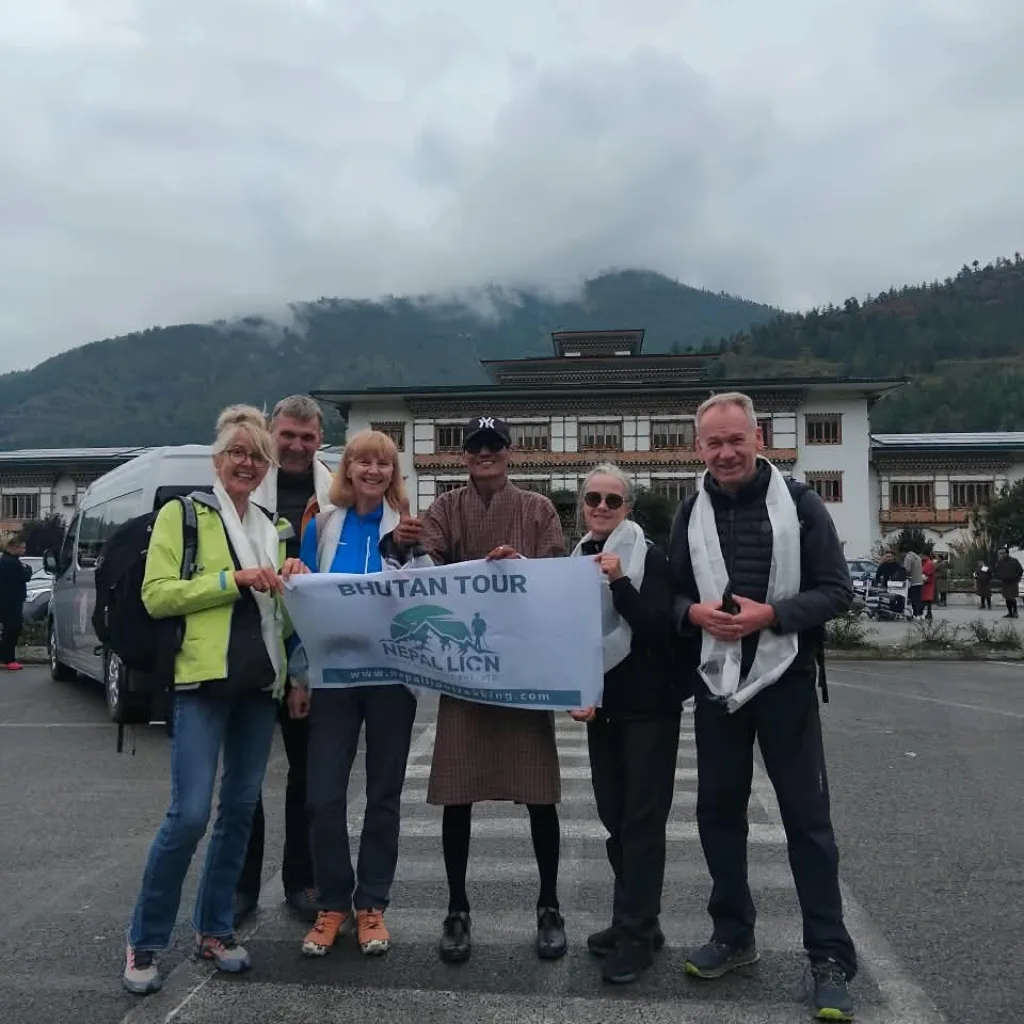
Bhutan Tour 3 Nights 4 Days
Across the border in the other direction — a short introduction to Bhutan from Kathmandu, covering Paro, the Tiger’s Nest Monastery at 2,356 m / 7,730 ft, and the Thimphu valley. Good if you have done Tibet and want to add the Kingdom of the Dragon Horse on the same Nepal itinerary.
Nepal Lion Tours also runs trekking and Himalayan expeditions throughout Nepal — from the gentle Poon Hill and Annapurna Base Camp treks to Everest Base Camp and the Annapurna Circuit — and we will happily combine any of them with a Tibet tour into a single itinerary.
Trip Essentials
Packing advice, required equipment & gear recommendations
Essential
Lhasa Tour Packing List
Because this is a road trip with a private jeep on every transfer, your packing list is shorter and different from a trekking kit. No heavy rucksack, no sleeping bag, no tent, no stove — you sleep in a hotel every night. What you need instead is layers for a 30-degree swing in a day, plus sun protection for a plateau, plus documents you will be asked for repeatedly.
Road Travel Gear (What Actually Goes in the Car)
- Daypack (20 to30 litres) — for monastery visits, your water, layers and camera. Not carried on roads.
- A small soft bag or duffel for clothes. You pack once and the vehicle takes it.
- Sunglasses (UV400) — essential at these altitudes.
- Sunscreen (SPF 50+) and lip balm — the UV at 4,000 m is severe.
- Reusable water bottle and purification tablets — see the water section.
- Power bank — essential given possible power cuts outside the cities.
- Moisturiser and lip balm — the air on the plateau is dry.
- A small daypack rain cover or pack liner — afternoon showers possible in summer.
Clothing: Use Layers Rather Than Bulk
The single most useful piece of advice for this tour is layering, because you will move from 3,900 m / 12,795 ft in the afternoon to the inside of a car at over 5,000 m in the shade, and back to a hotel.
- Base layer — merino or synthetic long-sleeve tops.
- Mid layer — a fleece or light insulated jacket.
- Outer shell — a windproof and waterproof jacket. Essential on the passes and for the Yamdrok causeway, which is exposed.
- Down jacket — light but warm. Karola Pass at 5,010 m / 16,437 ft can be genuinely cold even in summer.
- Thermal base layers — for the early morning monastery starts.
- Warm hat and a neck gaiter or buff — the wind on the passes is colder than the temperature suggests.
- Gloves — light pairs for the passes, warmer if you feel the cold.
- Sunglasses — every day, not just at the passes.
- Long trousers and modest clothing — for monastery visits. Shoulders and knees covered is respectful and required at many sites.
Sleeping and Evening Comfort
- Sleepwear and a change of clothes — a straightforward hotel night, but you will be glad of clean layers after a long road day.
- Earplugs — thin walls are common in Tibetan hotels.
- Your own towel — if you prefer.
- Hand warmers — optional but useful on the passes.
Toiletries and Personal Health Items
- Sunscreen SPF 50+, sunglasses, lip balm — non-negotiable at altitude.
- Moisturiser — the air is dry.
- Personal medications — including any altitude medication prescribed by your doctor. Take it as advised from before departure, not after you feel unwell.
- Hand sanitiser and wet wipes — helpful on road days.
- Any prescription medicines — keep in original packaging with a copy of prescriptions. Bring laxatives and rehydration salts — appetite at altitude is often reduced, and high-fibre diets plus altitude can be difficult.
- Insect repellent — for the lower valleys and summer evenings.
- Basic first aid — plasters, any personal allergy medication.
Documents and Money
This is the category where guests most often have a problem, and it is worth being precise:
- Passport — valid well beyond your travel dates, and carried with you at all times.
- Chinese visa or accepted entry document — must be arranged and obtained before you travel. Not included in the package price.
- Tibet Travel Permit — arranged by Nepal Lion Tours and included, but you must carry it with you alongside your passport for the whole trip.
- Travel insurance — strongly advised; not included. Ensure it covers travel to over 5,000 m / 16,404 ft.
- Some cash in Chinese Yuan (CNY) — widely preferred to cards outside the main cities. USD cash is a useful backup, but the Yuan is what is expected. ATMs are available in Lhasa and Shigatse.
- A copy of key documents — phone and cloud, in case of loss.
How Much Should You Pack?
Because your luggage travels by jeep and you sleep in a hotel every night, this tour needs far less than a trek of the same length. A single 20 to 30-litre daypack plus a small duffel or weekender is more than enough for seven days — most guests bring noticeably less than they expect to need.
Pack lighter than you would for a week in Europe, and pack warmer than you expect. The variable to plan for is altitude, not distance. If you follow the layering system above, turn any outfit into three usable combinations, and you will be comfortable from the monasteries of Gyantse to the causeway of Yamdrok Lake.
Read Before You Book
Permits, terms, medical considerations & advisory guidelines
Advisory
What to Know Before Booking
Seven days of Tibet sounds simple, and the sightseeing is not demanding. But this tour asks more of you logistically than a city break does, and every guest who enjoyed it most told us afterwards that they had read this section first. Read it before you pay — especially the first point.
Flights Are Not Included
The Kathmandu–Lhasa flights are not in the published price. The exclusion list reads train or air fare of any sector, so the two international sectors — Kathmandu to Lhasa on Day 01 and Lhasa to Kathmandu on Day 07 — are your responsibility to book and pay for.
This matters because those seats are limited and the Lhasa sector is the scarcer of the two. Book the flights before you commit to the ground programme, then send us your flight numbers, because the Tibet Travel Permit is issued against your confirmed itinerary. We will tell you exactly which sectors to look at, how much notice to give, and how to build your ground days around your actual arrival time.
We do not own aircraft. Nepal Lion Tours arranges charter flights for our own trekking operations, but the scheduled Kathmandu–Lhasa service is a third-party airline arrangement and is booked by you. Everything else on this tour — permit, guide, vehicle, hotels, entrance fees, airport transfers — is ours.
Accommodation and Facilities
You change hotels four times in six nights: Lhasa for three nights, then Shigatse, Gyantse and Tsetang. All are proper hotels with heating, hot water and en-suite bathrooms — this is not camping or a basic lodge — but they are functional Tibetan hotels rather than international-standard, particularly in Gyantse and Tsetang. Expect reliable warmth and hot water, not lifts or 24-hour room service.
Wi-Fi and mobile signal work in Lhasa and Shigatse and are weaker on the road. Power cuts are possible outside the cities, so bring a power bank. Plan your charging around hotel hours rather than assuming you can charge on demand. Bring earplugs — thin walls are normal — and ask for a room away from internal courtyards for a quieter night.
Accommodation is on a twin-sharing basis. If you are travelling solo, ask about single-room supplements or a room-share arrangement when you enquire.
Food and Dietary Requirements
Daily breakfast is included — and it is excellent — but lunch and dinner are not. Most guests spend USD 10 to 20 per meal on Tibetan or Chinese restaurants in the towns, with your guide and driver steering you to places they know.
Because this route visits places with limited restaurant choice, plan on eating at lunch stops, plus a light dinner near the hotel. Carry snacks for the days you are driving long distances, especially around Yamdrok Lake where options are sparse.
Vegetarianism is easy everywhere. Halal is available in the larger towns but more limited than in Kathmandu. Veganism is harder outside the cities. Allergies — particularly nuts and gluten — need specific planning: tell us at booking so your guide can know exactly where to eat safely.
One altitude note on food: appetite genuinely drops above 3,500 m / 11,483 ft, and forcing meals at altitude is worse than eating lightly. Eat when hungry, drink more than you feel like, and do not worry that you are not finishing your dinner — that is the altitude, not the food.
Altitude, Health and Insurance
Altitude is the only real safety consideration on this tour. You sleep at 3,650 m / 11,975 ft, 3,900 m / 12,795 ft and 3,950 m / 12,959 ft, and drive over 5,010 m / 16,437 ft on Day 06.
No previous high-altitude experience is needed and there is no trekking. But:
- Consult your doctor before booking if you have heart or respiratory conditions, or if you are pregnant. Travel above 3,500 m / 11,483 ft is not appropriate for everyone.
- Buy travel insurance that explicitly covers high-altitude travel above 5,000 m / 16,404 ft, and buy it before you depart. Insurance is not included in the package price.
- Take any prescribed altitude medication as advised from before departure.
- Drink two to three litres of water a day while on this route.
- Avoid alcohol for the first 48 hours at altitude, and ideally for the whole week — it suppresses the sleep that is doing your acclimatisation.
- Do not be brave about Karola Pass. If you feel unwell at the top, tell your guide. Skipping the pass while the group continues is a completely normal decision and our drivers handle it routinely.
Symptoms that warrant telling your guide immediately are a persistent headache, vomiting, loss of balance or coordination, unusual breathlessness at rest, or confusion. These are all treatable, and descent is the most effective treatment. Your driver carries supplementary oxygen and knows the descent points.
Money and Tipping
Bring cash in Chinese Yuan — cards are not reliably accepted outside the main cities. ATMs are available in Lhasa and Shigatse but not reliably at the passes or in smaller towns like Gyantse and Tsetang. Budget USD 30 to 50 per day for meals and incidental expenses, more if you enjoy the restaurants, and change your remaining currency before you leave Tibet.
Tipping is entirely optional but appreciated by your guide and driver, who work together for the full seven days across four towns. Guests commonly tip them together at the end of the trip in proportion to how the week went. There is no fixed rate and no expectation.
Long Road Days and Pacing
Days 04, 05 and 06 cover 280 km, 90 km and 290 km — about 660 km / 410 miles — plus the Day 07 airport transfer. This is the practical difference between this tour and a Lhasa-only package, and it deserves an honest paragraph.
Road surfaces vary, stretches are slow, and the Gyantse to Yamdrok Lake section is long and exposed. Day 06 in particular is a full day in a vehicle. Bring books, accept that you will not see everything at a walking pace, and be patient — this is how Tibet is.
Your comfort and preferences shape the day. Tell your guide if you want more stops, more time at Yamdrok Lake, or if you would rather press on. The itinerary is a framework, not a schedule to be endured. And tell us your flight times at booking so the Day 01 rest and Day 07 transfer are built around them properly.
Culture and Responsible Travel
Tibet is a place of living devotion, not a museum to be photographed. At monasteries, circumambulate clockwise, keep quiet in shrines, and do not step over thresholds. Ask before photographing people, especially monks and pilgrims — and note that some monasteries restrict photography entirely and your guide will tell you where.
Dress modestly — shoulders and knees covered — which is expected at most religious sites. Remove shoes where indicated. Avoid political comment; the region is sensitive and your presence there depends on a permit framework that is not yours to test.
Support the places you visit. Buy directly from craftspeople, drink local tea, and remember that the pilgrims you are photographing are also practising something. Guests who travel with a little of that awareness consistently tell us it was the part of the trip they remember most.
Booking and Before You Arrive
Here is the sequence that works, in order:
- Get your Chinese visa requirements confirmed with your nearest Chinese embassy or consulate, and confirm your passport validity.
- Check Kathmandu–Lhasa flight availability for your dates. Book these flights — they are not in the package price, and they are the constraint everything else depends on.
- Send us your dates, group size and flight numbers. We confirm the route, the price tier and the hotel arrangements.
- We apply for the Tibet Travel Permit against your confirmed itinerary. Allow at least a week, and more in peak season — permit processing does not accelerate.
- Arrange travel insurance covering travel above 5,000 m / 16,404 ft.
- Confirm your Chinese visa is issued before you travel.
- Pack using the list above — layers, sun protection, documents, cash in Yuan.
On arrival in Kathmandu, your guide meets you at the airport. If you have a spare day before the Lhasa flight — and we recommend one — it lets you absorb jet lag before the climb to 3,650 m / 11,975 ft, and gives you a buffer if the Lhasa flight is delayed by weather, which does happen at one of the world’s highest airports.
A Few Final Tips and the Bottom Line
- Book the flights first, then everything else follows from them.
- Get to Lhasa slowly — a spare day in Kathmandu is worth more than a spare day in Lhasa.
- Trust the acclimatisation order. Days 02 and 03 look like sightseeing days; they are actually the reason Day 06 works.
- Drink water as if you were never thirsty.
- Pack layers and sun protection, and leave the trekking kit at home.
- Keep a spare day at the end in Kathmandu before your onward flight.
The Lhasa Tour 6 Nights 7 Days is the fullest short circuit of central Tibet available from Nepal — Lhasa’s palaces and markets, Shigatse’s Tashilhunpo, Gyantse’s Kumbum and Pelkor, the passes at 5,010 m / 16,437 ft, the causeway of Yamdrok Lake, and the old fortress at Yumbulakhang. It is not a demanding trip physically. It is a demanding trip logistically, and it rewards you with one of the most extraordinary road journeys in the Himalaya.
Day-by-Day Itinerary
Explore each day's route, trekking elevation, and activities
Fly (1 Hr.) to LHASA over crossing over the highest Himalayan ranges of the world. Transfer and check-in to your hotel. Full rest for acclimatization- Hotel.
Full day sight – seeing tour to LHASA including JOKHANG TEMPLE, BARKHOR BAZAAR.And rest in lhasa hotel.
Full day sight – seeing tour to LHASA including POTALA PALACE, SERA & DREPUNG MONASTERIES. And rest in Lhasa overnight.
Scenic drive to XIGATSE, to the west of LHASA through the northern road. The drive is scenic as the road drives along the valley made by BRAHMAPUTRA RIVER(YARLUNGTSANGPO).Overnight-at-hotel.
Morning sight- seeing to the PANCHEN LAMA’S TASHILHUMPU MONASTERY. Drive to GYANTSE and visit to the KUMBUM STUPA & PHALKORMONASTERY.Overnight-at-hotel.
Full day picturesque drive crossing over KAROLA (5,010m), KAMBALA (4,794m), and colourful YAMDROK LAKE. Continue drive along the Tibetan lifeline river BRAMHAPUTRA (YARLUNG TSANGPO) on to TSEDANG, visit Yambulakhang&ThandrukMonastery-OvernighttoHotel.
Early morning drive (2hrs) to airport for departure flight to Kathmandu or to our onward destination.
Want to customize this itinerary?
Tailor duration, lodges, acclimatization days, or add private helicopter flights.
Inclusions & Exclusions
Everything that is covered and what you'll need to budget separately
What is Included
Fully covered in your package price
- Private transportation as per the by jeep .
- English speaking Tibetan Guide.
- Accommodation on twin sharing room basis.
- Daily breakfast.
- All Monastery entry fees as per your itinerary.
- Tibet travel permit.
What is Excluded
Personal expenses & optional extras
- Lunch & Dinner.
- Train or Air fare of any sectors.
- Insurance of any kind.
- Natural or political disturbance which beyond our control.
- Personal expenses such as drinks, tips, porter charge etc.
Our Customer Reviews
Authentic experiences and feedback from our travelers
Write a Review
Share your adventure experience with other travelers
Thank You!
Your review has been submitted and is awaiting approval.
Please Wait
You've submitted several reviews recently. Please wait a few minutes before trying again.
Alexander Vos
We wanted something memorable without making the children miserable, and this was a good balance. I still think about Kumbum Stupa more than anything else. Check was one of those places that made the long travel 7 feel worthwhile. We stopped often enough that the long drives never felt endless. The clouds cleared at exactly the right moment near Check. The quiet parts were just as important as the big views. The teahouse had a great common room where everyone swapped stories at night. There was a real sense of teamwork among the crew. It was tiring in places, but we would do it again as a family. Tip: A quick-dry towel and a couple of dry bags are worth the weight.
Chloe Girard
The meals were simple in places but always fresh, which is what matters to me. Pelkor Monastery was one of the few things we did that felt genuinely unique to this route. The light at Tsedang was incredible, and I ended up staying longer than planned. The tea stops were just as memorable as the meals, especially the ginger tea on cold mornings. Bumpy, dusty and completely worth it.
Elena Mercier
A jeep trip sounded a bit lazy to me at first, but it opened up a lot of country. The cold at Sight was sharper than we expected, so layers were essential. I would do Jokhang Monastery again in a heartbeat. The trip had a rhythm to it that took a couple of days to settle into. We had a lot of questions, and the team answered all of them. I liked that the food was local rather than international hotel fare. We laughed more in those days than we had in weeks at home. The local crafts and shops were interesting without being overwhelming. The boat ride was long, but the stops were well spaced. I would bring a cushion next time, but the bumpy parts were worth it. We came back with a few good stories and a much longer list of places to see next. Tip: Bring a headlamp; it is more useful than a phone torch after dark.
Oscar O'Connor
Every turn seemed to offer a different frame, especially around Gyantse. The weather changed completely at Gyantse, which made it feel like a different day. The timing of Karola Pass worked out perfectly with the weather. Fresh fruit and ginger tea got us through most afternoons. I filled an entire card before we even reached the halfway point. The team handled a difficult moment with calm and professionalism. The heat in the lower sections was more tiring than the altitude. The small details made a difference, from the morning tea to the evening briefing. The photos do not quite do it justice, which is probably the best compliment I can give. Tip: If you are travelling with children, build in a slower day halfway through.
Lucas Fournier
We came home buzzing and immediately started recommending this route to friends. Yumbulakhang ended up being the part we talked about most afterwards. I keep coming back to the memory of Tesedang when people ask about the trip. The roads were rough in places, but our driver knew them well. We ate a lot of dal bhat and never got tired of it. The jeep was the right way to cover that much ground in the time we had. Tip: Bring cash for small stops; cards are not always useful once you leave the cities.
Frequently Asked Questions
Essential information on preparation, route specifics, safety standards, and logistical details.